Need help?
Do you have a question about the Adcom GFP-750 and is the answer not in the manual?
Covers UL and CSA safety regulations, including warnings against electric shock and exposure to moisture.
Provides guidelines for grounding outdoor antennas to protect against voltage surges and static charges.
Details the front panel controls and functions, including input selection, volume, and mute.
Illustrates the rear panel connections and ports for audio input, output, and power.
Describes the Stereo/Reverse/Mono switch, Input Selection, Passive mode, Power, Processor, Balance, and Mute functions.
Details Tape In/Out, Processor loop, Main outputs, Remote Control Infrared Repeater, and Sensor Input.
Provides guidance on connecting speakers, power, and other audio sources to the GFP-750.
Illustrates how to connect an external processor, such as a surround sound processor, to the system.
Lists common symptoms and their possible causes for issues with the unit's operation.
Provides instructions for cleaning and maintaining the unit's chassis and finish.
Offers contact information and procedures for obtaining technical service and repairs.
Lists technical performance specifications for the GFP-750 preamplifier.
Includes power requirements, dimensions, and weight of the GFP-750 unit.
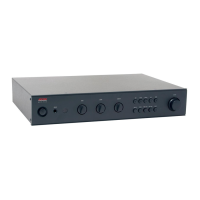
The ADCOM GFP-750 is a stereo preamplifier designed to manage and enhance audio signals from various sources before they reach a power amplifier. Its comprehensive set of features allows for precise control over audio playback, including input selection, volume, balance, and signal processing. The unit is designed for both casual listeners and audiophiles, offering flexibility in system configuration and sound customization.
The primary function of the GFP-750 is to act as a central control unit for an audio system. It receives audio signals from multiple input sources, processes them, and then sends them to a power amplifier. The preamplifier includes both balanced and unbalanced inputs and outputs, accommodating a wide range of audio components. A key feature is its ability to operate in a "passive" mode, bypassing active gain stages for a purer signal path, which can be desirable for certain audio setups.
The unit incorporates a stereo/reverse/mono switch, allowing users to adjust the polarity of the input signal or combine channels for monaural playback. This is particularly useful for correcting phase issues or adapting to speaker placements that don't suit stereo. The input selection is managed by a digital interface knob that freely indexes through available sources.
For external signal processing, the GFP-750 includes a dedicated processor loop. This allows users to integrate external audio processors, such as surround sound units, into the signal chain. When the processor feature is active, the external processor takes over volume and balance control, offering a seamless integration with multi-channel systems.
The GFP-750 also features a motorized volume control knob, which can be adjusted manually or via the remote control. The balance control provides fine-tuned adjustments without completely muting either channel. A mute feature is also included, which fully mutes the outputs and can be engaged or disengaged via the remote control.
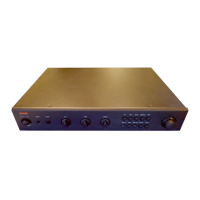
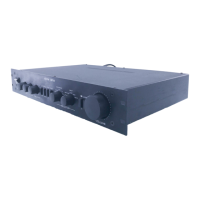
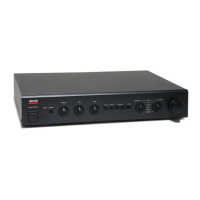
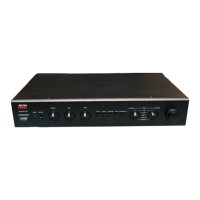
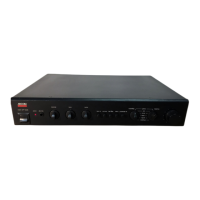
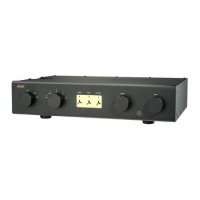
The GFP-750 offers a user-friendly interface with both front panel controls and a remote control for convenience. The front panel includes a power switch, input selector, passive mode toggle, external processor engagement, balance control, and volume knob. An infrared remote control sensor lens is integrated into the front panel to receive commands from the remote.
For connectivity, the rear panel provides a variety of options. Balanced CD inputs are available, which require the removal of gold jumpers between pins 1 and 3 for proper operation. These jumpers must be reinstalled when switching back to unbalanced CD inputs. The unit explicitly warns against using both balanced and unbalanced CD inputs simultaneously.
Unbalanced stereo inputs are provided for connecting various signal sources. The tape loop stereo in/out allows for the integration of tape recorders or other recording devices. The external processor loop stereo in/out facilitates the connection of external audio processors.
The GFP-750 offers multiple stereo outputs: Main 1 and Main 2 are unbalanced line-level outputs, with Main 1 typically connected to the primary amplifier and Main 2 accommodating a second amplifier for multi-room or multi-zone operation. Main 3 provides balanced stereo outputs for amplifiers that utilize balanced inputs.
Remote control capabilities are extended through infrared repeater outputs, allowing the GFP-750 to control other remote-controlled equipment. A remote control sensor input is also available for extending the remote control range to other rooms or zones using ADCOM's XR-500II or SPM-500II units.
A master on/off switch on the rear panel allows for electrical disconnection from the AC power source without unplugging the cord. This switch is recommended to be in the "O" (off) position when the unit is left unattended for extended periods. If the unit does not respond to remote control commands, users are advised to check that the master on/off switch is in the "I" (on) position.
The GFP-750 is designed with a durable steel chassis and an extruded aluminum front panel, both specially coated for an attractive finish. For routine cleaning, ADCOM recommends dampening a cloth and wiping off the chassis to remove dust and finger smudges. Users are cautioned against using strong solvents or detergents, as these can be abrasive or corrosive. It is also advised not to spray or pour any liquid onto the chassis or front panel. In the event of liquid ingress, the unit should be immediately unplugged from the AC outlet.
The manual emphasizes that servicing should only be performed by qualified service personnel. Users are warned not to attempt servicing the unit themselves due to the risk of electric shock from dangerous internal voltages. The graphic symbol of a lightning flash within a triangle on the unit signifies this hazard. Similarly, an exclamation point within a triangle warns users to refer to the instruction manual for proper operation.
ADCOM provides comprehensive technical support for installation and operation. In case of difficulty, users are encouraged to contact ADCOM's Technical Service Department for advice. If a problem cannot be resolved over the phone, ADCOM may refer the user to an authorized repair agency or authorize the return of the unit to their plant.
For returns, a specific Return Authorization number is required, and the unit must be shipped in its original packing. If the original packing is lost or damaged, replacement packaging can be obtained from ADCOM at a nominal charge. All shipments should be PREPAID via UPS or another appropriate carrier, as freight collect shipments will be refused. Shipping via Parcel Post is not recommended due to potential handling issues.
 Audio Output Specifications
| output level | 1.0 V |
|---|---|
| THD+N @ rated output (20Hz to 20kHz) balanced | <0.025% |
| THD+N @ rated output (20Hz to 20kHz) unbalanced | <0.095% |
| THD+N @ rated output (1kHz) balanced | <0.015% |
| THD+N @ rated output (1kHz) unbalanced | <0.017% |
| output impedance balanced | <1200 Ω |
| output impedance unbalanced | <600 Ω |
| frequency response (balanced and unbalanced) | 20Hz to 20kHz, -0.25dB to +0dB |
| IM distortions CCIF (balanced) | <0.009% |
| IM distortions CCIF (unbalanced) | <0.035% |
| SMPTE (balanced) | <0.05% |
| SMPTE (unbalanced) | <0.05% |
| signal to noise ratio (ref. to 1 volt) 'A' weighted (balanced) | >102 dB |
| signal to noise ratio (ref. to 1 volt) 'A' weighted (unbalanced) | >102 dB |
Input Specifications| input impedance balanced | 94 kΩ |
|---|---|
| input impedance unbalanced | 47 kΩ |
| input sensitivity @ rated output balanced | 183 mV |
| input sensitivity @ rated output unbalanced | 365 mV |
Power and Dimensions| power | 115 VAC-50/60Hz |
|---|---|
| power consumption | 30 VA |
| chassis dimensions | 3 1/2” (89 mm) x 17" (432 mm) x 11" (279 mm) |
| maximum dimensions | 4 1/8" (105 mm) x 17" (432 mm) x 12” (305 mm) |
| weight | 6.8 kg |
| packed weight | 7.7 kg |

 To Next Page