Need help?
Do you have a question about the ADE WS 2136-1 and is the answer not in the manual?
Purpose and importance of the operating manual.
Defines warning symbols and informational icons used in the manual.
Warnings regarding children's safety with batteries and small parts.
Hazards associated with battery handling and fluid contact.
Precautions to prevent device damage from environmental factors.
Defines the purpose and limitations of the weather station.
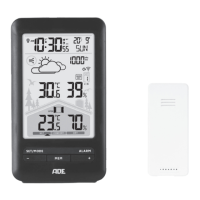
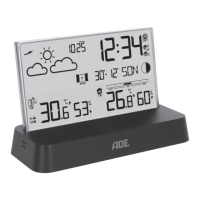
Lists features of the base unit, like display and time signal.
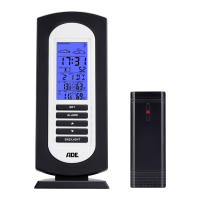
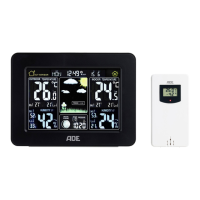
Describes the range of the wireless outdoor sensor.
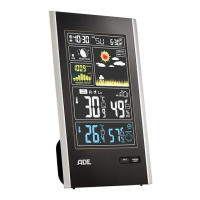
Identifies buttons and display areas on the front of the base station.
Identifies buttons, battery compartment, and foot on the rear of the base station.
Steps to install batteries in the outdoor sensor.
Checklist for when the time signal data is missing.
Checklist for when data from the wireless sensor is missing.
Step-by-step guide for manual time and unit adjustments.
How to manually start receiving the radio time signal.
Recommendations for placing the base station for best reception.
Instructions for mounting the outdoor sensor safely.
How to view highest and lowest temperature/humidity values for the last 24 hours.
How the frost symbol indicates near-freezing outdoor temperatures.
Steps to set the desired alarm hour and minute.
How the alarm sounds and how to switch it off completely.
Details on auto-stop, repeat alarm (snooze), and switching the alarm on/off.
How to turn on the display backlight using the SNOOZE/LIGHT button.
Automatic switching between summer and winter time based on signal reception.
Procedure to reset the weather station to factory settings.
How to clean the base station and outdoor sensor.
Instructions for disposing of the product's packaging materials.
How to dispose of the product at the end of its life.
Guidelines for environmentally friendly disposal of standard and rechargeable batteries.
 General
| Type | Wireless Weather Station |
|---|---|
| Indoor Temperature Range | 0°C to +50°C |
| Humidity Range | 20% to 95% |
| Radio frequency | 433 MHz |
| Power Source (Main Unit) | 2 x AA batteries |
| Display | LCD |
| Power supply | Battery |
| Power Source (Outdoor Sensor) | 2 x AAA batteries |
| Outdoor Temperature Range | -20°C to +60°C |

 To Next Page