Need help?
Do you have a question about the ADI AR-247 and is the answer not in the manual?
Instructions for cleaning the transceiver's exterior and front panel.
General technical specifications for the transceiver.
Technical specifications related to the transmitter.
Technical specifications related to the receiver.
Step-by-step instructions for mounting the transceiver bracket.
Instructions for connecting the transceiver in a mobile setup.
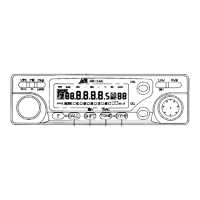
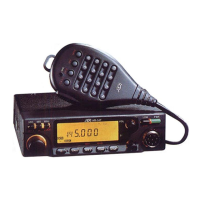
Detailed explanation of the transceiver's front panel controls.
Description of the transceiver's LCD display indicators and symbols.
Identification and function of the rear panel connectors and ports.
Procedures for receiving signals and initial setup for reception.
How to change and select operating frequencies in VFO or memory modes.
Fundamental steps for transmitting, including power levels and microphone use.
Explanation and setting of the time-out timer to limit transmission duration.
Overview of data that can be stored in memory channels.
Special functions assigned to certain memory channels.
Step-by-step guide for storing frequencies and data into memory channels.
How to retrieve stored memory channels.
Copying memory or call channel data to VFO for editing.
Procedures for erasing stored memory channels.
Available scanning modes: Band scan, programmable band scan, memory channel scan.
Setting up custom scan ranges using memory channels 11 and 12.
Scanning through memory channels that contain data and are not locked out.
Temporarily skipping specific memory channels during scan operations.
Monitoring two frequencies simultaneously.
Activating dual-watch using the dial frequency and memory channel 1.
Setting transmit frequencies relative to receive frequencies for repeater use.
Reversing transmit/receive frequencies for repeater operation.
Using sub-audible tones (CTCSS/DCS) and repeater access tones.
Selecting and setting CTCSS tones for squelch control.
Selecting and setting Digital Code Squelch (DCS) codes.
Scanning for CTCSS tones or DCS codes on a received signal.
Adjusting polarity for DCS signal encoding/decoding.
Using code squelch for selective reception based on three-digit codes.
Selecting and storing C.SQ codes from 000 to 999.
How to select and set C.SQ codes using the VFO or DTMF keypad.
Using Paging/Code Squelch functions with repeaters.
Storing individual, group, and station codes for paging.
Storing individual, group, and station codes for paging.
Procedures for entering and setting paging codes.
How to initiate paging calls to specific stations or groups.
Procedures for receiving paging calls and entering standby mode.
Temporarily disabling memory channels for paging transmission.
Displaying received DTMF signals on the LCD.
Entering and configuring the DTMF code decoding mode.
Saving decoded DTMF codes to memory.
Using DTMF autodialer for remote control or telephone numbers.
Redialing the last transmitted DTMF sequence.
Entering frequencies directly using the DTMF microphone keypad.
Setting the automatic power-off function to conserve battery.
Adjusting the display illumination intensity.
Turning the beep sound function on or off.
Functions for locking microphone or panel keys to prevent accidental changes.
Switching the frequency display to channel number display.
Factory alignment and general operating information.
Procedures and advice for returning equipment for repair.
Troubleshooting guide for common operational problems and their solutions.
 General
| Brand | ADI |
|---|---|
| Model | AR-247 |
| Category | Transceiver |
| Language | English |


 To Next Page