RevC 07/15/13 Page 30
attempt to add enough fuel to hit the target AFR.
Note:
The
calculated
LambdaTarget
influences
the
fuel
delivered
to
the
engine
at
all
times,
even
when
closed-loop
02
feedback
is
disabled.
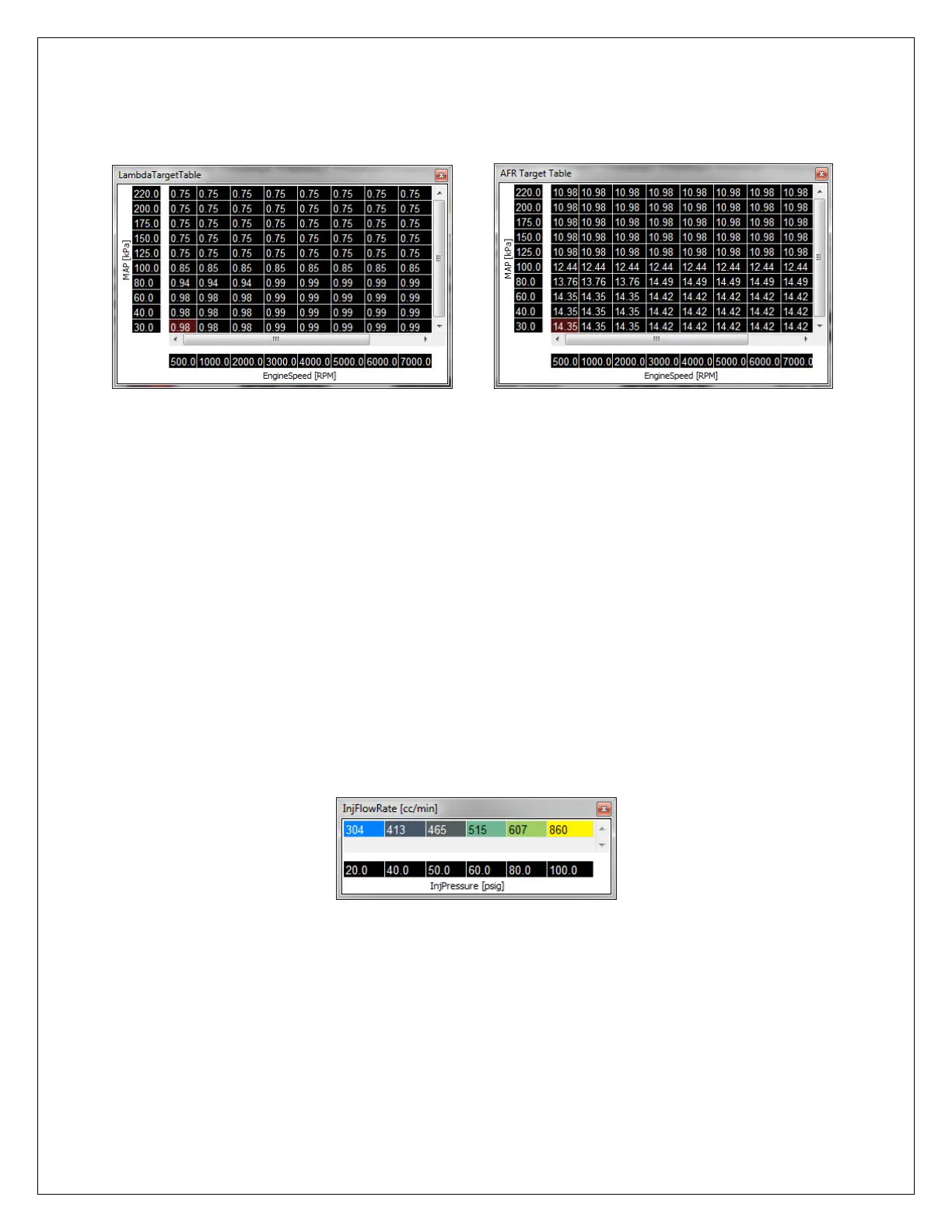
The suggested tuning method is to set the AFR using the LambdaTargetTable or AFR
Target Table to a value safe and suitable for the engine. For normally aspirated
engines a value of 13.0:1 or 0.887 lambda is usually sufficient at all operating
conditions. For boosted applications, the operating conditions dictate a safe AFR.
Please consult a tuner knowledgeable in your engine’s requirements for help. Once the
target lambda (AFR) values are chosen, run the engine at as many operating conditions
as possible and adjust the VE Table to reach the AFR Target Table values. Once the
VE Table has been tuned to accurately reach the AFR Target Table values at all
operating ranges, then you can change the AFR Target Table to use different AFR
settings later. Never adjust VETable to run a different AFR, only to achieve the
LambdaTarget value.
The Injector Flowrate is very important in determining the fuel requirements. The Infinity
ECU uses actual Injector Flowrate [cc/min] to determine the proper injector pulse width.
The InjFlowRate [cc/min] table is calibrated from the Setup Wizard: Injector Flow,
however the table can be modified manually for unlisted injectors.
Now that the base injector flow rate has been determined, the Infinity ECU applies a few
more compensating factors. Wall Wetting is a function of fuel condensing in the intake
manifold at the injection point. At different rates of change in the MAP [kPa] values, and
at different Coolant Temperatures, fuel enrichment compensations are used to prevent
lean and rich conditions during rapid manifold pressure changes. The WallWetting 2-
axis table can be adjusted to create a smooth fuel response. Note that this table has
several different functions. It can be used for dynamic transients by nature of its “MAP
Rate” x-axis. It can also be used for more steady state compensations by adjusting the
values in the “middle band” of the table where MAP rate changes are very small.
Positive numbers in this table will effectively add fuel to enrichen the mixture. Negative
numbers have the opposite effect.



 To Next Page
 Loading...