61
IVEDPY 1110 - 4879010_01
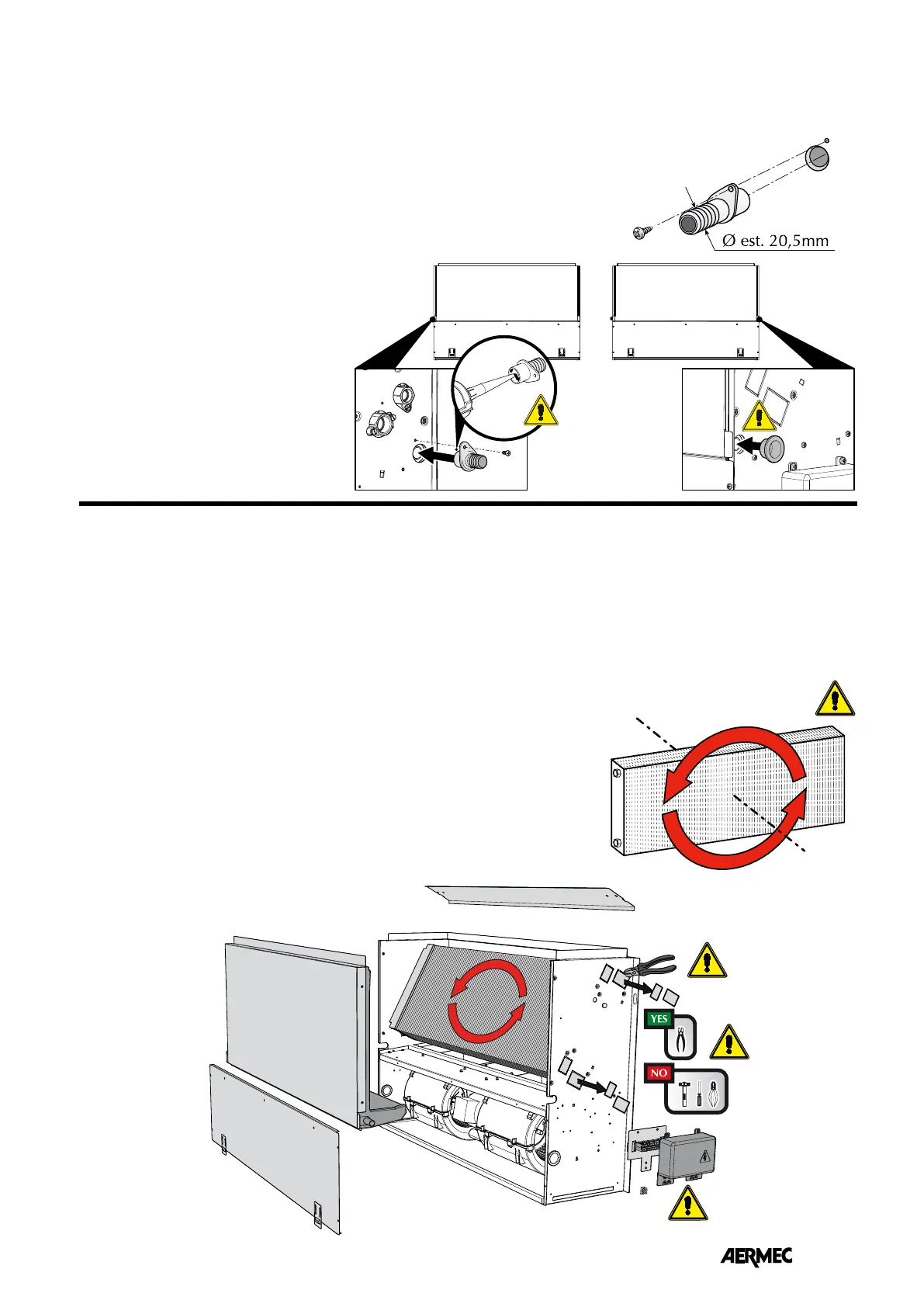
If the hydraulic connections require the
rotation of the coil, remove the front
closure panel and proceed as follows:
- Remove the condensate drip tray;
- Undo the screws and remove the coil
cover;
- Remove the screws securing the coil,
then remove the coil;
- Remove the push-outs on the right-
hand side;
- WARNING! Consult the coil rotation
diagram before rotating the coil.
It is important that the coil is installed
and rotated in the right direction.
Rotate the coil correctly and secure it
with the previously removed screws;
The spaces between the collector and
the hole on the side must be com-
pletely sealed and filled with insulating
material.
Reassemble the coil cover and fix it with
the screws;
- Block the holes left open by the
hydraulic connections on the left side
with insulating material.
- Reassemble the condensate drip tray;
The tray is designed to drain the con-
densate on both sides. The conden-
sate drain connection should ideally be
used on the hydraulic connection side.
Make sure the discharge that is not used
is closed and not leaking.
– Pull the electrical connections out of
the right side.
- transfer the electrical wirings to the left
side through the cable grommet;
- Move the support plate, the control
board, the earthing u-bolt and any
electric devices from the right side to
the left side.
- Reassemble the front closure panel;
COIL ROTATION
A
B
180°
COIL ROTATION DIAGRAM
The fan coil drip tray has got 2
condensate discharges (on the right and
left hand side).
It is recommended to use the condensate
discharge on the water connections.
Fit the condensate discharge connection
supplied with the unit. Please make
sure you seal together with silicone the
drip tray and the connection.
Seal the drain that is not used.
Connect the tray connection to the
condensate drainage system, using
a hose fixed to the tray connection.
The drain connections are designed
to be connected to flexible hose only
of suitable internal diameter, avoid
applying higher loads and do not used
for other purposes.
Make sure the discharge that is not used
is closed and not leaking.
The condensate drain network must be
properly scaled and the piping situated
in such a way as to keep an adequate
slope along the route (min. 1%).
If condensate is discharged into the
sewage system, install a siphon to
prevent the return of unpleasant odours
into the room.
Carry out a functioning and seal test
of the condensate drain system by
pouring water into the tray.
CONDENSATE DISCHARGE



 To Next Page