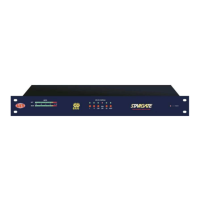
AEV STARGATE
Futurcom Srl via della Tecnica 35, 40050 Argelato Bologna ITALY
12
· Command TA - TA EON 0 - TA EON 1 - TA EON 2 - TA EON 3 - TA EON 4 - MS - RDS
OFFremote
available on the rear panel via Cannon 25 pin connector
· Enabling of transmitted groups (eg. RDS - CT - RADIOTEXT)
· Control of leap years
· RDS segnal level adjust
Applications
Radiodata (RDS) has been developed principally for transmitting tuning information, such as
the channel identifier, for the control of radio networks and the control of basic functions of the
new generation of radio receivers. It also, however, offers basic ARI functions for in-car
reception besides many interesting possibilities for domestic radio reception.
For example, it will be possible to transmit a commentary to the main program, as a
RADIOTEXT message comprising text made up of alphanumeric characters (ASCII) that will
appear on a display integrated into the receiver, and ultimately be able to control a voice
synthesizer.
It is also possible to use Radiodata for the distribution of computer software.
It will thus be possible for software users to record software transmissions without the
inconvenience of often extended interruptions to the main program being transmitted.
General Description
Definition of terms
T
HE FOLLOWI NG LI ST OF DEFI NI TI ONS RELATE TO THE STANDARDI ZATI ON SPECI FI CATI ON ANTERI OR TO THE
EBU
TECHNI CAL DOCUMENT
- T
ECH
. 3 2 4 4 - E
AND
CENELEC
FOR
EN 5 0 0 6 7 .
Program Identifier ( PI )
This is a code which enables the receiver to distinguish the country of origin and the
identification of the transmitted program.
The most important application of this information is the ability for the receiver to search
automatically for alternative frequencies in the event of bad reception of the program to which
it is tuned.
The change of frequency happens when a better signal with the same code of PI (program
Identifier) is found.
Program Service name ( PSN)
This function allows transmission of messages upto a length of eight alphanumeric characters
which can be used by the receiver to display to the listener the name of the currently tuned
station and other information.
The Program Service name is not used for automatic searching.
Traffic Program identifier ( TP)
This is a function that identifies stations which transmit traffic information to drivers by, for
example, changing the colour of the receiver’s display.
Alternative Frequency list ( AF)
This function allows lists comprising 25 alternative frequencies to be transmitted. The receiver
can thus hop automatically to the best reception frequency of the transmission.
Traffic Announcement identifier ( TA)
When this function is enabled by the station, the receiver will switch automatically from
cassette to radio listening.
The car radio, as well as being tuned to the station transmitting traffic announcements, has to
be enabled to receive ARI INFO or TA.
Once the announcement has been made, the radio automatically reverts to cassette listening.
This function is analogous to ARI.
Program Type ( PTY)
This function allows a code corresponding to the type of program to be transmitted with the
program in order to identify it.
This service is not yet available on all receivers, but will eventually allow the receiver to be
programmed to record certain types of program.
31 categories of program have already been defined by the EBU and are listed as follows:
0. No program type or undefined
1. News
2. Current Affairs


 To Next Page