6 7
TRANSPORTATION, OPERATION AND STORAGE CONDITIONS
IMPORTANT
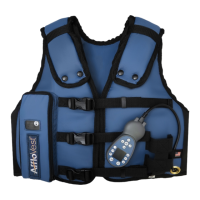
Please observe the following during transportation, storage and operation of the
AffloVest product.
STORAGE AND TRANSPORT CONDITIONS BETWEEN USES
In between uses, please observe the following:
• Keep the AffloVest dry
• Protect the AffloVest from direct sunlight
• Remove the battery from the AffloVest during transport/storage
• Keep in the AffloVest between -20° C (without relative humidity control) and
50° C (93% relative humidity, non-condensing)
OPERATING CONDITIONS
While using the AffloVest, please observe the following:
• Keep the AffloVest dry
• Protect the AffloVest from direct sunlight
• Keep the AffloVest between 5° C - 35° C, 15 - 93% relative humidity
(non-condensing) and 700 - 1060 hPa.
SAFETY FEATURES
The AffloVest was designed with maximum safety in mind, therefore it contains the
following safety features:
• Motors operate at safe, low voltages.
• Controller contains a fuse in the event of electrical problems.
• The Controller operates on a timer to ensure shut-off.
USER INFORMATION
IMPORTANT
The AffloVest should be worn over clothing or with a fabric shield to prevent cross-
contamination in a clinic or hospital setting where more than one patient uses the
unit. The AffloVest should be cleaned appropriately between patient use, see the
Cleaning Section.
According to the American Association for Respiratory Care (AARC) Guidelines for
Postural Drainage Therapy, the decision to use the unit for Airway Clearance Therapy
requires careful consideration and a doctor’s assessment of the individual patient’s
case if the following conditions exist:
• Intracranial pressure (ICP) greater
than 20 mm Hg
• Recent spinal surgery or acute
spinal injury
• Bronchopleural fistula
• Pulmonary edema associated with
congestive heart failure
• Large pleural effusions or
empyema
• Pulmonary embolism
• Acute illness
• Pregnancy or nursing mothers
• Electronic implants
• Rib fractures, with or without
flail chest
• Surgical wound or healing tissue
or recent skin grafts or flaps on the
thorax
• Uncontrolled hypertension
• Distended abdomen
• Recent esophageal surgery
• Active or recent gross hemoptysis
• Uncontrolled airway at risk for
aspiration such as tube feeding or
a recent meal
• Subcutaneous emphysema
• Recent epidural spinal infusion or
spinal anesthesia
• Burns, open wounds, and skin
infections on the thorax
• Recent placement of transvenous
or subcutaneous pacemaker
• Suspected pulmonary tuberculosis
• Lung contusion
• Bronchospasm
• Osteoporosis or osteomyelitis of
the ribs
• Coagulopathy
• Complaint of chest wall pain


 To Next Page