28
4.3.7 Checking electrolyte level
4.3.8 Checking drive belt
4.3.9 Checking cooling fan
Perform visual check on the cooling fan for flaw or any other defect. The fan should be installed reliably. Tighten the
fastening bolts or replace the damaged fan if necessary.
ŸWarning: Damaged fan blades can cause serious personal injury. Do not pull or pry the fan, and never
rotate the engine crankshaft with the fan.
4.3.10 Checking intake system
Check the intake hoses for any crack, as well as perforation, and clamps for looseness. Replace the hose(s) if any
fault is found, and tighten clamp screw(s) if looseness is found to ensure the intake system free from leakage.
4.3.11 Changing lubricating oil and oil filter
ŸWarning: Be careful when changing lubricating oil and oil filter because skin contact with the hot
lubricating oil or hot engine surface can cause scald.
Caution: Do not drain lubricating oil when the engine is in cold-state at which foreign particles has
deposited and attached to the bottom of an oil pan, and will not drain with oil. When lubricating oil is warm,
Perform visual check on the drive belt everyday for any
intersecting cracks. Transverse cracks along the width
direction of the belt are acceptable, while longitudinal
cracks (along the length direction) that intersect with
transverse cracks are not allowed. If any wear or abrasion
occurs on the belt, replace it.
Batteries that are not maintenance-free need electrolyte
level checking.
(1) Check the electrolyte level before starting the engine.
Remove the filler cap and check the electrolyte level. It
should be at the bottom of the filler port. If necessary,
make supplement as per requirement.
(2) Install the cap.
(1) Don’t stop the engine until the temperature of coolant
reaches 60°C, then remove the oil drain plug, scrap the
gasket and drain the lubricating oil.
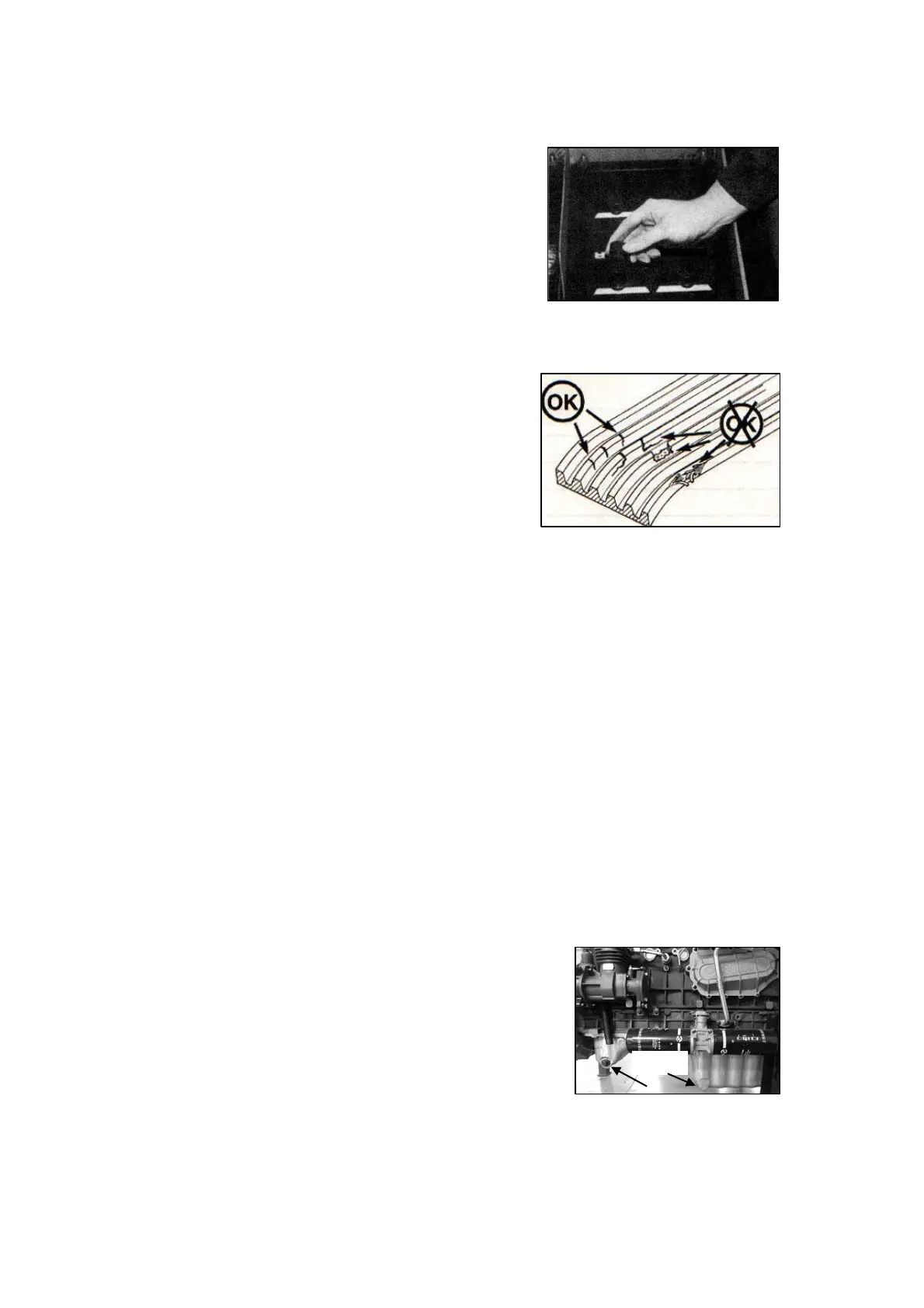
Note: There are two oil drain plugs for some engine
models: one on the bottom of the large oil pan, the other on
the side of the small oil plan.
Oil plug



 To Next Page