
 Need help?
Do you have a question about the Air Torque AT-HD Series and is the answer not in the manual?
Ensure compatibility of operating media with actuator parts and atmosphere.
Verify ATEX classification for explosive atmosphere areas and safety instructions.
User responsibility for electrical accessory compliance with zone classification.
Use by trained personnel with proper protective equipment is recommended.
Do not exceed temperature, pressure, or corrosive environment limits.
Do not disassemble spring module; exhaust pressure before operations.
Ensure correct orientation and position before mounting actuator to valve.
Customer must ensure compliance with national/local safety laws for incorporated systems.
Specifies approved media, dew point, and maximum particle size for operation.
Details pressure ranges for low and high-pressure media types.
Defines temperature ranges for standard, high, and low-temperature actuators.
Factors affecting operating time and cautions for temperature variations.
Factory lubrication, standard lubricant, and special grease for extreme temperatures.
Scotch yoke design for indoor/outdoor use; corrosion protection options.
Information on type, size, pressure, torque, and marking details.
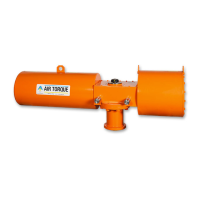
Pneumatic operation for remote valve control; fail-open/fail-close for spring return.
Read technical info before installation; ensure correct orientation and pressure media.
Do not pressurize during installation; prevent contaminants; ensure accessibility of emergency controls.
Verify torque limits, alignment, and mounting methods for valve integration.
Recommended tightening torques for screws and nuts based on material strength.
Shut off supply, exhaust pressure, disconnect connections before maintenance.
Maintenance allowed only for Air Torque personnel or trained technicians to preserve warranty.
Spare parts availability and service requirements based on conditions and actuator size.
Ensure operating conditions are restored and actuator is properly placed back in service.
Step-by-step guide to disassembling the Power Module (Air/Oil).
Procedure for removing the Spring Module; contact Air Torque for maintenance.
Steps for disassembling the Central Module and its components.
Ensure components are clean, in good condition, and use suitable spare parts/lubricants.
Reassembly of the Mechanism Unit, plug, and guide bar within the Central Module.
Procedure for installing the Spring Module into the Central Module.
Steps for assembling the Power Module, piston, and cylinder connection.
Assembling external group adjustment for double acting actuators.
Securing the cover and mounting the position indicator after assembly.
Actuator stroke adjustment allows +/-5° range; ensure correct valve operation.
Steps for adjusting the actuator stroke in the closed position.
Instructions for adjusting the actuator stroke in the open position for different actuator types.
Regular checks for stroke, pressure, leaks, and surface condition.
Table identifying common problems, causes, and remedies for actuator operation.
Guidance on safe lifting and handling by qualified personnel using appropriate systems.
Visual inspection for damage, verification of model/data plate, and accessory compliance.
Diagrams illustrating the Spring Module, Central Module, and Power Module components.
Detailed list of part numbers, execution, quantity, and description for actuator components.
 General
| Brand | Air Torque |
|---|---|
| Model | AT-HD Series |
| Category | Controller |
| Language | English |


 To Next Page