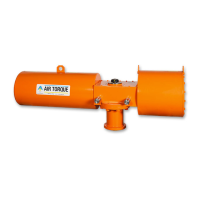
This document is an installation, maintenance, and operating instruction manual for the AIR TORQUE pneumatic actuator models AT1001U/PT1000 B and AT1001U R/PT1000B R. These actuators are available in both double-acting ("D") and spring-return ("S") configurations, designed for a 0° to 90° stroke.
Function Description
The AIR TORQUE actuator is a pneumatic device designed for the remote operation of industrial valves, facilitating their opening and closing through a 90° rotation. Its operation can be activated by direct mounting of a solenoid valve (5/2 for double-acting, 3/2 for spring-return) to pressure connections 2 and 4, or by screwed connection to pressure connections 2 and 4 with air lines from a separate control cabinet.
For standard rotation, when port 4 is pressurized or for spring action, the actuator rotates clockwise to close the valve. When port 2 is pressurized, counter-clockwise rotation is achieved. The actuator's assembly and rotation direction can be customized based on the required operation and installation.
In a double-acting configuration, supplying air to port 2 forces the pistons towards the actuator end caps, resulting in a counter-clockwise rotation, with exhaust air exiting from port 4. Conversely, supplying air to port 4 forces the pistons inward, achieving a clockwise rotation, with exhaust air exiting from port 2.
For single-acting (spring-return) operation, supplying air to port 2 forces the pistons toward the actuator end caps, compressing the springs and resulting in a counter-clockwise rotation, with exhaust air exiting from port 4. A loss of air pressure at port 2 (due to air or electric failure) causes the springs to force the pistons inward, achieving a clockwise rotation, with exhaust air exiting from port 2.
Important Technical Specifications
The actuators are classified as "PARTLY COMPLETED MACHINERY" according to the Machinery Directive 2006/42/EC and are designed, produced, and classified according to the ATEX Directive 2014/34/EU.
Operating Media:
Dry or lubricated air or inert gases compatible with the actuator's internal parts and lubricant. The operating media must have a dew point equal to -20°C (-4°F) or at least 10°C below the ambient temperature. The maximum particle size should not exceed 30 μm.
Supply Pressure:
- AT1001U/PT1000 B (spring return type) and AT1001U R/PT1000B R (double acting and spring return): Maximum supply pressure is 8 bar (116 Psi).
- AT1001U/PT1000 B (double acting): Maximum supply pressure is 7 bar (101.5 Psi).
Operating Temperature:
- Standard actuators: -40°C (-40°F) to +80°C (+176°F).
- High Temperature ("HT") actuators: -15°C (+5°F) to +150°C (+300°F).
- Extreme Low Temperature ("LLT") actuators: -55°C (-67°F) to +80°C (+176°F).
- Note: Special grease and components are required for HT and LLT service. Working at extreme temperatures can affect the actuator's life and output torque.
Rotation and Stroke Adjustment:
- Standard actuator rotation: 90°.
- Stroke adjustment at 0° (closed pistons): +5° / -5°.
- Stroke adjustment at 90° (open pistons): +5° / -5°.
Lubrication:
Actuators are factory lubricated for their lifespan under normal working conditions. The standard lubricant type GSTD is suitable for -40°C (-40°F) to +80°C (+176°F). Special grease is required for LLT and HT service.
Construction:
Rack and pinion actuator design suitable for both indoor and outdoor installations. All actuators are supplied with corrosion protection for normal environments.
Usage Features
Installation:
- The actuator must not be pressurized during installation.
- Utmost cleanliness is required during air supply connection.
- Accessories should be fitted to ensure easy access for emergency manual operations.
- Before fitting onto the valve, ensure correct orientation for the desired rotation direction.
- For spring-return actuators, use adequate filters and/or solenoid valves to prevent corrosive substances from entering external chambers.
- Remove plugs from air connections during installation and operation.
- When installing on a valve with a gearbox for emergency manual operation, ensure the gearbox stroke does not exceed the actuator's allowed stroke to prevent damage.
Operation:
- Do not operate the actuator with inflammable, oxidizing, corrosive, explosive, or unstable gases or liquids (only non-dangerous fluids - group 2 according to 2014/68/EU directive).
- For actuators in potentially explosive zones, ensure internal parts do not contact the external atmosphere.
- Operate only within specified working limits, temperature, and pressure.
- Do not disassemble individual spring cartridges, as this may result in personal injury.
- Close and disconnect all air supply lines and vent air connections during maintenance and installation.
- Do not disassemble the actuator or remove end caps while pressurized.
- Before installing onto a valve, verify the correct rotation direction and position indicator.
- Ensure compliance with national and local safety laws and regulations if the actuator is part of a safety system.
Storage:
- Store the actuator in a clean, dry environment at temperatures between -20°C (-4°F) and +40°C (+104°F).
- It is recommended to store the actuator in its original box.
- Do not remove the plastic plugs on air supply ports.
Lifting and Handling:
- Lift actuators using proper and adequate systems, considering their weight.
- Avoid clashes and accidental falls to prevent damage.
Maintenance Features
General Maintenance:
- The actuator requires only periodic observation under normal conditions.
- Disassembly, maintenance, and rebuilding should only be performed by AIR TORQUE personnel or properly instructed personnel to maintain product guarantee.
- Spare kits are available to replace all seals and bearings (soft parts) between 200,000 and 1,000,000 cycles, depending on operating and environmental conditions and actuator size.
Disassembly Procedure:
- Before any disassembly, remove the actuator from the valve and ensure it is not pressurized. Verify that ports 2 and 4 are vented and free from accessories.
- For spring-return units, ensure the actuator is in the failed position with pistons completely inwards.
- Removal of position indicator and graduated ring: Remove cap screw (39), then lift off the position indicator (19 or 19.1) and graduated ring (19.0).
- Positioning/disassembly of stop screws: Remove spring clip (02.1), nuts (04), washer (03), and O-rings (11). Unscrew stop screws until at least 80 mm outside the body. For specific models (AT1001U R/PT1000R and AT1001U FA/PT1000 B FA), screw plugs (02F) may be removed for O-ring (11) replacement.
- End Caps Disassembly:
- For spring-return actuators, disassemble one end cap at a time. Unscrew end cap bolts (13) 4-5 turns. If force remains, discontinue disassembly as it may indicate a damaged spring cartridge.
- For double-acting actuators, unscrew end cap bolts (13) until they are completely unscrewed.
- Always remove spring cartridges for spring-return actuators.
- Remove and discard O-rings (14), external chamber connections (09.1).
- For specific models (AT1001U R/PT1000B R and AT1001U FA/PT1000 B FA), remove nuts (04E), washers (03E), O-rings (11E), and screws (24E). Discard bearings.
- Pistons Disassembly: Fix the drive shaft (60) and rotate the body (50) until pistons (40 or 40F) are released. Do not use air pressure to remove pistons. Remove piston O-rings (16), piston back (05), and piston head (15) bearings. Discard bearings. For specific models, remove nuts (04F), washers (03F), O-rings (11F), and screws (23).
- Pinion Shaft Disassembly: Remove graduated ring (19.0), spring clip (18), thrust washer (10), and external thrust bearing (08). Apply downward force to the drive shaft (60) to partially remove it, then remove internal thrust bearing (08) and octi-cam (01). Rotate body 90° and push pinion (60) out. Remove top and bottom pinion bearings (06, 07) and O-rings (21, 22). Discard bearings and O-rings.
Assembly Procedure:
- Ensure all components are clean and in good condition. Use suitable spare parts and lubricant for the operating temperature.
- Positioning/assembly of stop screws: Screw stop screws from inside the body until at least 80 mm outside. Insert nut (04), washer (03), O-ring (11), and spring clip (02.1) on both stop cap screws (02).
- Drive shaft assembly: Install top and bottom pinion bearings (06, 07) and O-rings (20, 21) onto the shaft. Grease the drive shaft's outside surface. Insert the drive shaft (60) partially into the body (50), install octi-cam (01) in the correct position, and internal thrust bearing (08). Insert the drive shaft completely. Fit external thrust bearing (08), thrust washer (10), and external spring clip (18).
- Pistons assembly: For specific models, install screws (23), O-rings (11F), washers (03F), and nuts (04F). Grease and install piston O-rings (16), piston skirt (05), and piston head (15) bearings. Grease the internal surface of the body (50) and piston (40) rack teeth. Hold the body (50) horizontally. Ensure the octi-cam is in the right position. Rotate the body (50) about 40-45° counter-clockwise (from bottom view) or clockwise (from top view). Press the two pistons (40) simultaneously inside the body (50) until engaged, and rotate the body clockwise (from bottom view) or counter-clockwise (from top view) until the stroke is completed. Ensure rotation is over 0° and dimension "A" on both sides is the same. For specific models, adjust screws (23) until the desired stop position at 0° is achieved, then tighten nuts (04F).
- End cap and spring cartridge assembly: Assemble one end cap at a time. Lubricate the inside surface of end caps and piston O-rings (16), and the body. For spring-return actuators, insert springs into each end cap according to the desired configuration and insert spring cartridge (17). Ensure springs housing of pistons are oriented correctly. Fit end cap O-ring seal (14) into the groove. Fit O-rings external chamber connections (09.1). Ensure the body is perpendicular to the pistons, then fit end caps onto the body (50), verifying the O-ring remains in the groove. For actuators with 50% or 100% stroke adjustment, ensure adjustment screws are completely screwed into the end-cap. Insert cap screws (13) and washer cap screw (13A) and partially tighten. Complete tightening by making 1-2 turns for each screw in the specified sequence.
- Stroke adjustment for standard rotation actuator:
- Close position (0°): Screw or unscrew the right stop cap screw (02) until the desired stop position is achieved, then tighten nut (04).
- Open position (90°): Screw or unscrew the left stop cap screw (02) until the desired stop position is achieved, then tighten nut (04). For spring-return actuators, rotation tests may be needed.
- For specific models, adjust screws (24) for 90° open position, then tighten nuts (04E).
- For 50% or 100% adjustment, fit O-rings (11R), washers (03R), and nuts (04R) on end-cap adjustment screws (221G/222G). Adjust screws until desired position is achieved, ensuring both screws contact the pistons, then lock nuts (04R).
- Assembly of graduated ring and position indicator: Fix the graduated ring (19.0) to the body. Position the "Top Adaptor" (19.5) and lock with screws (19.6). Insert the indicator (19.1) to show the correct actuator position. Screw the indicator screw (39) if assembled.

 Need help?
 General


 To Next Page