Applications
• Plastic housing recommended for fiberglass or metal hull only.
Never install a plastic housing in a wood hull since swelling of
the wood may overstress the plastic causing a fracture.
• Bronze housing recommended for fiberglass or wood hull.
Never mount a bronze housing in an aluminum hull because
electrolytic corrosion will occur.
• Stainless steel housing compatible with all hull materials.
Recommended for aluminum hull to prevent electrolytic corrosion
provided the stainless steel housing is isolated from the metal
hull.
• Accommodates up to 22° deadrise angle
Tools & Materials
Safety goggles
Dust mask
Water-based anti-fouling paint (mandatory in salt water)
Electric drill with 10mm (3/8") or larger chuck capacity
Drill bit: 3mm or 1/8"
Hole saw: 51mm or 2"
(plastic or metal housing in non-metal hull)
57mm or 2-1/4" (stainless steel housing in a metal hull)
Countersink tool (installing a flush housing)
Sandpaper
Mild household detergent or weak solvent (such as alcohol)
File (installation in a metal hull)
Marine sealant (suitable for below waterline)
Additional washer [for aluminum hull less than 6mm (1/4") thick]
Slip-joint pliers (installing a bronze housing)
Grommet(s) (some installations)
Cable ties
Installation in a cored fiberglass hull (see page 3):
Hole saw for hull interior: 60mm or 2-3/8"
Fiberglass cloth and resin
or Cylinder, wax, tape, and casting epoxy
17-355-01 rev. 06 12/14/10
Thru-Hull, Retractable
TRIDUCER
®
Multisensor
Model DST800
U.S. Patents: 6,904,798; 7,110,908; 7,352,171. UK Patents: 2 407 874; 2 409 527
Record the information found on the cable tag for future reference.
Part No._________________Date___________Frequency________kHz
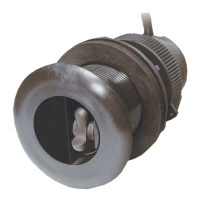
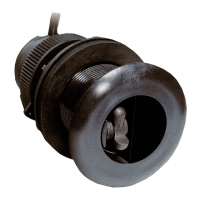
plastic
low profile
P17 housing
INSTALLATION INSTRUCTIONSOWNER’S GUIDE &
Pretest
Connect the multisensor to the instrument and spin the
paddlewheel. Check for a speed reading and the approximate air
temperature. If there are no readings or they are inaccurate, check
all the connections and repeat the test. If there are still no readings
or they are inaccurate, return the product to the place of purchase.
WARNING: Always wear safety goggles and a dust
mask when installing to avoid personal injury.
WARNING: The O-rings must be intact and well
lubricated to make a watertight seal.
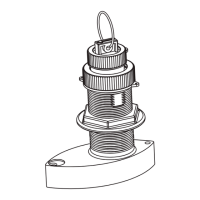
WARNING: Always attach the safety wire to prevent
the insert or blanking plug from backing out in the
unlikely event that the cap nut fails or is screwed on
incorrectly.
WARNING: Immediately check for leaks when the
boat is placed in the water. Do not leave the boat
unchecked for more than three hours. Even a small
leak may allow considerable water to accumulate.
WARNING: Stainless steel housing in a metal hull—
Be sure the washer contacts the hull. Do not tighten
the hull nut with the washer against the isolation
bushing, as the housing will not be firmly installed. If
necessary, sand the isolation bushing until the washer
rests against the hull.
CAUTION: Never install a metal multisensor on a
vessel with a positive ground system.
CAUTION: Never use a fairing with a plastic housing;
the protruding sensor would be vulnerable to damage
from impact.
CAUTION: Never pull, carry, or hold the multisensor
by its cable; this may sever internal connections.
CAUTION: Never use solvents. Cleaners, fuel,
sealants, paint, and other products may contain strong
solvents, such as acetone, which attack many
plastics, greatly reducing their strength.
CAUTION: Stainless steel housing must be isolated
from a metal hull to prevent electrolytic corrosion. Use
the isolation bushing supplied.
IMPORTANT: Read the instructions completely
before proceeding with the installation. These
instructions supersede any other instructions in your
instrument manual if they differ.

 Need help?
 General

 To Next Page