AIRMAR
®
TECHNOLOGY CORPORATION
35 Meadowbrook Drive, Milford, New Hampshire 03055-4613, USA
■
www.airmar.com
4
Copyright © 2003, 2005, 2006 Airmar Technology Corp. All rights reserved.
4. Remove the plug of core material so the
inside
of the outer skin
and the inner core of the hull are fully exposed. Sand and clean
the inner skin, core, and the outer skin around the hole.
Caution: Completely seal the hull to prevent water seepage
into the core.
5. If you are skilled with fiberglass, saturate a layer of fiberglass cloth
with a suitable resin and lay it inside the hole to seal and strengthen
the core. Add layers until the hole is the correct diameter.
6. Alternatively, a hollow or solid cylinder of the correct diameter
can be coated with wax and taped in place. Fill the gap between
the cylinder and hull with casting epoxy. After the epoxy has set,
remove the cylinder.
7. Sand and clean the area around the hole, inside and outside, to
ensure that the sealant will adhere properly to the hull. If there is
any petroleum residue inside the hull, remove it with either mild
household detergent or a weak solvent (alcohol) before sanding.
8. Proceed with “Bedding” and “Installing” (see pages 2 and 3).
Maintenance, Parts & Replacement
Using the Blanking Plug
To protect the paddlewheel, use the blanking plug:
• When the boat will be kept in salt water for more than a week.
• When the boat will be removed from the water.
• When aquatic growth buildup on the paddlewheel is suspected
due to inaccurate readings from the instrument.
Warning: The O-rings must be intact and well lubricated to
make a watertight seal.
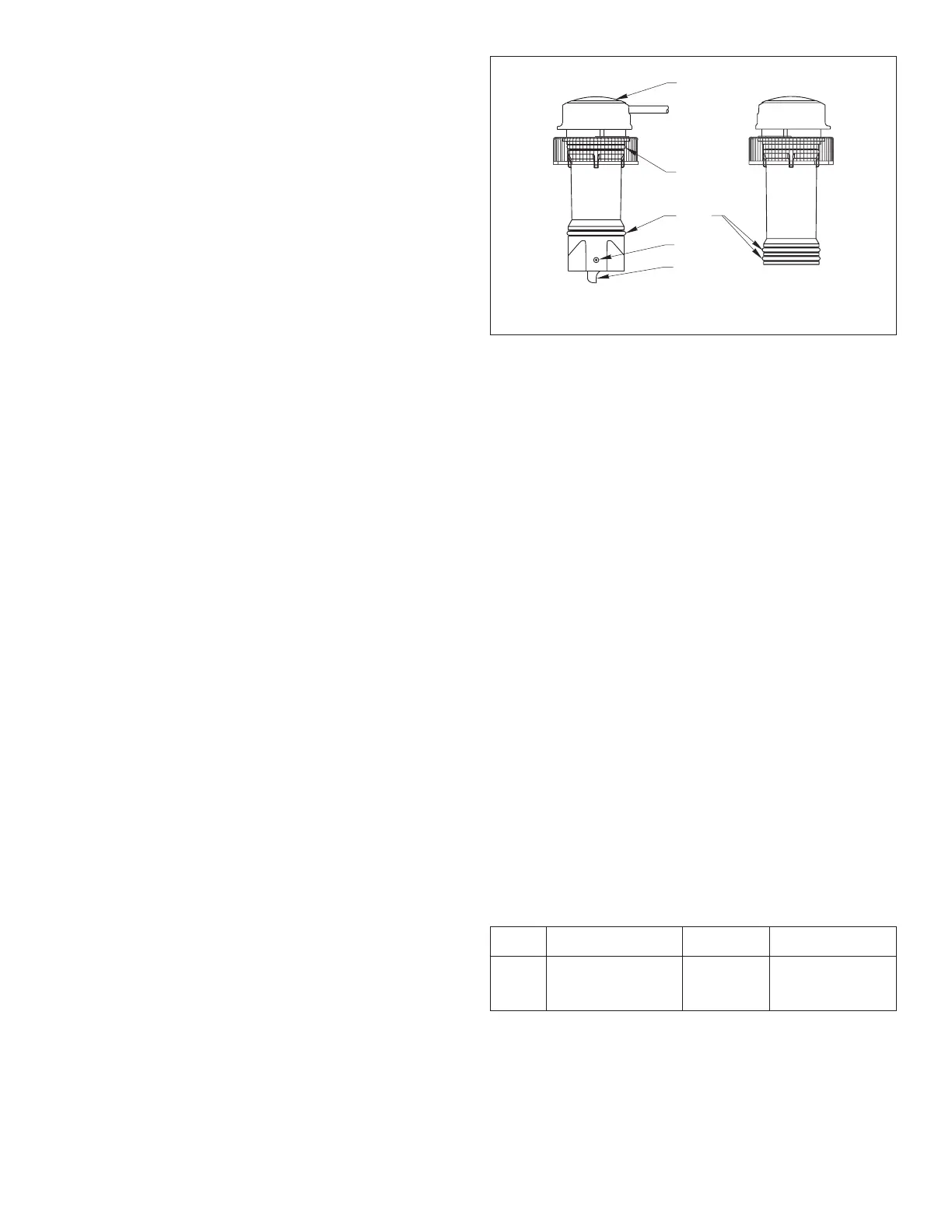
1. On the blanking plug, inspect the O-rings (replace if necessary)
and lubricate them with the silicone lubricant supplied or
petroleum jelly (Vaseline
®
) (see Figure 5).
2. Remove the insert from the housing by removing the safety wire and
unscrewing the cap nut (see Figure 3). This will jack out the insert.
3. With the blanking plug ready in one hand, pull the insert most of
the way out. Remove the insert and rapidly replace it with the
blanking plug. With practice, only 250ml (10oz.) of water will
enter the boat.
Warning: Be sure the blanking plug is fully inserted into the
housing, and the cap nut is screwed on completely.
4. Screw the cap nut several turns until the threads are engaged.
Continue to tighten the cap nut.
HAND-TIGHTEN
only.
Do not
over tighten.
Warning: Always attach the safety wire to prevent the blanking
plug from backing out in the unlikely event that the cap nut fails
or is screwed on incorrectly.
5. Reattach the safety wire.
Servicing the Insert
Aquatic growth can accumulate rapidly on the depth transducer’s
surface and impede or freeze the paddlewheel’s rotation reducing
performance within weeks. Clean the insert with a Scotch-Brite®
scour pad and mild household detergent,
being careful
to avoid
scratching the depth transducer. If fouling is severe, remove the
paddlewheel (see step #1 below). Lightly wet sand it with fine
grade wet/dry paper.
The water lubricated paddlewheel bearings have a life of up to 5
years on low-speed boats [less than 10kn (11MPH)] and 1 year on
high-speed vessels. Paddlewheels can fracture and shafts can
bend due to impact with water borne objects and mishandling in
boat yards. O-rings
must
be free of abrasions and cuts to ensure a
watertight seal. Order a replacement Paddlewheel Kit 33-398-04.
1. To remove the old paddlewheel shaft, grasp the end with small
diagonal wire cutters and pull (see Figure 5).
2. Place the new paddlewheel in the cavity with the flat side of the
blade facing the same direction as the arrow on the top of the
insert.
3. Tap the new shaft into place until the end is flush with the
outside wall of the insert.
4. Install a large O-ring near the top of the insert. Install a small
O-ring near the paddlewheel.
5. Place the remaining two O-rings near the bottom of the
blanking plug.
Winterizing
After the boat has been hauled for winter storage, remove the
blanking plug to let the water drain away before reinserting it. This
will prevent any water from freezing around the blanking plug and
possibly cracking it.
Replacement Parts
Lost, broken, or worn parts should be replaced immediately.
Obtain parts from your instrument manufacturer or marine dealer.
Gemeco (USA) Tel: 843.394.3565
Fax: 843.394.3736
email: sales@gemeco.com
Airmar Europe Tel: +45.45.81.04.18
Fax: +45.45.81.04.93
email: sales@airmareurope.com
If you have purchased a plastic housing and have a wood hull or
desire greater strength, purchase an Airmar metal housing.
Multisensor Replacement—The information needed to order a
replacement Airmar multisensor is printed on the cable tag.
Do
not
remove this tag. When ordering, specify the part number,
date, and frequency in kHz. For convenient reference, record this
information on the top of page one.
Blanking
Plug
Hull Nut or
Isolation Ring
Paddlewheel,
Shaft & O-rings
Housing, Nut & Washer
33-538-01
04-004 (plastic)
02-030 (bronze)
02-570-01 (stainless steel)
04-186-1 (isolation ring)
33-398-04
33-417 (plastic, P17)
33-100 (bronze, B17)
33-495-01 (stainless
steel SS577)
Figure 5. Replacing the paddlewheel and O-rings
arrow
flat side
of blade
shaft
blanking pluginsert
faces bow
large
O-ring
small
O-ring (s)
Copyright © 2006 Airmar Technology Corp.
BOW ➤


 To Previous Page
 Loading...