2
Safety
Flying Cloud 2-5
properly maintained, are improperly ventilated, or
malfunction, CO levels can rise quickly. CO is a real
danger in air-tight trailers with added insulation, sealed
windows, and other weatherproong can trap CO
inside.
The following conditions can result in potentially
dangerous CO situations:
1. Excessive spillage or reverse-venting of fuel-
burning appliances caused by outdoor conditions,
such as:
• Wind direction and/or velocity, including high
gusts of wind. Heavy air in the vent pipes (cold/
humid air with extended periods between
cycles).
• Negative pressure differential resulting from sue
of exhaust fans.
• Simultaneous operation of several fuel-burning
appliances competing for limited internal air.
• Vent-pipe connections vibrating loose from
clothes dryers, furnaces, or water heaters.
• Obstructions in or unconventional vent-pipe
designs which can amplify the above situations.
2. Extended use of un-vented fuel burning devices.
3. Temperature increase that can trap exhaust gases
near the ground.
Symptoms of Carbon Monoxide Poisoning
The following symptoms are related to CO
POISONING:
• Mild Exposure - Slight headache, nausea, vomiting,
fatigue (u-like symptoms).
• Medium Exposure - Throbbing headache, drowsiness,
confusion, fast heart rate.
• Extreme Exposure - Convulsions, unconsciousness,
heart and lung failure. Exposure to carbon monoxide
can cause brain damage and/or death.
WARNING
Many causes of reported CARBON MONOXIDE
POISONING indicate that while victims are aware
that they are not well, they become so disoriented
that they are unable to save themselves by either
exiting the building or calling for assistance. Also
young children and pets may be the rst to be
affected.
WARNING
Test units used in RVs after the vehicle has been in
storage, before each trip, and once a week while in
use. Failure to test units used in RV’s as described
may remove your protection.
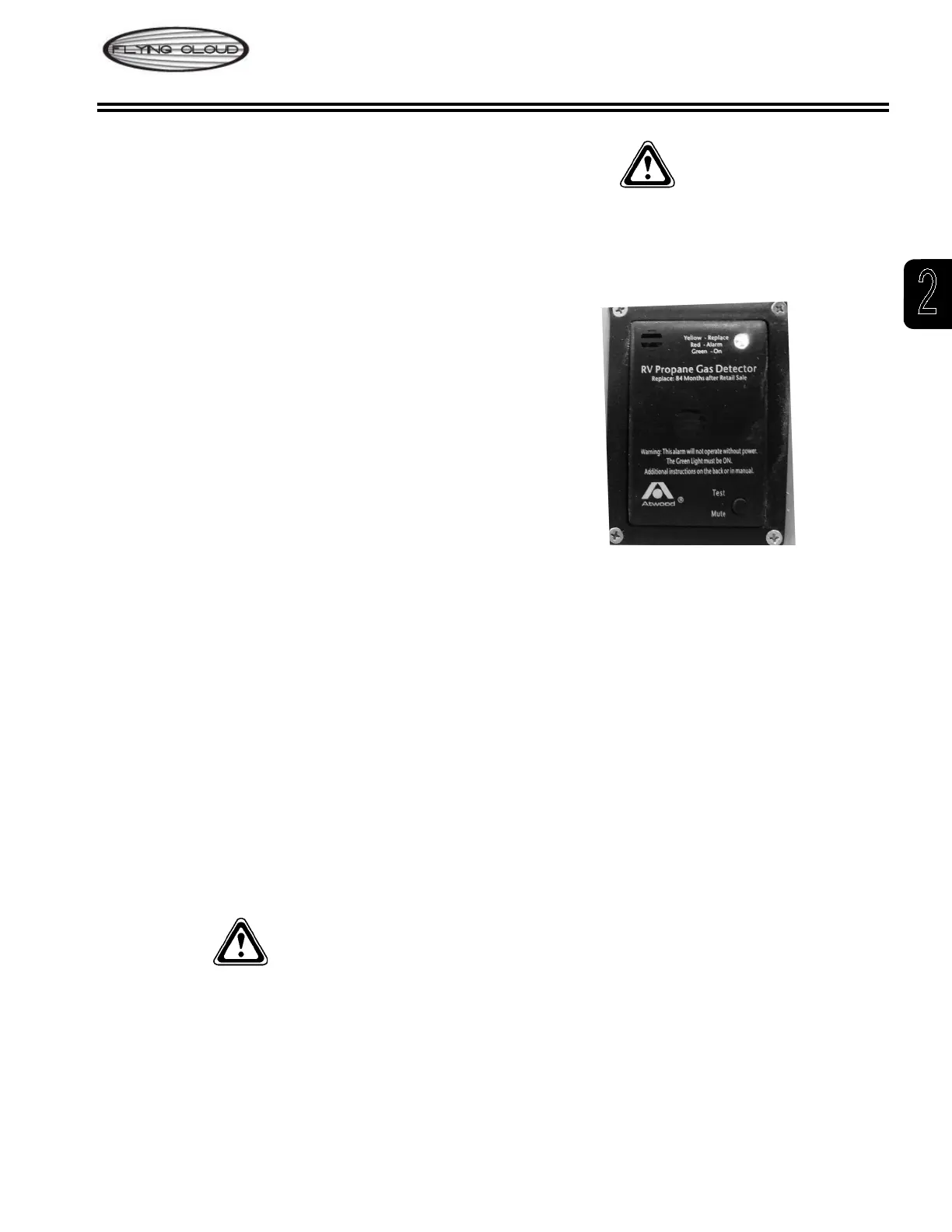
Liquid Propane Gas (LPG) Detector
This alarm has a seven year life; see end-of-life
notication in LPG detector manual. Please read entire
detector manual before operating unit.
The LPG detector is located in the kitchen area. LPG
is a mixture of gases produced and sold commercially
as a fuel for heating and cooking appliances. LPG is
highly ammable and, as a result, can be explosive
if ignited under certain circumstances. LPG is
heavier than air and, if conned in a closed space,
will accumulate close to the oor. The LPG detector
is designed to alarm at less than 25% of the legal
explosive limit. It will provide a visual and audible alarm
by sounding an alarm every 5 seconds and lighting the
red LED.
Your LPG detector is wired directly to your trailer
battery and incorporates a 1 amp, in-line fuse. It has no
internal battery backup. In normal stand-by mode, the
LED indicator will be green.













 To Next Page