7
Towing
Flying Cloud 7-5
WARNING
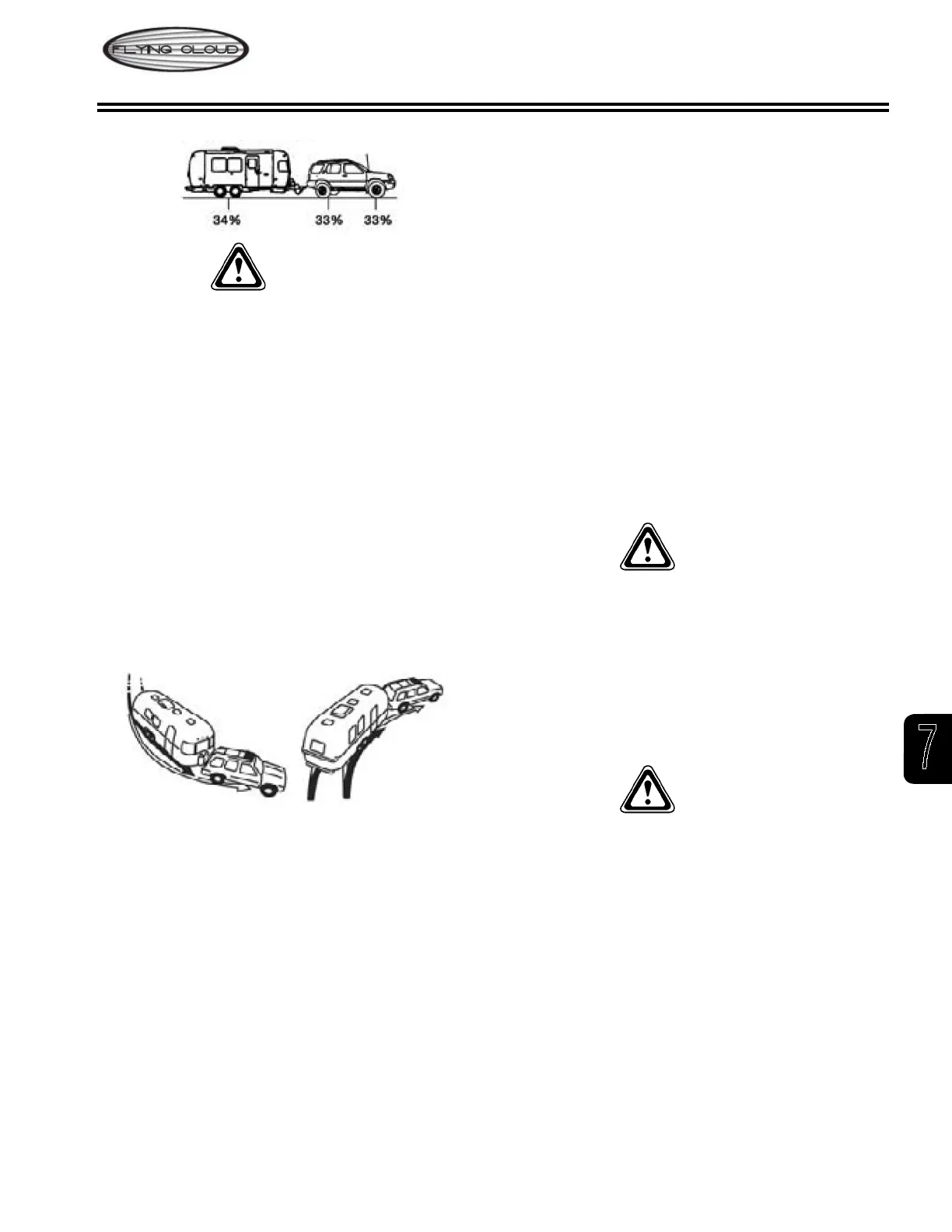
The tongue weight should be approximately 10
to 15% of the trailer’s total weight, but must not
exceed 1,000 lb. Under no condition should it
exceed the hitch rating. Your hitch installer should
provide your hitch rating information.
Towing Tips and Information
We want every Airstream owner to be a safe and
courteous driver. A few hours of towing practice in a
large, empty parking lot will make pulling your trailer
over the road much easier. Mark off two corners of the
parking lot for left and right turns. These corners may
also be used to practice backing and parking.
Tracking Observation
Observe that the tracks made by the trailer wheels are
distinctly different from those made by the tow vehicle.
Studying this will make it easier for you to correct
mistakes.
General Information
NOTE
Truck or trailer type fender, door grip, and rear
view mirrors are a must for maximum visibility and
required by law in most states.
After thoroughly inspecting your hitch, brakes, and
tires, you should be ready to tow. Check trafc, signal
when you are about to pull away, and start slowly.
Look often in your mirrors, and observe the action of
the trailer, then carefully move into the proper lane of
trafc. Remember that the trailer wheels will not follow
the path of the tow vehicle wheels, therefore, wider
turns are necessary when turning to the left or to the
right.
Cooling System Overload
When towing, you might encounter a temporary cooling
system overload during severe conditions, such as:
• hot days when pulling on a long grade
• when slowing down after higher speed driving
• driving with long, idle periods in trafc jams
If the tow vehicle’s temperature gauge, or indicator
light indicates overheating, and the air conditioner is
on, turn it off, pull over in a safe place, and apply the
emergency brake. Increase the engine idle speed.
Lift the engine hood and check for uid leaks at the
radiator overow outlet. Ensure that all drive belts are
intact and the radiator fan is turning. If you have a
problem, have it xed at the next opportunity. If there
is no problem, the light should go off, or temperature
should come down within one minute. Proceed on the
highway a little slower, resume normal driving after ten
minutes.
WARNING
Never open a radiator cap when the tow vehicle is
hot. Check the coolant level when the vehicle is
cool.
Downhill and Non-level Driving
When going downhill in dry weather, downshift so that
engine compression will slow the whole rig down. Take
dips and depressions in the road slowly and do not
resume normal driving speeds until you are sure that
the trailer wheels are clear of the dip.
WARNING
On slippery pavement, do not use engine drag to
help slow down as this may cause the rear wheels
of the tow vehicle to skid. On icy pavement, drive
slowly and, if you feel the tow vehicle skidding,
gently apply the trailer brakes only. This will bring
the tow vehicle and trailer back into a single line.
Chains do not help trailer wheels.
Off-Road Towing
When driving in mud and sand, let the momentum
carry the rig through. Apply power gently and use as
little as possible. Stay in the tracks of the vehicle ahead
and keep the tow vehicle in the highest possible gear. If
you get stuck, it is best to tow out the entire rig together
without unhitching.




 To Next Page