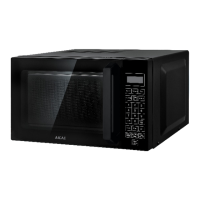
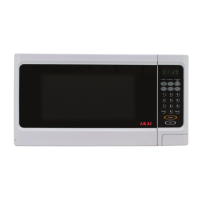
This document is an instruction manual for the AKAI A24001 800W Microwave Oven. It provides essential information regarding the appliance's technical specifications, safety guidelines, usage instructions, troubleshooting, and maintenance.
Function Description
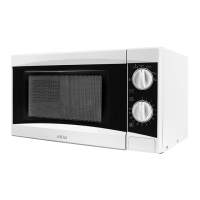
The AKAI A24001 is an 800W microwave oven designed for heating food and beverages in household and similar applications. It features six power levels for microwave cooking, allowing users to select the most suitable setting for various tasks. The appliance is intended for free-standing use and is operated via two dials on the control panel: one for setting the power level and another for setting the cooking time.
Important Technical Specifications
- Model No: A24001
- Voltage: 220-240V ~ 50Hz
- Input Power: 1200W
- Output Power: 800W
- Microwave Frequency: 2450MHz
- Guarantee: 3 Year Guarantee (with product registration online)
- Compliance: Conforms to 2014/30/EU (Electromagnetic Compatibility Directive), 2014/35/EU (Low Voltage Directive), 2011/65/EU (Restriction of Hazardous Substances Directive), and 1935/2004/EC (Materials & Articles in Contact With Food).
- Customer Support: +44 (0)333 220 6042 (8:30 am to 6:00 pm Monday-Friday)
- Website: www.akaionline.co
Usage Features
The microwave oven is designed for straightforward operation.
- Control Panel: Consists of two dials:
- Power Dial: Used to select one of six cooking power levels:
- 1st (100%): High
- 2nd (88%): M.High
- 3rd (73%): Medium
- 4th (52%): M.Low
- 5th (42%): Defrost
- 6th (20%): Low
- Timer Dial: Allows setting a desired cooking time up to 30 minutes per session. For times less than 2 minutes, the user should turn the dial past the 2-minute mark and then back to the desired time. The microwave starts cooking as soon as the timer is turned.
- Cooking Session Steps:
- Place food in the oven and close the door.
- Turn the Power Selector to choose a power level.
- Use the Timer dial to set the cooking time.
- Stopping Cooking: Push the door release button to stop the oven during a cooking process.
- Utensils Guideline: It is strongly recommended to use only microwave-safe containers, typically made of heat-resistant ceramic, glass, or plastic. Metal containers are not suitable for microwave cooking due to the risk of arcing, fire, or injury. Wooden and ceramic containers with metallic inlays should also be avoided. Cling film can be used if pierced and not touching the food.
- Food Preparation Tips:
- Arrangement: Place thicker areas of food towards the outside of the dish, with thinner parts towards the center. Spread evenly and avoid overlap.
- Cooking Time: Start with shorter times and extend as needed to prevent overcooking, which can lead to burnt food or smoke.
- Piercing: Pierce foods like potatoes, apples, fish, chicken, and sausages in several places to prevent steam buildup and explosions.
- Even Cooking: Turn foods like chicken, burgers, or steak once during cooking. Stir liquids from outside to the center once or twice.
- Standing Time: After cooking, allow food to stand in the microwave for a few minutes to complete the cooking cycle and cool naturally.
- Browning Dish: When using a browning dish or self-heating container, always place a heat-resistant insulator underneath to prevent damage to the turntable.
- Plastic Wrap: Do not allow plastic wrap to contact high-fat foods, as it may melt.
- Installation Requirements:
- Must be placed in dry, non-corrosive environments, away from heat and humidity.
- Ensure sufficient ventilation: at least 10 cm from the back to the wall, 5 cm from the sides to the wall, and 20 cm free space above the top surface.
- The microwave should be at least 85 cm from the ground.
- Position away from TV, radio, or antenna to avoid interference.
- The plug must be accessible, and the appliance must be properly grounded.
- The oven must be operated with the door closed and is not intended to be built into a cabinet.
Maintenance Features
- Regular Cleaning: The microwave should be cleaned regularly, and food deposits removed to prevent deterioration of the surface, which could affect the appliance's life and lead to hazardous situations.
- Cleaning Procedure:
- Disconnect from the power outlet before cleaning.
- Do not immerse the appliance in water or other fluids.
- Avoid harsh detergents, gasoline, abrasive powder, or metal brushes.
- Exterior: Wipe with a dampened soft cloth.
- Door and Window: Wipe with a dampened soft cloth. Clean door seals and adjacent parts. Wipe the control panel with a slightly dampened soft cloth.
- Interior Walls: Wipe the cavity with a dampened soft cloth. Clean the waveguide cover to remove food remnants.
- Turntable/Rotation Ring/Rotation Axis: Wash with mild soap water, rinse with clean water, and dry thoroughly.
- Waveguide Cover: Do not remove the waveguide cover during cleaning. Ensure it is correctly installed and undamaged.
- Odor Removal: If odors emit from the microwave after lengthy use, methods include:
- Heating several lemon slices in a cup with high Micro Power for 2-3 minutes.
- Heating orange peel in the microwave with high Micro Power for 1 minute.
- Seal Cleaning: Keep the microwave door seal clean to ensure proper door closure.
- Spicy/Salty Food Residue: Always clean the oven interior after cooking spicy sauces (ketchup, mustard) or salty dishes, as these can erode the surface.


 To Next Page
 General