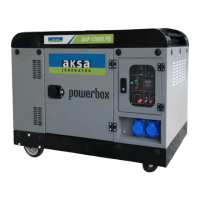
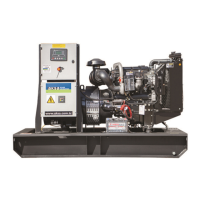
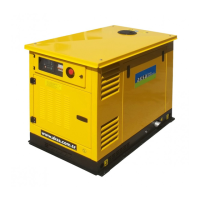
This document is a user manual for the AKSA Power Portable Series Diesel Generator, model AAP 4200 DE. It provides comprehensive information on the generator's technical specifications, operation, maintenance, and troubleshooting.
Function Description
The AKSA AAP 4200 DE is a single-phase diesel generating set designed to provide electrical power. It is a portable unit, as indicated by "Portable Series" in the manual title. The generator is intended for various applications, supplying both AC and DC voltage outputs. It features an electric start system and incorporates safety mechanisms such as low oil pressure protection. The manual emphasizes proper installation, operation, and maintenance to ensure the generator's longevity and safe use.
Important Technical Specifications
The AAP 4200 DE is a single-phase diesel generator with the following key specifications:
- Frequency: 50 Hz
- Max Power (KVA): 4.5
- Rated Power (KVA): 4.2
- Voltage (A.C)(V): Multiple options including 220V, 230V, 240V, 110/220V, 120/240V, 115/230V.
- Excitation Mode: Self-excitation brushless or self-excitation constant voltage (AVR).
- Revolution (r/min): 3000
- Voltage (D.C)(V): 12
- Current (D.C)(A): 7
- Noise Level dB(A)/7m (0-100% load): 70-74
- Power Factor cos φ: 1
- Insulation Grade: F
- Model of Power (Diesel Engine): CF186F (E)
- Engine Type: 4-stroke single-cylinder air cooled direct injection
- Max Power (kW/rpm): 6.5
- Bore × Stroke (mm): 86×70
- Cylinder Displacement (ml): 406
- Cooling System: Force air-cooled
- Lubricating System: Pressure splash, duplex type lubrication
- Volume of Lube Oil (L): 1.65
- Start System: Electric start
- Fuel: Diesel fuel
- Fuel Tank Volume (L): 15
- Low Oil Pressure Protection: Have
- Total Weight (kg): 186
- Overall Dimensions (mm): 970×580×785
The manual notes that the maximum power is achieved only after 30 hours of initial run. It also provides a table for power output based on height above sea level and ambient temperature, indicating that the generator's performance can be affected by environmental conditions.
Usage Features
The generator is designed for ease of use with an electric start system. The control panel includes a voltmeter, digital timing display, low-oil protection indicator, and various sockets (Square American type-socket, 3-hole unit loose socket, 4-hole unit loose socket) for connecting electrical loads. A transfer switch and fuses are also present for safety and control.
Key operational procedures include:
- Preparation: Checking fuel level, engine oil level, and air filter before starting. The manual strongly advises against using gasoline or kerosene and emphasizes using clean, light diesel fuel.
- Starting: Ensuring the generator is on a level surface, disconnecting all electrical loads, turning the fuel valve to "ON," pushing the speed level to "run," and then using the ignition key for electric start.
- Operation: Pre-heating the engine for 3 minutes under no load, checking the low oil pressure light, and avoiding adjustment of factory-set speed limit and fuel adjustment bolts.
- Loading: Connecting electrical loads one by one, starting with the largest load, and allowing the engine to stabilize between connections. It warns against overloading the generator and connecting 3-phase loads to this single-phase unit.
- Stopping: Disconnecting electrical loads, moving the air switch to "off," and allowing the engine to run for 3 minutes at idle for cooling before stopping.
- Battery Charging: The 12V battery for electric start is automatically charged when the engine is running. For long storage periods, the battery should be disconnected.
Maintenance Features
Regular maintenance is crucial for prolonging the generator's life. The manual provides a detailed maintenance schedule:
- Everyday/Before Starting: Check fuel level, check fuel oil leakage, check and screw fastened parts, check lube oil level.
- After 1 Month or 50 Hours: Drain fuel tank, check and fill engine oil, clean fuel filter, replace lube oil, clean lube oil filter, check air cleaner element, check battery liquid level.
- Every 3 Months or 200 Hours: Replace lube oil, clean lube oil filter, check air cleaner element.
- Every 6 Months or 400 Hours: Adjust intake and exhaust valve clearance.
- Every 1 Year or 1000 Hours: Grind air intake and air exhausted gate, exchange piston ring, check electric brush and slide ring.
- If Damaged or Smeary: Change the core of the air filter.
- If Necessary: Exchange injector, injection pump, and fuel pipe.
- After 10 Days of Stop: Check insulation resistance.
Specific maintenance tasks include:
- Changing Engine Oil (every 100 hours): Drain hot oil from the bottom of the cylinder and refill with proper engine oil.
- Air Filter Maintenance: Clean every 6 months or 500 hours; exchange if necessary. Do not use detergent.
- Fuel Filter Maintenance: Clean every 6 months or 500 hours. Drain fuel, remove filter, clean with diesel fuel, and clean carbon deposits around the fuel injector.
- Cylinder Head Bolt Tensions: Tighten to specifications (refer to diesel engine manual).
- Battery Check: Check battery acid level monthly and add distilled water if needed.
The manual contains numerous warnings and notes to ensure safe operation:
- Fire Prevention: Use only light diesel fuel, keep flammable fuels away, operate on a level site, and maintain a 1.5-meter distance from buildings.
- Exhaust Gases: Never inhale exhaust gases; operate in well-ventilated areas.
- Accidental Burns: Avoid touching the hot muffler and its cover.
- Electric Shock: Do not touch the generator if wet; ground the generator.
- Battery Safety: Wear protective gear; wash immediately if in contact with electrolytic liquid; do not reverse polarities; avoid flames/sparks near the battery during charging.
- Overloading: Do not overload the generator or connect 3-phase loads.
- Engine Oil: Do not fill engine oil while the machine is running.
- Air Filter: Never start the engine without the air filter.
Troubleshooting
A troubleshooting section provides common malfunctions and their remedies, such as:
- Diesel cannot be started: Not enough fuel, fuel switch not at "OPEN," high-pressure pump/nozzle issues, speed control lever not at "RUN," low lubrication oil, weak reactive starter, dirty nozzle, or dead accumulator.
- Generator cannot generate electricity/welding voltage: Master switch (NFB) off, worn carbon brush, bad socket contact, engine not reaching rated revolution, damaged AVR, or damaged potentiometer for current regulation.
The manual also includes circuit diagrams for single-phase double voltage, single-phase single voltage, and three-phase configurations, along with an appendix listing various socket types and a general power list of appliances to assist users in determining their power needs.

 Need help?
 General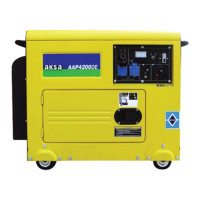

 To Next Page