259
02
/3AL 91669 AA AA
674
674
3.7.2.3 Protection sub–system
The following protection
mechanisms are provided:
– native packet ring protection, refer to point [1] on page 259
– Dual Attach, refer to point [2] on page 260.
– Customer Edge (CE) Dual Homing, refer to point [3] on page 261.
[1] Packet ring protection
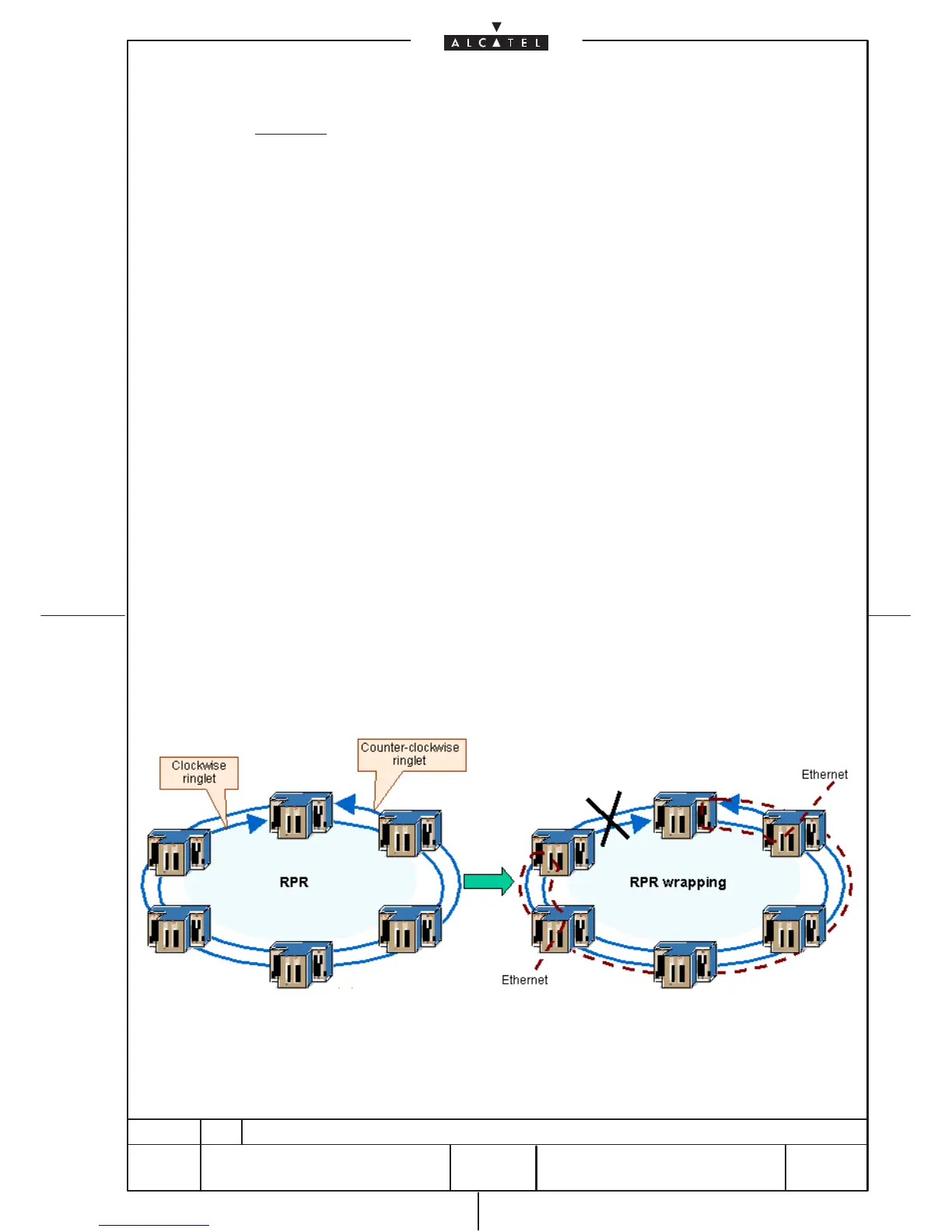
The packet protection is provided by the MPLS–based Resilient Packet Ring (RPR) technology, via
“Wrapping” mechanism (see Figure 131. on page 259).
RPR is currently being standardized by the IEEE 802.17 Working Group and specifies a technology for
packet–based transport in ring topologies defining special functions that offer fast fault location and trigger
fast switchover at packet level.
RPR is used to optimize and manage the portion of bandwidth dedicated to packet traffic in SDH networks.
An RPR topology consists of two counter rotating fiber rings (or portion of SDH fiber rings bandwidth) in
which multiple nodes share the whole bandwidth (see Figure 131. on page 259)
Negotiation for bandwidth occurs among the nodes through specific fairness mechanism that guarantees
fair bandwidth allocation for customer traffic per each node. Nodes can send packets to other nodes either
by utilizing unicast (point–to–point) or multicast (multipoint) destinations, which enables multipoint
Ethernet VPN and Ethernet aggregation services be implemented over RPR.
When sending a packet, the node determines which ring direction to use, so the spans in the opposite
direction remains free for other customer traffic sent by other nodes.
A packet traveling on the ring is stripped by the destination node. This means that the packet does not use
all the ring bandwidth but only the span that it requires to go from source to destination. This features is
called “spatial reuse” as the bandwidth of the other span of the ring can be used by other paying traffic.
RPR protection protocol provides sub–50msec resilience for traffic in case of fiber or node failure.
Specific control packets are exchanged among the nodes to keep the ring constantly monitored.
“Wrapping” mechanisms is provided for packet protection switch accomplished by merging the frames
destined at the failed segment, into payload destined at the opposite direction by node adjacent to the
failed segment.
Additionally, RPR provides ring–wide QoS assurance mechanisms and three different CoS.
1660SM 1660SM
Figure 131. RPR protection mechanism


 To Next Page