
 Need help?
Do you have a question about the Alcatel ALE-30h and is the answer not in the manual?
Visual indicators for phone modes, connections, and features like silent mode, headset, and Wi-Fi.
Icons representing call states, such as incoming calls, calls in progress, and held calls.
Dedicated physical keys on the phone for functions like redial, mute, speaker, and messaging.
Guide for initial voicemail configuration, including password setting and name recording.
Instructions on how to record or change your personal voicemail greeting message.
Steps to retrieve and manage voicemail messages via the phone interface.
Dialing extensions or external numbers, including name dialing and Qwerty keypad use.
Methods for answering incoming calls and placing active calls on hold.
Procedures for transferring calls and retrieving parked or held calls.
Using the redial key for the last number dialed or accessing the redial list.
Setting up a callback notification when an extension becomes free.
Instructions for parking calls and retrieving them from specific extensions.
Using phone keys to navigate menu options or enter codes during a call.
Viewing missed call logs and accessing voicemail messages with a default password.
Configuring call diversions to another number or extension.
Making three-way conference calls and broadcasting messages via Tannoy.
Answering calls ringing on other extensions or within a group.
Setting up and using personal speed dial entries for quick calling.
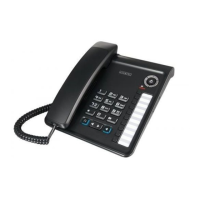
This document serves as a quick user guide for the Alcatel OXO ALE-30h telephone, providing instructions on its various functions, usage features, and some maintenance aspects.
The phone displays several icons to indicate its current status. A silent mode icon signifies that the phone is muted. A padlock icon indicates that the telephone is locked, preventing unauthorized use. A headset icon shows when a headset is connected, allowing for hands-free communication. Similarly, a hands-free icon indicates that the speakerphone is active. An appointment icon signifies that an appointment has been programmed into the device. An encrypted signal icon suggests that the communication is secure. Lastly, a Wi-Fi icon is present, though its usage is marked as "future use," implying potential wireless connectivity features not yet active.
During calls, specific icons provide visual cues about the call's status. An incoming call icon alerts the user to an incoming call. A call in progress icon indicates that a call is currently active. A call holding icon shows when a call has been placed on hold. Finally, an icon indicating "Your contact ended the conversation" appears when the other party has disconnected.
The phone features several permanent keys with dedicated functions. The Redial Key allows the user to redial the last number called. The Mute Key mutes the microphone during a call. The Speaker Key activates the speakerphone for hands-free communication. The Messaging Key is used to access messages. There are also programmable function keys, labeled F1 and F2, which can be customized for specific actions. Volume Up and Down keys control the audio level. An Alpha Numeric Key is available for text input.
The voicemail system is a core feature of the Alcatel OXO ALE-30h. To set up voicemail, the user presses the flashing Mail key and enters a default password. The system then prompts for a new, 6-digit password, emphasizing the importance of choosing a secure one to prevent unauthorized access. After setting the password, the user records their name or department name. The system allows replaying, re-recording, or confirming the recording. Once set up, callers will hear a message indicating they've reached the user's mailbox.
To record a Personal Greeting, users navigate through the MENU tab to Settings, then Mailbox, and select Listen. Here, they can listen to the current message or record a new one. To access voicemail messages, the user presses the flashing Mail key, selects 'Voice' on the screen, and enters their password. Options like Play and Clear are then available.
The phone supports various basic call handling functions. Internal calls are made by dialing an extension number or pressing a speed dial button. External calls require dialing '9' followed by the desired number. Dialing by name involves pressing the ABC key and entering the first three letters of the contact's name, then pressing OK. If the phone has a QWERTY keypad, the process is similar, using the QWERTY keypad and the right arrow to search.
Receiving a call is done by lifting the receiver or pressing the speaker button for hands-free mode. To hold a call, the user presses 'Hold' on the screen. To retrieve a held call, the user presses the key next to the musical note icon.
When attempting to call a busy extension, the screen will display 'Wait'. Pressing the 'Call Back' key will notify the user when the extension becomes free. To cancel a call back, the user presses '#'.
External calls can be parked by dialing '12' or scrolling to 'Park' on the screen, then dialing the desired extension number. A "Parking Accepted" message confirms the action. To retrieve a parked call, the user lifts the receiver and dials '12' followed by the extension number where the call was parked.
During a call where menu options or PIN codes are required, users can press the F1 key or the 'MF Code' key on the handset screen to activate touch-tone dialing.
The message key (represented by an envelope icon) allows users to view missed calls, voicemail messages, and instant messages. Users select the desired option and enter their voicemail password (defaulting to 0000 if no personal voicemail is set). The system also differentiates between answered outgoing, unanswered outgoing, answered incoming, and unanswered incoming calls using distinct icons.
Calls can be transferred in two ways:
If an extension is busy or unanswered, the user can press the release key. To reconnect with the first caller after a transfer attempt, the user presses the key next to the pause/musical note icon.
To initiate a 3-way conference, while on a call, dial a third party. Once they answer, announce the conference, scroll down, and press 'Confer'. To end the conference with the third party and return to the first call, select 'End Confer' or press 'Transfer'. Alternatively, replacing the receiver or pressing the Hang Up key ends the entire conference.
The Tannoy feature allows broadcasting a message through selected phones. Users dial the broadcast group number (provided by the administrator) and make their announcement within 20 seconds. The broadcast is heard only if the phone is not in use and has a speaker function.
To pick up a call within a user's group, press the F2 key and lift the receiver. This will connect to the longest ringing call. To pick up a call ringing on a specific extension, press the 'PICK UP' key on the handset screen, enter the extension number, and lift the receiver.
To forward calls or set up a divert, users press the arrow key in the top right corner of the screen. They select the type of forward required from the on-screen options. For 'Imm fwd' (immediate forward), a destination number must be entered. A solid black, spinning arrow indicates an active forward. To cancel, press the arrow key again and select 'Canc Fwd'.
Users can set up speed dials for their phone. From the 'Perso' tab, select a line key with '...' next to it. Press 'Name' and enter a name (using the ABC key), then press OK. Then press 'Number' and enter the number, starting with '9', using the keypad, and click OK.
To call a speed dial, press the key next to the name. To edit speed dials, navigate to Menu, then Settings, and then Keys. These speed dials are specific to the handset and will not appear on other phones.
The document provides contact information for support. The Support Desk can be reached at 01392330033 or via email at supportdesk@swcomms.co.uk. Customer Service is available at 01392315315 or customer.service@swcomms.co.uk. Additional guides and manuals are available online at www.swcomms.co.uk/resource-centre/user-guides-and-manuals.
 General
| Connectivity | Ethernet |
|---|---|
| Ethernet Ports | 2x 10/100 Mbps |
| Power over Ethernet | Yes (IEEE 802.3af) |
| Speakerphone | Yes |
| Audio Codec | G.711, iLBC |
| VoIP Protocols | SIP (RFC3261) |
| Power Supply | 5V DC |



 To Next Page