CHAPTER
2
SpemER
lusrnlrATton
Like any speaker system,
your
Ml Active speakers will workbest
when properly
positioned in a suitable
acoustic environment. Achieving
proper
speaker
placement
is usually shaightforward, but even
with
nearfield monitors, speaker
placement
and
the acoustics of the listening room itself are too often overlooked and canbecome
significant contributors
to an inaccurate and uninspiring monitoring environment.
Avoiding reflections
in
the studio
While nearfield monitors are
more forgiving of the
surrounding
room acoustics, it is
always prudent to optimize
the
listening
environment whenever possible. First, the
user should be aware
of the effect that the
size of the listening
room can have on low
frequency response. In general,
the smaller the room,
the stronger
the
bottom
end
will
be, although
placement
within a larger room can also make a difference.
This
has
to do with the way low-frequency
waves travel in closed spaces. If
you
find your
monitor system
to be either light or heavy
on the bottom, try
moving
them around
within your listening
rff)m.
You should avoid
locating
your
M1 Actives near reflective
surfaces such
as glass,
tile,
large open walls or table
tops. Still, many rooms
used
for recording have these
surfaces, so the best
way to deal with them is to place
the
monitors
out
in the room
away
frorr
refl".1ivs
r4'alls,
windows and sizable objects. Even with these reflective
surfaces separated from
the
monitoring
position, typical mixing situations usually
still have the top
surface of the mixing board to deal
with.
Unfortunately, the
board itself can
be
a major
source of
reflections and the additional
acoustic
conduction into the
board can affect
your
monitor's amplitude and phase
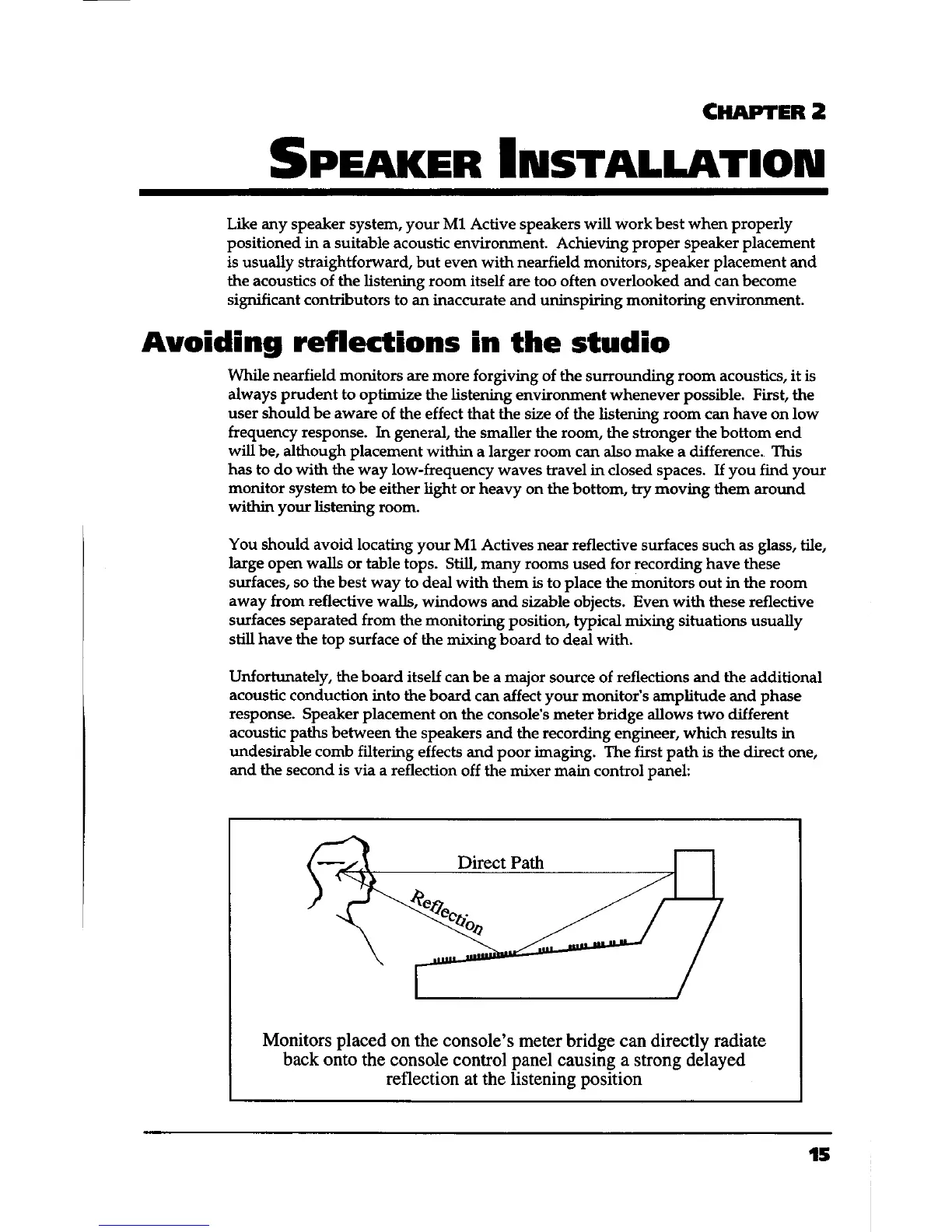
response. Speaker placement
on the console's meter
bridge
allows two different
acoustic paths
between the
speakers and the recording engineer, which results in
undesirable comb filtering
effects and poor irnaging. The fust path is
the
direct
one,
and the
second
is
via a reflection
off tJre mixer main control
panel:
Monitors
placed
on
the console's
meter bridge can directly radiate
back onto
the console control
panel
causing a
strong delayed
reflection at the listening
position
t5







 To Next Page