Spcakcr
Installation
Stereo
nearfield
placement
of the
M{
Active
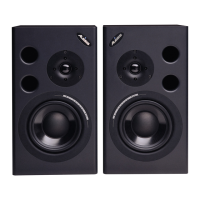
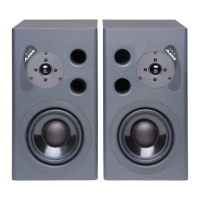
NOTE: We recommend
that the M1
Active speakers be
placed
with the
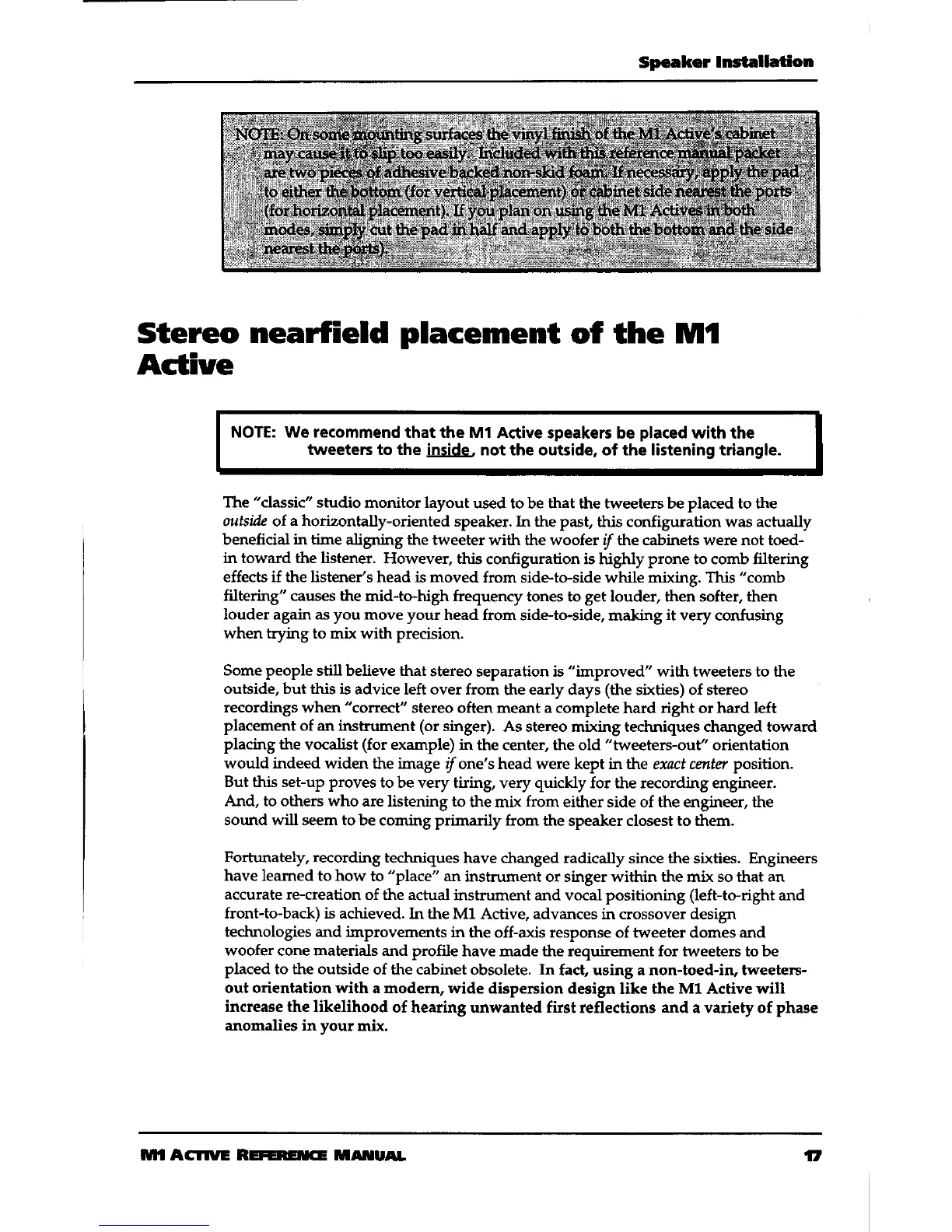
tweeters to the inside.
not the outside, of the listening triangle.
The
"classic"
studio
monitor layout
used to be that the tweeters be
placed
to the
outside of
ahot'tzontally-oriented
speaker. In
the
past,
this configuration was actually
beneficial
in
time aligning the
tweeter with the woofer
f
the cabinets were not toed-
in toward the listener.
However, this
configuration is highly
prone
to comb filtering
effects if the listener's head is moved
from side-to-side while mixing. This
"comb
filtering" causes the
mid-to-high frequency
tones to
get
louder, then softer, then
louder again as you
move
your
head from
side-to-side, making
it
very confusing
when trying to mix with precision.
Some people
still believe that
stereo separation is
"improved"
with tweeters to the
outside, but this is
advice left over from
the early days
(the
sixties) of stereo
recordings when
"correct"
stereo often meant a complete
hard right or
hard left
placement of an instrument (or
singer).
As stereo mixing techniques changed toward
placing
the vocalist
(for
exarnple) in
the center, the old
"tweeters-out"
orientation
would
indeed
widen the image
f
one's head were kept in the exact cmter position.
But this set-up proves
to be very tiring,
very
quickly
for the recording engineer.
And, to others who
are listening to
the mix
from
either side of the engheer, the
sound will seem to
be coming primarily from
the speaker closest to them.
Fortunately, recording
techniques
have changed radically
since the sixties. Engineers
have leamed to how
to
"place"
an
instrument or singer within the mix so that an
accurate re-creation
of
the
actual
instrument and vocal positioning
(left-to-right
and
front-to-back) is achieved.
ln the M1
Active,
advances
in crossover design
technologies and
improvements in
the off-axis response of tweeter domes and
woofer cone materials and profile
have made the requirement for tweeters tobe
placed to the outside
of the cabinet
obsolete.
In
fact, using a non-toed-in, tweeters-
out orientation with a modern,
wide diapersion design
like the
M1
Active
will
inctease the likelihood
of hearing
unwanted
first
reflections and a variety of
phase
anomalies
in vour mix.
IT}I ACT]UE Rffi MAilUAL






 To Next Page