Speaker
lnstallatlon
Playback
check
mode
(yertical
mid-field)
After you've
got your
mix
just
right
it's always
good practice
to perform
a
,,playback
check"
by standing
the
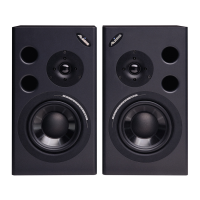
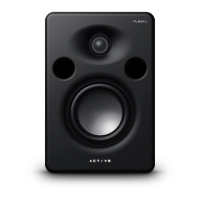
Ml Actives
vertically
and makhg
the
lisiening
triangle-
largel.
The purpose
of the playback
check is to
simulate
what
your
masterpiece
will
sound like
in a
"typical"
home listerring
environment.
It
is in this
configuration
that
the imaging
specificity
of your mix
can
best be evaluated.
Generally, in the
playback
check
mode you
want
to arrange
the speakers
in the
same equilateral
listening
hiangle
that you
do in a nearfield
setup, but instead
of each side of
the kiangle
being
about
3
feet long,
the
distances between
stereo speakers
and to your
listening
position should
be betwem 7
and L2
feet.
When
setting the left
and right
speakers vertically,
place the
tweeters
toward the
center
with the ports
toward the
outside. In this vertical position,
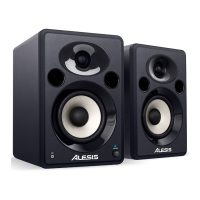
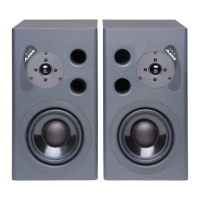
the ML Active
becomes a
"line
source"
speaker which is
the most common home
set up.
(A
12',
three-way with
woofer on bottom,
midrange in
the cmter and tweeter
at the top is a
line
source, as are most
forurs of tower
speakers.)
When the Ml Active is
set
vertically in its
"column"
configuration,
thehoinntal
dispersion
(left
and right)
d
the speaker is widest,
and the vertical
dispersion
(up
and down) is narrowest.
Unforfunately a vertical
setup will also increase
room effects, so
there are minimum
recommmded
setup distances from
side and
back walls: the speakers
should be a
minimum of 2.5
feef
from
the side walls
and 3
feet
ftom the rear
walls. See the
illustration on page 26.
After you've got the
requisite distances
from the
side
and
back walls, it's often
helpful
to adjust the 7 to 12 foot
equilateral listening
triangle distances. What you
want to find is the maximum
distance
that
you
can separate the two
speakers while
still
holding
a solid center irnage.
If you get this placement
conect and you've
done a
good
job
in
the mix, you
should be rewarded with
a soundstag€ that accurately
places
the musicians in the
width and depth perspective
in which they were
recorded. The
sound should
be very similar to
what
you heard
at your mixing
board, with possibly
a little more ambimce
contributed by the listening
room.
The
"other"
playback check
mode, sorretimes
considered of greater importance
than
the home
environment, is to listen
to
your
mix over
a car audio system. Bear in mind
that an expertly designed car
audio system can
approach the imaging and
soundstaging
capabilities of an optimally
setup studio
or
living room,
but most tirnes
this is NOT the case. The
inhermt limitations
of an always-off-axis listening position
and
the variables of speaker placement,
bass coupling
(boost)
in the
small
interior
and numerous other factors
make the car environment
higNy suspect. So,
understand the sonic
capabilities
(and
deficiencies) of your
(or
other)
car
audio
systeurs, and evaluate your
mix accordingly.
TII
ACTIi'E REFffi
If,ATUAL


 To Next Page
 Loading...