EasyManua.ls Logo

Alesis M1 ACTIVE - Page 27

Alesis M1 ACTIVE
40 pages
Print Icon
To Next Page IconTo Next Page
To Previous Page IconTo Previous Page
Loading...
Spcaker Installrtlon
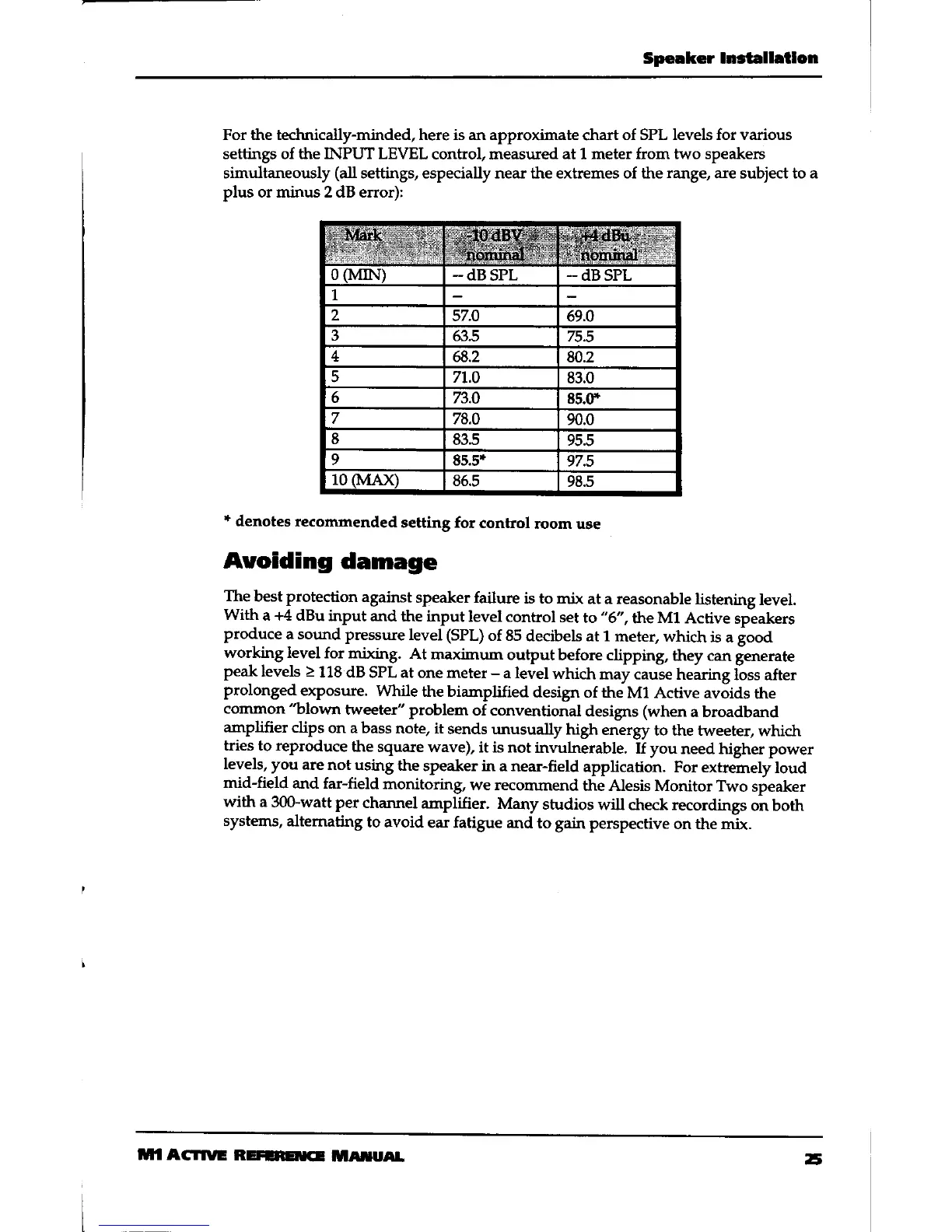
For the tectmically-minded, here is an approxirnate
chart
of SPL levels for various
seftings
of the INPUT LEVEL
control, measured
at
1
meter from two speakers
simultaneously
(all
settings, especially near the extremes of the
range,
are subject to a
plus or minus 2 dB error):
O(MIN)
-
dB
SPL
--
dB SPL
1
2
57.0
69.0
J
53.5
75.5
4
6.2
80.2
5 7L.O
83.0
6
73.0
85.0*
78.0
90.0
8
835 v5.5
9
85.5*
97.5
10
(MAX)
85.5
98.5
+
denotes
recommended
setting for
control
room
use
Avoiding
damage
The-best
protection
against
speaker failure
is to
mix at a reasonable
listening
level.
With
a +4 dBu
input
and the input
level control
set
to
"5,,,
the
Ml
Active
speakers
produce
a sound pressure
level (SPL)
of 85
decibels at 1
meter, which
is a good
working level
for mixing.
At maximum
output
before clipping,
they can
generate
peak
levels >
118 dB
SPL at one meter
-
a level
which
may
cause hearing
lbss after
prolonged
exposure.
While
the biampli.:fied
design of the
M1 Active
avoids
the
common
"blown
tweeter"
problem
of conventional
designs (when
a broadband
amplifier
clips
on a bass
note, it
sends unusually
high
energy
to the tweeter,
which
tries-to reproduce
the
square wave),
it is not
im'ulnerable.
If you
need higher power
lev9l9,
y9u
are
not using
the
speaker in
a near-field
application.
For extremelyloud
mid-field
and far-field
monitoring,
we recorunend
the Alesis Monitor
Two
speaker
with a
3O&watt per
channel
amplifier.
Many
studios
will check recordings
on botL
systems,
altemating
to avoid
ear fatigue and
to gain perspective
on the mix.
ffiIACilUI
Rffi
MATUAL
a

Related product manuals