Sunound
Sound
tn developing
the Ml
Actives
for use
as
left,
center and
right
front channel
sources,
we wanted them
to be useable
in both
audio/video
and audio-only
,,matrix,,
type
applications.
We discovered
twq already
available
solutions
to the large
,,wall-of-
mono" effect produced
by Dolby Pro
Logic
when playing audio,only
material. The
first is easy.
Most home audio
Dolby
Pro Logic receivers will
let
you
take the center
channel out
completely by
putting the receiver
in the
"phantom,,
(no
center drannel)
mode.
It preserves
the classic
stereo effect of the front
channels
while adding rear
surrotmd. This method
works well
with most stereo-only recordings
which have no
surround encoding.
But it's mudr
better if
the rear channels have true
makix
(mono)
surround
(like
applause)
encoded in
the mix.
The
second method of using Do\ Pro Logic gets
the center drannel
back into the
mix. Most of these
same
home
audio receivers have an
audio-only surround mode
which sigfficantly attenuates
the output of the cerrter drannel in relation
to the left
and
right.
The
audible benefit here is that the mix
sounds
like
a stereo only
recording but the center image
(like
a vocalist) becomes a haril centet. There is no
image wander, as the frequencies
drangg
for instance. And
the classic list€ning
"sweet
spot'' expands dramatically, allowing for accurate soundstage and instrument
placement when listening far
off-axis.
(This
attenuating of the center
channel
for
audio only
is
also employed by advanced professional matrixed decoders such as the
Circle Surround Mles Tedmology and Lexicon units.)
Placement
of the center
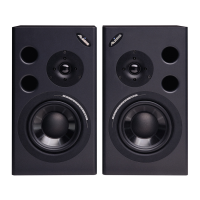
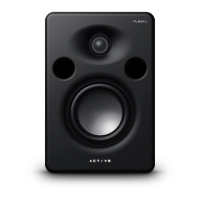
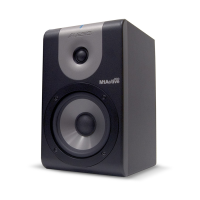
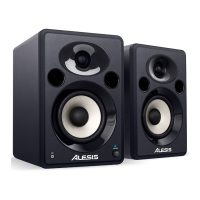
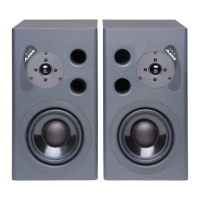
lUll Actine speaker
in
the studio
The left, center and right speakers should allbe
placed in an arc
so
that
the
distance
of all drivers to the listener is identical
(see
page 29). The equilateral listening
triangle as described earlier for stereo
(two-cnannel)
playback should be retained,
with the center speaker
placed
oertically
in
the
center, exactly between the left and
right
(vertical)
Mt Actives
It iloes not tutter what type of M1 Actioe is used
for
the center
spalcer
(hoeeter
in or hreeter
out), Since MI Actioes are solil as
pairs,
a Fchannel system
requies
thc
purcluse
of
a
single
speakcr, bteaking up a pir. Sone ilealns nq rquest that
you pwchase
in
pirs
only; others
tnay be ablc
to
anange
purdtax
of a single unit. For tlu
rear clunnels,
we
recommend a
minor-inuge
pair,
although this is less citiul than in the
front.
As discussed above, for music-only recording the sigrr.al level to the cmter channel
will be attenuated over the
levels
of the
left and right speakers. As a starting point we
would recommend that
you
setthe c€nter dramel
level
-6dBbelow
the left
and right
channels.
To get these
levels
faidy accurate a white or pink noise source
(sudr
as
from a test
CD)
is very helpful along with an inexpensive sound level rneter
(such
as
the Radio Shack cal no. 392050).
If you are recording audio'for-video, the center drannel signal level should be lfte
wne aslelt
and right
channels.
The left,
center,
right speaker layout configuration
can
remain the same
as
for an audio-only mix. With all front speakers operating at
equal levels,
the
"sweet
spot"
listming area will become very large but the
"wall-of-
mono" effect mentioned above
(in
regards to music) will be of
little
cons€quence
since
most of the dialogue will be mixed specifically into the center charmel.
MIAC'TUE RH4CI TAil'AL


 To Next Page
 Loading...