508133-01 Page 7 of 25Issue 2140
5. Disconnect the liquid line from the expansion valve at
the liquid line assembly.
6. Disconnect the expansion valve from the liquid line
orice housing. Take care not to twist or damage
distributor tubes during this process.
7. Remove and discard expansion valve and the two
Teon
®
rings.
8. Use a eld-provided tting to temporarily reconnect the
liquid line to the indoor unit’s liquid line orice housing.
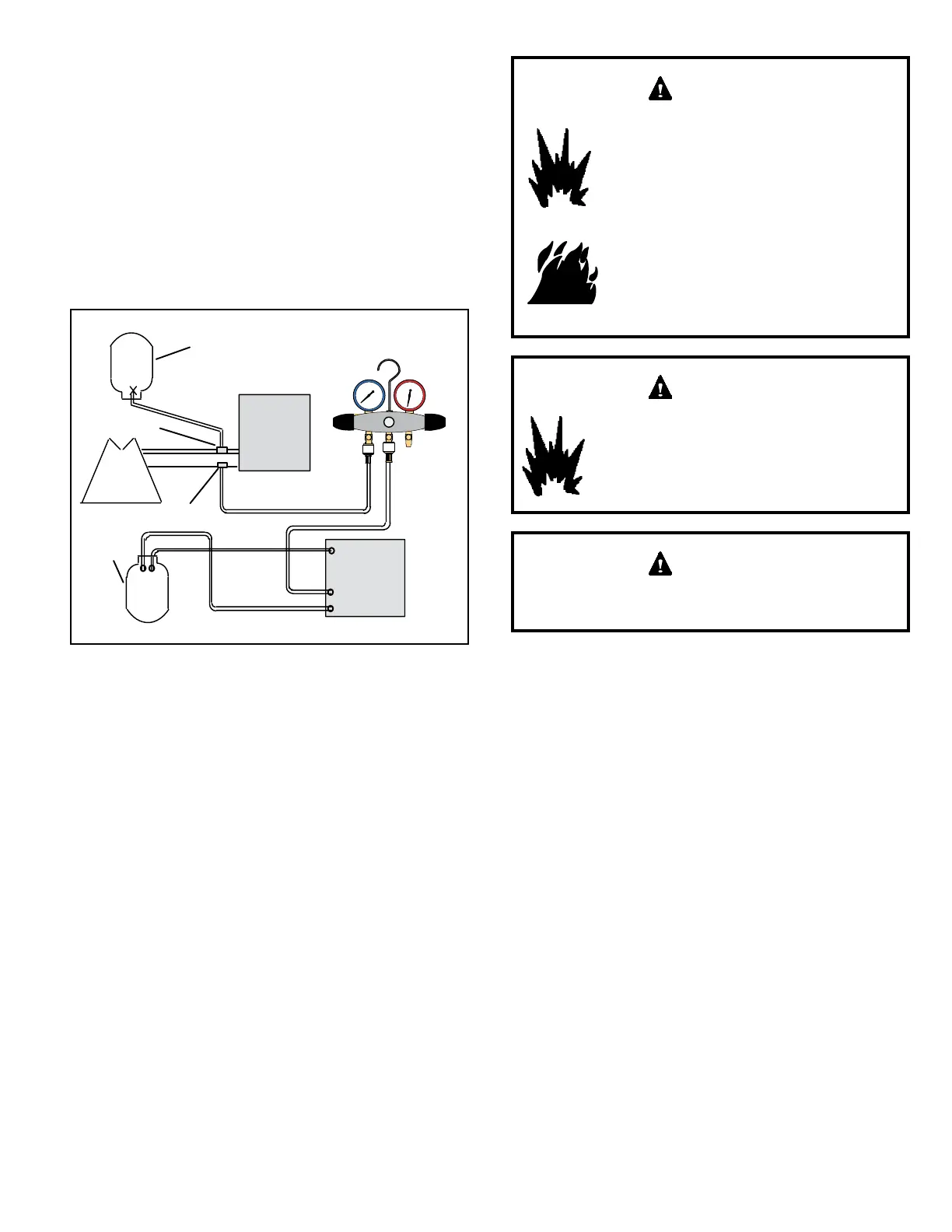
Connect Gauges and Equipment for Flushing
Procedure
LOW HIGH
EXISTING
INDOOR
UNIT
GAUGE
MANIFOLD
CYLINDER CONTAINING
CLEAN R-410A TO BE
USED FOR FLUSHING
(Positioned to deliver liquid
refrigerant)
LIQUID LINE SERVICE
VALVE
INLET
DISCHARGE
TANK
RETURN
CLOSED
OPENED
RECOVERY
CYLINDER
RECOVERY MACHINE
NEW
OUTDOOR
UNIT
VAPOR LINE
SERVICE VALVE
VAPOR
LIQUID
1
1
2
3
4
Figure 5. Connecting Gauges
1. Cylinder with clean R-410A (positioned to deliver liquid
refrigerant) to the vapor service valve.
2. Refrigerant gauge set (low side) to the liquid line valve.
3. Refrigerant gauge set center port to inlet on the
recovery machine with an empty recovery tank
connected to the gauge set.
4. Connect recovery tank to recovery machine per
machine instructions.
Flushing Line Sets
If the unit will be installed in an existing system that uses
an indoor unit or line sets charged with R-22 refrigerant,
installer must perform the following ushing procedure.
NOTE: Existing system components (including line set
and indoor coil) must be an AHRI match with the unit in
order to fulll unit warranty requirements.
Fire, Explosion and Personal Safety
hazard. Failure to follow this warning
could result in damage, personal injury or
death.
Never use oxygen to pressurize or
purge refrigeration lines. Oxygen, when
exposed to a spark or open ame, can
cause re and/or an explosion, that could
result in property damage, personal injury
or death.
WARNING
When using a high pressure gas such as
nitrogen to pressurize a refrigeration or air
conditioning system, use a regulator that can
control the pressure down to 1 or 2 psig (6.9
to 13.8 kPa).
WARNING
Refrigerant must be reclaimed in accordance with
national and local codes.
WARNING
1. Set the recovery machine for liquid recovery and start
the recovery machine. Open the gauge set valves to
allow the recovery machine to pull a vacuum on the
existing system line set and indoor unit coil.
2. Position the cylinder of clean R-410A for delivery of
liquid refrigerant and open its valve to allow liquid
refrigerant to ow into the system through the vapor
line valve. Allow the refrigerant to pass from the
cylinder and through the line set and the indoor unit
coil before it enters the recovery machine.
3. After all of the liquid refrigerant has been recovered,
switch the recovery machine to vapor recovery so
that all of the R-410A vapor is recovered. Allow the
recovery machine to pull the system down to 0.
4. Close the valve on the inverted R-410A drum and the
gauge set valves. Pump the remaining refrigerant out
of the recovery machine and turn the machine o.


 To Next Page