Need help?
Do you have a question about the Alpine MRP-T220 and is the answer not in the manual?
Explains the meaning of warning and caution symbols used in the manual for safe repair.
Details specific safety advice for laser light, wiring, temperature, fuses, batteries, parts, and soldering.
Lists all components included in the product packaging assembly.
Visually guides the correct procedure for packing the amplifier and its accessories.
Provides specific voltage readings for integrated circuits and transistors for diagnostic use.
Comprehensive list of all integrated circuits used in the amplifier.
Detailed listing of all diodes utilized within the amplifier circuitry.
Catalog of all transistors and field-effect transistors used in the amplifier.
Detailed listing of all capacitors used in the amplifier, including types and values.
Detailed listing of all resistors used in the amplifier, including types and values.
Lists LED indicators and various connector assemblies found in the amplifier.
Lists other essential parts like terminals, fuses, and input/output jacks.
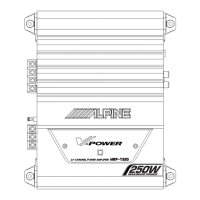
This document outlines the service and maintenance procedures for the Alpine MRP-T220 2/1 Channel Power Amplifier. It serves as a comprehensive guide for technicians, covering everything from basic safety precautions to detailed parts lists and schematic diagrams.
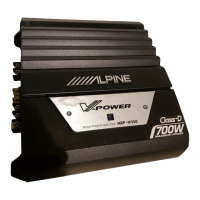
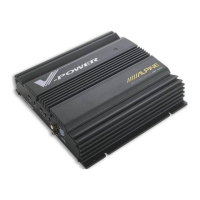
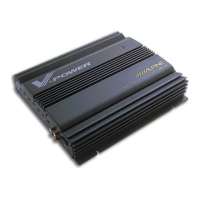
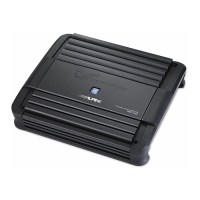
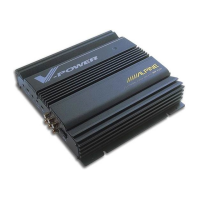
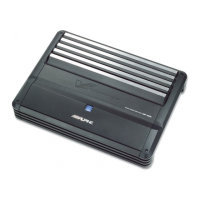
The Alpine MRP-T220 is a robust 2/1 channel power amplifier designed to enhance the audio experience in a vehicle. Its primary function is to amplify audio signals, delivering clear and powerful sound to speakers. The amplifier is capable of operating in both stereo and bridged (BTL) modes, offering flexibility in system configuration. In stereo mode, it provides two amplified channels, ideal for driving a pair of full-range speakers or components. When configured for bridged operation, it combines the power of both channels into a single, more powerful output, making it suitable for driving a subwoofer. This versatility allows users to tailor their audio setup to their specific needs, whether they prioritize a balanced soundstage or deep, impactful bass.
For usage, the amplifier features various input and output connections to integrate seamlessly into an existing car audio system. It includes RCA inputs for line-level signals from a head unit, as well as speaker-level inputs, which are particularly useful for connecting to factory radios that may not have RCA outputs. This broad compatibility ensures that the MRP-T220 can be incorporated into a wide range of vehicles and audio setups. The amplifier also incorporates a gain control, allowing users to match the input sensitivity of the amplifier to the output level of their head unit, preventing distortion and ensuring optimal performance. Bass EQ controls are provided to fine-tune the low-frequency response, enabling users to adjust the bass to their preference. Additionally, the amplifier includes selectable low-pass filter (LPF) and high-pass filter (HPF) functions. These filters are crucial for directing specific frequency ranges to the appropriate speakers. For instance, the LPF can be used to send only low frequencies to a subwoofer, while the HPF can be used to send only mid-range and high frequencies to full-range speakers, thereby improving sound clarity and protecting speakers from damage. A remote turn-on input allows the amplifier to power on and off automatically with the head unit, providing convenient operation.
Maintenance features are extensively detailed in this service manual to ensure the longevity and reliable operation of the MRP-T220. Safety is paramount, and the manual begins with a section on "Cautions for Safe Repair Work," which highlights critical warnings and cautions to prevent accidents, injuries, and damage during servicing. These cautions cover various aspects, such as avoiding direct eye exposure to laser light (though not directly applicable to this amplifier, it's a general caution in Alpine manuals), preventing wiring from being caught in the chassis, using designated fuses, ensuring correct battery polarity, handling hot components like heat sinks, and using only designated replacement parts. The manual emphasizes the importance of following instructions carefully, especially when dealing with electrical components and wiring.
For troubleshooting and repair, the manual provides a "Parts Layout on P.W.Boards and Wiring Diagram," which visually guides technicians through the internal arrangement of components. This is complemented by a "Schematic Diagram" that offers a detailed electrical blueprint of the amplifier's circuitry, showing how each component is connected and functions within the system. A "Terminal Voltage of IC/TR" section provides expected voltage readings at various integrated circuits (ICs) and transistors (TRs), which is invaluable for diagnosing electrical faults. By comparing measured voltages with these reference values, technicians can quickly identify components that are not operating within their normal parameters.
The "Exploded View (Cabinet)" diagram is crucial for disassembling and reassembling the amplifier, showing the order and location of all mechanical parts, such as screws, covers, and brackets. This ensures that the amplifier can be taken apart for repair and put back together correctly without causing further damage. The "Packing Assembly Parts List" and "Cabinet Assembly Parts List" provide comprehensive inventories of all components, including their part numbers and descriptions. This allows technicians to order the correct replacement parts, ensuring compatibility and maintaining the amplifier's original performance specifications. The "Electrical Parts List" further breaks down all electrical components, from ICs and transistors to diodes, coils, thermistors, transformers, switches, capacitors, and resistors, each with its specific part number. This detailed listing is essential for precise component replacement during repairs.
The manual also includes "Measuring Conditions" for terminal voltage checks, specifying the power supply voltage (DC14.4V), the type of measuring meter (Digital Multi Meter), the reference point for measurements (Between GND), and the signal condition (No Signal Input). These standardized conditions ensure consistent and accurate diagnostic readings. Overall, the Alpine MRP-T220 service manual is a thorough resource designed to facilitate effective and safe servicing, ensuring that the amplifier continues to deliver high-quality audio performance throughout its lifespan.
 General
| Channels | 2 |
|---|---|
| Frequency Response | 10 Hz - 50 kHz |
| Signal-to-Noise Ratio | 100 dB |
| THD at Rated Power | 0.08% |
| RMS Power at 4 Ohms | 40 Watts x 2 |
| Input Sensitivity | 0.2V - 4V |
| Crossover | Low Pass / High Pass |

 To Next Page