Poseidon_GB01
Function
C
1
Pump Function
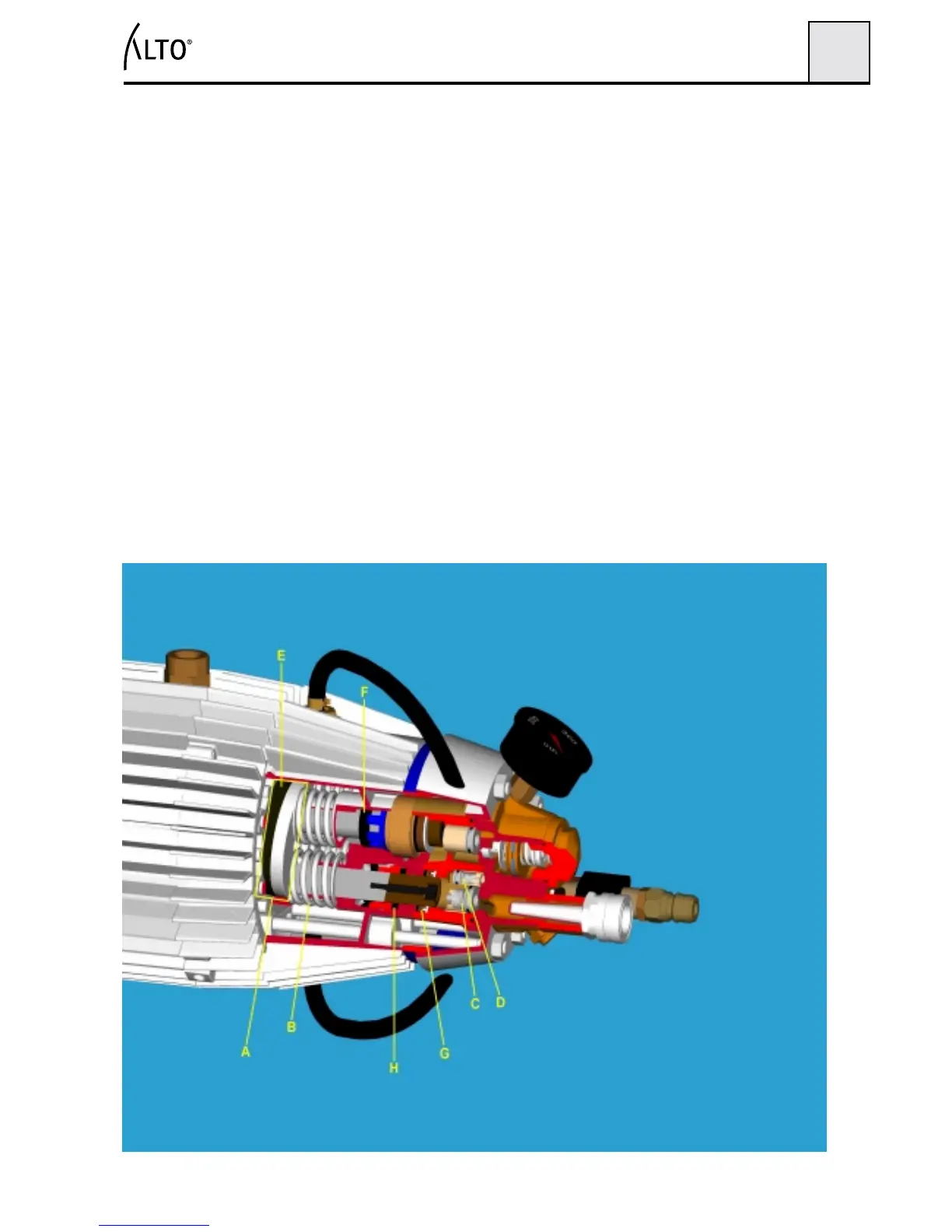
The illustration below shows a cross-section of the Poseidon pump.
The pump’s job is to move a given amount of water from the suction side to the high-pressure nozzle.
The volume of water depends on the pistons’ quantity, diameter, impact length, and number of impacts
per minute.
When wobble disc A is turned, the piston is pulled down with the help of retracting spring B, and water
is sucked through suction valve C.
When the piston rises again, the suction valve closes, and pressure valve D opens.
From here, water is propelled towards the pump’s bypass valve.
Because of the high-pressure nozzle’s small opening, considerable force is needed to move the pistons
forward.
In order to reduce lost friction, the force of the motor is transferred to the pistons via the wobble disc’s
oil-soaked E roller bearings.
The pistons are composed of a stainless steel portion, which is controlled by the cylinder and sealed
with oil sleeve F. The upper portion of the piston is ceramic, the seal on the water side consists of a gasket
system.
At the top is textile sleeve G, which seals out high-pressure. A smaller leakage current passes down
to low-pressure sleeve H, and between these two sleeves, the lubrication is drained back to the suction
side through a small channel.


 To Next Page