Need help?
Do you have a question about the Amkus IC750 and is the answer not in the manual?
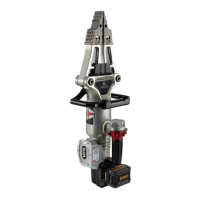
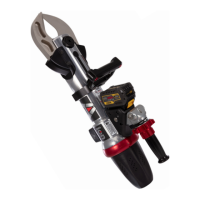
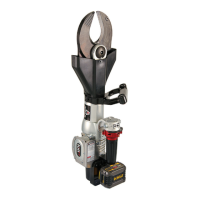
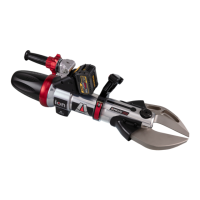
The AMKUS ION battery-powered electro-hydraulic rescue tools are designed for emergency response, offering a complete line of cutters, combi tools, and spreaders. These tools are self-contained, utilizing a brushless direct current (BLDC) motor powered by a 60 Volt battery to drive a high-pressure pump. Hydraulic fluid from the pump passes through a user-operated control valve, moving a piston that actuates the arms or blades of the rescue tool to perform cutting, spreading, squeezing, or lifting operations.
The primary function of AMKUS ION rescue tools is to facilitate extrication in emergency situations. The tools are designed for intermittent use, allowing for sufficient pauses to cool down, especially if the exterior temperature exceeds 120°F (49°C) or the hydraulic oil temperature reaches 158°F (70°C), which can reduce efficiency. Continuous operation against an end stop can lead to overheating and potential damage, so releasing the control valve actuator to the neutral position when an end stop is reached is crucial.
For cutting operations, the blades are opened, placed around the object, and then closed to make the cut. Maximum cutting forces are achieved nearest the pivot point, and cuts should begin with the blades as fully engaged as possible. After the cut, the blades are opened, and the tool is removed. When operating the cutter, users should be positioned to the side, as the tool may rotate or drift when meeting resistance. If rotation creates a hazard, the control valve actuator should be immediately released, returning to neutral and stopping blade movement. The blades are effective for cutting steering columns, brake pedals, door mechanisms, and other vehicle components. However, they are not recommended as piercing tools for heavy metal, and care should be taken to ensure a clear path of travel for the blade tips to avoid obstacles like backing plates, hinges, and latching mechanisms. Cutting hardened metals can dent or deform the blade's edge, potentially leading to breakage on subsequent cuts, especially near the tips. Therefore, cutting hardened solids of unknown strength, such as padlock shackles, tie rods, leaf springs, spindles, hardened bolts, tool steel, or heat-treated chain, should be avoided.
For spreading, squeezing, pulling, and lifting operations, the spreader tips should be positioned to maintain maximum contact with the surfaces to be spread, gripped, or lifted to prevent unstable loads. The object being lifted should always be stabilized. Similar to cutting, the spreader may rotate as it meets resistance, and the control valve actuator should be released immediately if rotation creates a hazard. A new purchase point should then be sought.
The tools feature a power button for activation and deactivation. A quick press and release turn the tool on, indicated by the status LED. Holding the button for one second turns the tool off. The tool automatically powers off after 20 minutes of inactivity.
The ION Cutter and Combi Tools are equipped with a 360° swiveling handle with variable tension. The handle can be rotated by flipping up a red latch on the tool's cuff and then locked into position by flipping the latch down. The tension of the rotating handle can be adjusted by tightening a tension screw.
Dual handle lights operate at three intensity levels (low, medium, high) and can be cycled through by pressing a button behind each light. The lights can be turned off by scrolling through the settings or by a single button press if they have been on for over 5 seconds. A battery saver function turns the lights off after 15 minutes of continuous use.
The control valve actuator has three positions: CLOSE, OFF (neutral), and OPEN. It includes a deadman safety feature that automatically returns the actuator to the OFF position when released, stopping tool movement and holding position and load. The actuator controls the motor and hydraulic pump, with electronics preventing electrical overload.
Battery charge status can be checked using indicator lights on the battery by pushing a status button. The battery management system maintains power until the battery is drained. The battery should be changed if it no longer continuously operates the tool, if only one bar is left on the charge indicator, or if the Status LED indicates "red" for low battery. During operation, the brightness of the Status LED adjusts to indicate the power being applied, with brighter light signifying more power. The LED also communicates tool status, such as "Battery Good" (green), "Battery Low" (red), or "Tool in Error" (yellow), which can indicate temperatures over 125°F (52°C) or under -25°F (32°C), or issues with the actuator or motor.
The ION spreaders use removable tips, including Gator Tip, ERT (Extended Reach Spreader Tips), Combination Gator Tip and ERT, and Combination Offset ERT. Tips are removed by depressing spring-loaded pins and sliding them off, and reinstalled by sliding them back until the pins return to their original positions. Chain kits are available for spreaders, used by securing chains around the load with grab hooks, removing slack with quick adjust links, and tensioning the chain slightly to ensure stable connections. The control valve actuator is then activated to close the arms and draw the load.
Regular inspection and maintenance are crucial for the safe and effective operation of AMKUS ION rescue tools. After every use, the blades, tips, and arms should be visually checked for wear or damage. The tool itself, including operating controls, should be inspected for damage and verified for proper function. Every 8 hours of use, all nuts and bolts should be visually checked and tightened with hand tools to ensure they are secure.
All maintenance, inspection, and cleaning operations should be performed after the battery is removed and the tool has cooled down to avoid injury. The tool should be cleaned and inspected before starting any maintenance work, and annual tool maintenance should be completed regardless of usage hours.
Damaged blades decrease cutting efficiency and can cause the motor to overheat. Worn, cracked, or gouged blades should be replaced. The torque on the cutter and combi tool pivot bolt should be checked monthly, with a proper torque of 120 ft-lbs (163 N-m). The pressure relief valve (PRV) is not user adjustable, and attempts to adjust it can cause damage.
Motor maintenance involves keeping the cooling vents clean and unobstructed to prevent overheating.
Cutter blades, combi blades, spreader arms, links, and pins are lubricated with white lithium grease. Annual re-lubrication is recommended for average service conditions, with more frequent lubrication needed for severe or frequent usage.
The handle lights are powered by CR123A batteries. To replace them, the lid screws at opposite ends of the handle are removed with a 3mm hex key, the old batteries are replaced, and the lid screws are tightened back into position.
Troubleshooting guidelines are provided for malfunctions related to the electric motor and hydraulic system. If the motor does not start, possible reasons include a defective battery, the tool not being turned on, or an uncharged battery. Remedies involve replacing the battery, pressing the power button, or charging the battery. If the electronic motor overheats, the battery may be overheated or cooling vents obstructed; remedies include allowing the battery to cool or cleaning the vents. For hydraulic issues, if the stroke does not begin, the control valve actuator may be damaged, requiring replacement. If the motor does not stop, the battery may be shorted or the control valve actuator stuck; remedies include replacing the battery or blowing out the control valve with air. A discontinuous stroke may indicate a max pressure valve fault, requiring consultation with AMKUS Service Department.
Immediately remove malfunctioning or damaged tools from service and consult a dealer or AMKUS Rescue Systems. All service must be performed by qualified service technicians.
For storage, tools should be kept securely in a clean, cool, dry space. Pressure should be relieved after use, and the battery should be removed and charged. Before returning to service, the tool must be inspected: all markings must be legible, the tool wiped clean, and any contamination decontaminated according to AHJ guidelines. The tool, controls, and battery should be inspected for damage, leakage, and excessive wear. Any tool failing these checks is unsafe and must be repaired before use.
 General
| Power Source | Hydraulic |
|---|---|
| Operating Pressure | 10, 500 psi |
| Max Spreading Force | 75, 000 lbs |
| Spreading Distance | 32 inches |
| Cutting Force | 195, 000 lbs |
| Spreading Force | 75, 000 lbs |

 To Next Page