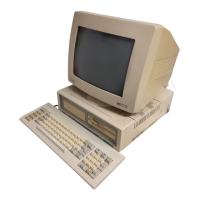
TECHNICAL
SPECIFICATION
KEYBOARD:
74
Keys -
qwerty
style,
numeric
cluster,
cursor
and
copy
cursor,
return, enter, shift, caps, lock, tab, delete, clear, control.
CASSETTE
HANDLING:
Write
speed
software
selectable
- 1K
baud
or
2K baud, read
speed
automatically
established
by
software.
Motor
on/off
controlled
by
software.
POWER
SUPPLY:
Screen
System:
240V
AC
50Hz
(keyboard
and
disc
drive
power
supplied
by
screen
system).
CP/M
usually
assumes
an
80
column
screen
is available. The
CPC6128'sability
to
present
text
in
80
column format is a prerequisite
for
the
majority
of
CP/M
applications.
DIMENSIONS
(mm):
w h d
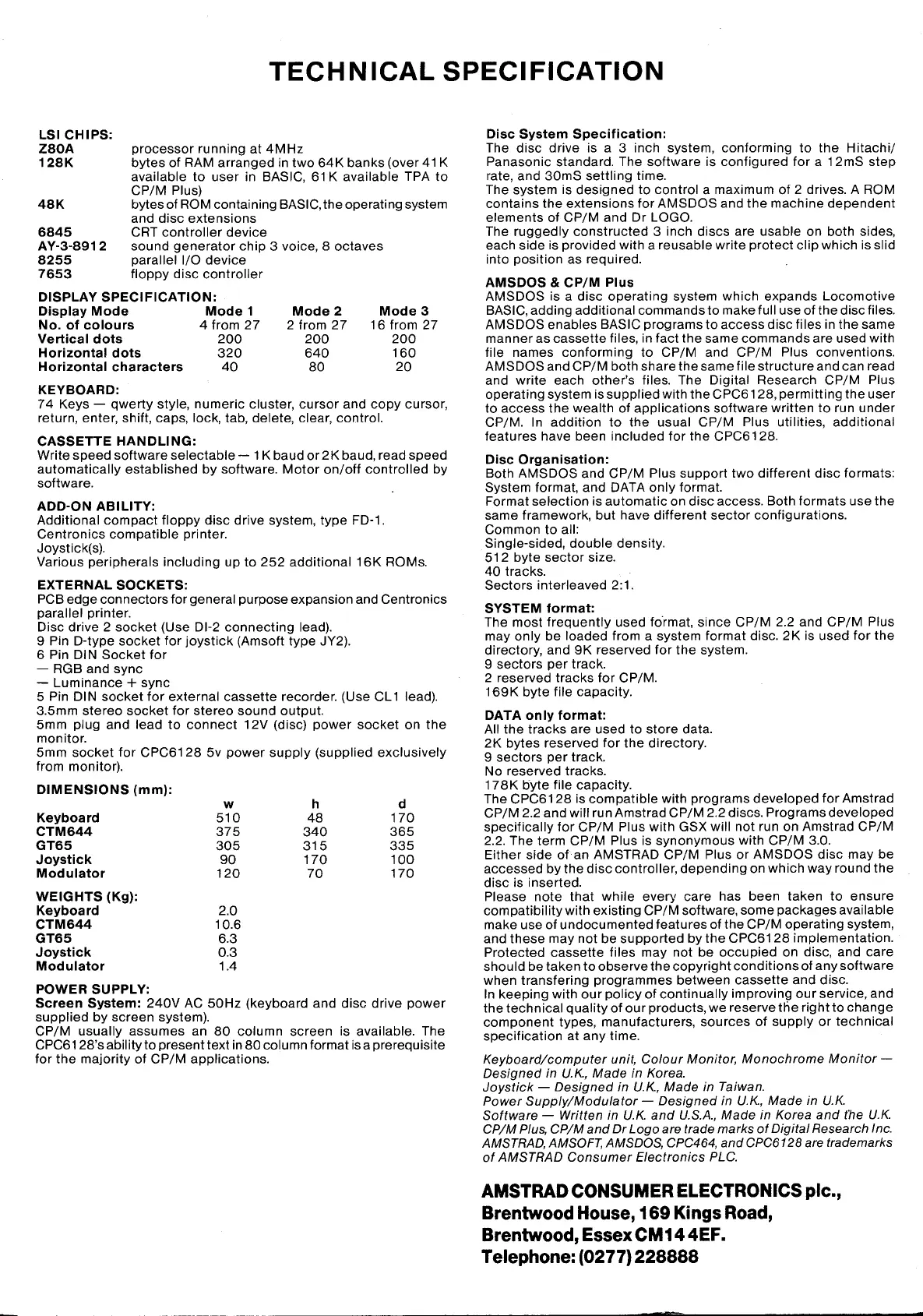
Keyboard
510
48
170
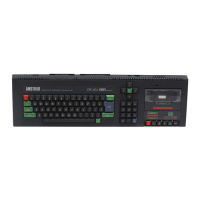
CTM644
375 340 365
GT65
305
315
335
Joystick
90
170 100
Modulator
120
70
170
WEIGHTS
(Kg):
Keyboard
2.0
CTM644
10.6
GT65
6.3
Joystick
0.3
Modulator
1.4
Disc
System
Specification:
The
disc
drive
is a 3 inch system,
conforming
to
the
Hitachi!
Panasonic
standard. The
software
is
configured
for
a
12mS
step
rate,
and
30mS
settling
time.
The
system
is
designed
to
control
a
maximum
of
2 drives. A ROM
contains
the
extensions
for
AMSDOS
and
the
machine
dependent
elements
of
CP/M
and
Dr
LOGO.
The
ruggedly
constructed
3 inch
discs
are usable
on
both sides,
each
side
is
provided
with
a
reusable
write
protect
clip
which
is slid
into
position
as required.
AMSDOS
&
CP/M
Plus
AMSDOS
is a
disc
operating
system
which
expands
Locomotive
BASIC, adding additional
commands
to
make
full use
of
the
disc files.
AMSDOS
enables
BASIC
programs
to
access
disc
files
in
the
same
manner
as
cassette
files, in
fact
the
same
commands
are
used
with
file names
conforming
to
CP/M
and
CP/M
Plus
conventions.
AMSDOS
and
CP/M
both
share
the
same
file
structure
and can read
and
write
each
other's
files. The Digital Research
CP/M
Plus
operating
system is
supplied
with
the
CPC6128,
permitting
the
user
to
access
the
wealth
of
applications
software
written
to
run
under
CP/M. In
addition
to
the
usual
CP/M
Plus utilities,
additional
features
have been
included
for
the
CPC6128.
Disc
Organisation:
Both
AMSDOS
and
CP/M
Plus
support
two
different
disc
formats:
System format, and DATA
only
format.
Format
selection
is
automatic
on
disc
access.
Both
formats
use
the
same
framework,
but
have
different
sector
configurations.
Common
to
all:
Single-sided,
double
density.
51
2
byte
sector
size.
40
tracks.
Sectors
interleaved
2:
1.
SYSTEM
format:
The
most
frequently
used
f6rmat,
since
CP/M
2.2
and
CP/M
Plus
may
only
be loaded from a
system
format
disc.
2K
is
used
for
the
directory, and
9K
reserved
for
the
system.
9
sectors
per
track.
2 reserved
tracks
for
CP/M.
169K
byte
file capacity.
DATA
only
format:
All
the
tracks
are used
to
store
data.
2K
bytes
reserved
for
the
directory.
9
sectors
per
track.
No reserved tracks.
178K
byte
file capacity.
The
CPC6128
is
compatible
with
programs
developed
for
Amstrad
CP/M
2.2 and will run Amstrad
CP/M
2.2 discs.
Programs
developed
specifically
for
CP/M
Plus
with
GSX will
not
run on Amstrad
CP/M
2.2. The term
CP/M
Plus is
synonymous
with
CP/M
3.0.
Either
side
01an
AMSTRAD
CP/M
Plus
or
AMSDOS
disc
may
be
accessed
by
the
disc
controller,
depending
on
which
way
round
the
disc
is inserted.
Please
note
that
while
every
care
has
been
taken
to
ensure
compatibility
with
existing
CP/M
software,
some
packages
available
make use
of
undocumented
features
of
the
CP/M
operating
system,
and
these
may
not
be
supported
by
the
CPC6128
implementation.
Protected
cassette
files
may
not
be
occupied
on disc, and
care
should
be
taken
to
observe
the
copyright
conditions
of
any
software
when
transfering
programmes
between
cassette
and
disc.
In
keeping
with
our
policy
of
continually
improving
our
service,
and
the
technical
quality
of
our
products,
we
reserve
the
right
to
change
component
types,
manufacturers,
sources
of
supply
or
technical
specification
at
any
time.
Keyboard/computer
unit,
Colour
Monitor,
Monochrome
Monitor-
Designed
in UK., Made in Korea.
Joystick
-
Designed
in UK., Made in Taiwan.
Power
Supply/Modulator
-
Designed
in UK., Made in UK.
Software
- Written in UK.
and
US.A., Made in Korea
and
t'he
UK.
CP/M Plus, CP/M
and
Dr
Logoare trade marks
of
Digital Research Inc.
AMSTRAD, AMSOFT, AMSDOS, CPC464,
and
CPC6128 are trademarks
of
AMSTRAD
Consumer
Electronics PLe.
Mode
3
16 from
27
200
160
20
Mode
2
2 from
27
200
640
80
LSI
CHIPS:
Z80A
128K
48K
processor
running
at
4MHz
bytes
of
RAM
arranged
in
two
64K
banks
(over
41
K
available
to
user
in BASIC,
61
K available TPA
to
CP/M
Plus)
bytes
of
ROM containing BASIC,
the
operating system
and
disc
extensions
6845
CRT
controller
device
AY·3·8912
sound
generator
chip
3 voice, 8
octaves
8255
parallel
I/O
device
7653
floppy
disc
controller
DISPLAY
SPECIFICATION:
Display
Mode Mode
1
No.
of
colours
4 from
27
Vertical
dots
200
Horizontal
dots
320
Horizontal
characters
40
ADD-ON
ABILITY:
Additional
compact
floppy
disc
drive system,
type
FD-1.
Centronics
compatible
printer.
Joystick(s).
Various
peripherals
including
up
to
252
additional
16K
ROMs.
EXTERNAL
SOCKETS:
PCB
edge
connectors
for
general purpose expansion and Centronics
parallel printer.
Disc
drive
2
socket
(Use DI-2
connecting
lead).
9 Pin D-type
socket
for
joystick
(Am
soft
type
JY2).
6 Pin DIN
Socket
for
- RGB and
sync
-
Luminance
+
sync
5 Pin DIN
socket
for
external
cassette
recorder. (Use
CL
1 lead).
3.5mm
stereo
socket
for
stereo
sound
output.
5mm
plug
and
lead
to
connect
12V
(disc)
power
socket
on
the
monitor.
5mm
socket
for
CPC6128
5v
power
supply
(supplied
exclusively
from monitor).
AMSTRAD
CONSUMER ELECTRONICS pic.,
Brentwood House, 169
Kings
Road,
Brentwood,
Essex
CM144EF.
Telephone: (0277) 228888



 To Previous Page