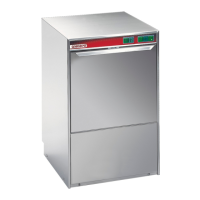
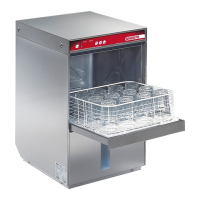
This document provides comprehensive instructions for the installation, use, and maintenance of a commercial dishwasher, ensuring its long life and correct operation. It is designed for both installers and end-users, covering various aspects from initial setup to troubleshooting.
Function Description
The appliance is a commercial dishwasher designed exclusively for washing plates, glasses, and general crockery with food residuals. It is not intended for washing unspecified items, overly fragile items, or those unable to withstand the washing process. The dishwasher operates through wash and rinse cycles, with options for hot or cold rinsing depending on the model. It can be equipped with a water softener and detergent/rinse aid dispensers for optimal cleaning performance.
Important Technical Specifications
- Water Supply Pressure:
- Static Pressure: 250-400 kPa
- Dynamic Pressure: 200-350 kPa
- If dynamic pressure is less than 200 kPa, a pressure pump is required.
- If water supply pressure exceeds 400 kPa, a pressure reducing device must be installed.
- Water Hardness:
- Recommended: 2°f - 10°f
- For hardness greater than 10°f, a water softener must be used.
- Water Supply Temperature:
- Cold H₂O (Machine upon request): 5°C ≤ t < 50°C
- Hot H₂O (Standard Machine from catalogue): 50°C ≤ t ≤ 60°C
- Operating Temperature:
- Minimum room temperature: 10°C
- Recommended wash cycle temperature (tub): 55°C
- Recommended rinse cycle temperature (boiler): 85-90°C
- Machines with boiler inside the washing tub: 75-80°C
- Rinse Aid Dispenser:
- Adjustable from 0 to 4 cc per rinse cycle.
- Each turn of the adjustment screw varies the product drawn by 1.6 cm (0.2 cm³/turn or 0.21g/turn with 1.05 g/cm³ concentration).
- Cannot function properly if the level difference between machine bottom and container exceeds 80 cm.
- Detergent Dispenser:
- Adjustable using a screwdriver.
- Every 2 cm of product drawn into the tube corresponds to 0.25 cm³ (0.3 g with 1.2g/cm³ concentration).
- Electrical Connection: Must comply with current technical standards, including a suitable omnipolar thermal magnetic circuit breaker (at least 3 mm contact opening) and proper earthing.
Usage Features
- Control Panel: Features a main switch (0-1), START button, supplementary cold rinse button, regeneration START button (optional), manual empty button (optional), and wash type selector (if provided). Indicators include power on, tub full, washing cycle, regeneration cycle, and temperature.
- Operation Sequence:
- Insert overflow tube and ensure filter is correctly fitted.
- Close the dishwasher door.
- Insert rinse aid dispenser tube into liquid container and check quantity.
- Turn on water tap.
- Turn main switch to position 1.
- Machine fills with water; heating begins when tub is full.
- Insert dishrack with plates correctly placed.
- Select wash cycle (if applicable).
- Add liquid detergent to the tub and press START button.
- Hot rinse cycle follows wash cycle.
- For cold rinse (if equipped), press and hold selector 3 after indicator C turns off.
- Appliance is ready for a new wash.
- At the end of the day, clean the machine and turn off water tap and main switch.
- Detergent Use: Only non-foaming liquid detergents suitable for industrial glass-washers and dishwashers should be used. The correct amount depends on water hardness and is suggested by the product manufacturer. An electric detergent dispenser is recommended.
- Rinse Aid Use: The machine automatically draws rinse aid. The amount can be adjusted via a fine-adjustment screw. Reducing the amount is achieved by turning clockwise, increasing by turning anticlockwise. Recommended amount is 2-5 cm measured on the suction tube.
- Regeneration Device (Optional): For water softeners, resin regeneration is crucial. The frequency depends on water hardness (e.g., 27°f = 39 cycles). To perform regeneration:
- Turn main switch to 0.
- Remove overflow tube and empty tub.
- Replenish coarse salt (1-2 mm grains) in the special container inside the tub, avoiding spills.
- Close door and press button 4 for a few seconds until the regeneration device releases. The indicator light (d) will come on for approx. 20 minutes, then turn off when complete.
- Hygiene Regulations (H.A.C.C.P.):
- Wait for temperature indicator to light up before starting next cycle.
- Scrape food from dishes to prevent filter/nozzle clogging.
- Unload tub and clean filters at least twice daily.
- Check detergent and rinse aid levels daily.
- Clean dish support floor.
- Remove rack with clean hands/gloves.
- Do not dry/polish dishes with non-sterilized cloths/brushes/dusters.
Maintenance Features
- Regular Maintenance (Daily):
- Turn main switch to 0 and turn off water tap.
- Remove overflow tube to empty water (or press button 5 for emptying pump models).
- Remove and clean filter with a brush under running water.
- Loosen screws, remove rotors, and thoroughly clean nozzles and washing/rinsing arms.
- Reassemble all parts.
- Clean tub thoroughly with specific products.
- Leave dishwasher door open at end of day.
- Replace tub water at least every 20 wash cycles or twice daily.
- Warning: Do not use pressure cleaning systems, bleach, chlorine-based detergents, metal brushes, or corrosive products.
- Special Maintenance (Annually/Bi-annually): A qualified technician should inspect the machine to:
- Clean electrovalve filter.
- Remove residual deposits.
- Check piston seal holding capacity.
- Check component condition/wear.
- Check dispenser operation.
- Troubleshooting: A detailed table is provided for common problems, possible causes, and solutions, covering issues like the machine not turning on, insufficient washing results, poor drying, streaks/stains, and machine stopping during operation. For other problems, contact Technical Assistance.
Environmental Features
- Packing: Consists of wood pallet, nylon bag (LDPE), multi-layered cardboard, polyurethane foam (PS), and polypropylene support (PP). Dispose of in accordance with environmental regulations.
- Disposal: The WEEE Symbol indicates separate collection for electric and electronic appliances. Do not dispose of as domestic waste. Disconnect electrical and water supply, cut electrical cable. All metal parts (stainless steel) and plastic parts (marked with symbol) are recyclable.
- Ecological Recommendations:
- Salt Dispensing: Observe recommended regeneration cycles to avoid spills/lime deposits.
- Full Capacity Operation: Operate at full capacity to avoid waste of energy, water, detergent, and rinse aid.
- Detergents and Rinse Aids: Use highly biodegradable products. Check correct amounts based on water hardness annually.
- Temperature: Tub and boiler temperatures are factory-set for optimal results but can be re-set by installer.
- Food Removal: Scrape food from dishes carefully using lukewarm water. Soaking in hot water is recommended for caked-on material.
- Timely Washing: Wash dishes as soon as possible to prevent hardening of deposits.
- Regular Cleaning: Regular cleaning and maintenance are essential for effective washing.
Failure to comply with these instructions may invalidate the product warranty and relieve the manufacturer of responsibility.

 Need help?
 General

 To Next Page