Need help?
Do you have a question about the Antelope ORION STUDIO Synergy Core and is the answer not in the manual?
Explains Thunderbolt 3 daisy chaining rules and device limits.
Details the ability of the Thunderbolt 3 port to charge Type-C devices.
Manages connected devices, showing name, bundle version, and device info.
Launch the Control Panel application or set it to autorun.
Troubleshoot device connection issues using the Add Drivers wizard.
Install, update, and uninstall Antelope Audio software like mic emulations and AFX2DAW.
Manage Manager Server, USB, and Thunderbolt drivers; restart server and manage connections.
Configure updates, view logs, and manage automatic update settings for device firmware and drivers.
Toggles device power between On and Standby states.
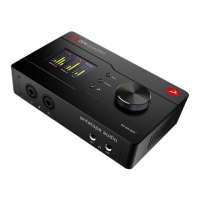
Four Class-A preamps with phantom power on combo XLR inputs, switchable Mic/Line/Hi-Z/Direct.
Activates the built-in talkback microphone for routing to headphones or monitors.
Large-stepped attenuator for gain and menu navigation; modes: turn, press, press-and-hold.
Controls gain for preamps, and volume for headphones and monitor outputs A/B.
Shows peak metering, menu options, and firmware update progress.
Three buttons with different functionalities: view gain, clock/sample rate, or enter System Menu.
Navigate System Menu using rotary control; options include Comm. Interface, Device Info, Screensaver settings.
Access Control Menu via Middle button; navigate options like Clock Source, Sample Rate, SR Conversion, Peak Meter, Monitor Trim.
Load up to five presets with session parameters and device settings.
Two independent stereo headphone outputs on 1/4-inch TRS jacks.
Direct outputs for re-amping DI tracks with guitar amplifiers or as Sends.
Connects the unit to the AC power supply unit.
USB 2.0 Type-B port supporting up to 24 I/O audio channels.
Thunderbolt™ 3 Type-C port supporting up to 32 I/O audio channels.
2 inputs and 2 outputs for up to 16 I/O audio channels via Toslink fiber optic cables.
Two DB-25 connectors for 16 audio channels (8 per connector), TASCAM Standard Pin Layout.
Two pairs of assignable unbalanced stereo outputs (L/R) on 1/4-inch TRS jacks.
75ohm S/PDIF connectors for compatible equipment over coaxial RCA cables.
BNC connector to output Word Clock reference signal.
8 Class-A mic discrete ultra-linear preamps with phantom power on combo XLR connectors.
Two 1/4" TRS inserts (I1 & I2) for integrating external analog equipment.
Connect external gear via Y-cables to AD Inserts for Send/Return functionality.
Route incoming audio from a preamp to headphones via HP Output 1.
Run audio through FX chains and monitor through studio monitors.
Connect guitar, select Hi-Z input, route through amp/cab FX to monitors.
Connect mic, use emulations, and monitor live with headphones.
Explains items in the Function Strip: Power Button, Clock Source, Sample Rate, Settings, Minimize/Close buttons.
Details the Preamp, ADAT IN, S/PDIF IN, Monitors/Headphones, Session, and Admin tabs.
Details controls for the 12 preamp/combo inputs: Input type, Gain, Meter, Mic Emulations, 48V, Phase, Text Label.
Adjusts input gain, shows signal strength, and indicates clipping.
Accesses mic emulations and enables/disables phantom power.
Information on Hi-Z inputs, Direct option benefits, and dynamic range improvements.
Controls for 16 ADAT digital audio inputs, including gain and signal meters.
Controls for 2 S/PDIF digital audio inputs, including gain and signal meters.
Controls for monitor outputs, headphone outputs, and the integrated Talkback microphone.
Dim, Mute, Mono buttons for monitor outputs; adjust gain and activate/deactivate outputs A/B.
Configure talkback input, adjust volume, activate/deactivate, and route to outputs.
Dim, Mute, Mono buttons for headphone outputs; adjust output gain for outputs 1 and 2.
Save and load projects, choose components, export/import session files.
Save and load hardware presets into chosen slots.
Provides links for troubleshooting, tech support, online manual, and launching the Registration Wizard.
Manage analog and digital audio routing using the row-based Routing Matrix.
Explains rows like PREAMP, EMU MIC, COMP PLAY, ADAT IN, S/PDIF IN, AFX OUT.
Explains rows like LINE OUT, HP1, HP2, MONITOR A/B, REAMP, COMP REC, ADAT OUT, S/PDIF OUT, AFX IN.
Discusses limitations like no grouping/sub-mixing, no volume automation, and no MIDI control.
Details parameters like Richness, Reverb Time, Room Size, Reverb Level, and BP/ON Switch.
Route audio to AFX IN, use Link buttons, DEL ALL, ADD NEW EFFECT, SAVE/LOAD, BP/DEL buttons.
Lists 50 Synergy Core FX, including Mic Preamps, Guitar Amps, Cabinets, Compressors, Limiters, EQs, Reverbs, and Utility Effects.
Suite of 11 guitar amps and matching cabinets for monitoring and recording electric guitar.
Includes 6 vintage compressor/limiter models.
Includes 13 vintage equalizer models.
Includes AuraVerb and 4 utility effects (Compressor, Expander, Gate, De-Esser).
Connect guitar, select Hi-Z input, route through amp/cab FX to monitors.
Adjust cabinet model, mics, virtual mic positioning, and use ReSPiRe, HPF, LPF, BP buttons.
Route AFX OUT to COMP REC for recording in DAW, disable cab sim to use custom IRs.
Connect REAMP outputs, assign DIs to outputs, route to COMP PLAY, then COMP REC.
Re-amp DI guitar tracks using Synergy Core amps & cabs via DAW and Control Panel.
Install emulations via Launcher, access via 'Mic' symbol in PREAMPS tab.
Connect mic, calibrate gain, activate 48V phantom power.
Select emulations, phase, phantom power, channel swap, and polar patterns.
Functionality for selecting emulations, phase, and phantom power.
Route PREAMP/EMU MIC outputs to monitor/record dry and mic emulation audio.
Select emulations, phase, phantom power, channel swap, and polar patterns.
Handle multiple signals (dry/emulation) from front/rear membranes for monitoring and recording.
Options for connecting as single/dual-membrane mic using XLRs from Top/Bottom heads.
Apply two different mic emulations and polar patterns simultaneously to each head.
Handle eight concurrent mono tracks (dry/emulation) from four membranes for extensive routing.
Select emulations, phase, and phantom power for the Verge microphone.
Route PREAMP/EMU MIC outputs to monitor/record dry and mic emulation audio.
Claim code, install AFX2DAW via Launcher, register device.
Load AFX2DAW on tracks, choose effects, save/load FX chains, adjust parameters.
Routing tab shows AFX2DAW button; window for setting FPS refresh rate for peak meter animations.
Configure unit as Master clock for other devices via Word Clock Out.
Utilize DC-coupled analog I/O for sending/receiving Control Voltage commands to modular synths.
Route I/O channels to COMP REC row in Control Panel, then set up Ableton Live project.
Links to Antelope Audio YouTube channel for tutorials and endorser content.
Interact with users and employees; not a direct support channel.
Source of troubleshooting, FAQs, and Antelope know-how.
Explains RMA number purpose and how to obtain one for factory service or repair.
Details required information and packaging for returning products for repair.
Specifies warranty period (1 year) for defects in material and workmanship.
Covers B-stock, factory refurbished, or open box products for 6 months.
Outlines remedies: repair, replacement, or refund at Antelope Audio's discretion.
Policy for repairing or replacing obsolete or discontinued products.
Lists conditions not covered by warranty (wear, abuse, unauthorized repair, improper use, etc.).
States Antelope Audio's liability limits for special, incidental, indirect, or consequential damages.
Antelope Audio is not responsible for backing up or recovering data lost from storage devices.
Explains how to make a warranty claim through the point of purchase or directly to Antelope Audio.
Instructions for returning products, including obtaining an RMA# and shipping details.
Steps to obtain an RMA number via online claim or email for end-users and B2B customers.
Details on return addresses, packaging, and responsibility for lost/damaged products during transit.
Avoid water/liquids, handle cables with dry hands, ensure proper ventilation, disconnect power before servicing.
Provides EIN, Dynamic Range, THD, Max input, and Max Gain for mic preamps.
Details dynamic range and THD+N for D/A Monitor, A/D, and D/A Converters.
Specifies digital inputs (ADAT, S/PDIF) and digital outputs (ADAT, S/PDIF).
Details USB 2.0 I/O, Thunderbolt™ 3, Word Clock Input/Output specifications.
Details clocking system (Acoustically Focused Clocking, DDS), stability, aging, and calibration.
Lists supported sample rates: 32, 44.1, 48, 88.2, 96, 176.4, 192 kHz.
 General
| Mic Preamps | 12 |
|---|---|
| Connectivity | Thunderbolt 3, USB 2.0 |
| Type | Audio Interface |
| Phantom Power | Yes |
| MIDI I/O | Yes |
| Microphone Preamps | 12 |
| DSP Processing | Yes |
| Headphone Outputs | 2 |
| Preamps | 12 |
| Outputs | 16 analog, 8 digital |
| Thunderbolt | Yes |
| USB | USB 2.0 |
| DSP | Yes |
| Digital I/O | ADAT, S/PDIF |
| FPGA Processing | Yes |
| DSP Effects | Yes |
| Compatibility | Mac, Windows |

 To Next Page