7
Important: Before using the unit, and after each time
the cylinder is removed and reattached,
check the hose for wear (see a.) and check
DOOFRQQHFWLRQVIRUOHDNV7XUQRႇWKHXQLW
valves and open the main cylinder valve,
then check connections with soapy water.
Repair any leaks before lighting the unit.
CAUTION: Always turn the propane cylinder main valve
RႇDIWHUHDFKXVHDQGEHIRUHPRYLQJWKHXQLW
and cylinder or disconnecting the coupling.
This valve must remain closed and the
cylinder disconnected while the appliance
LV QRW LQ XVH HYHQ WKRXJK WKHJDVÀRZLV
stopped by a safety feature when the coupler
is disconnected.
Carefully inspect the hose assembly each time before the
gas is turned on. A cracked or frayed hose must be replaced
immediately.
If the appliance is stored indoors, the cylinder must be
disconnected and removed. Disconnected cylinders must be
stored outdoors, out of the reach of children, with threaded
valve plugs tightly installed, and must not be stored in a
building, garage, or any other enclosed area.
FOR YOUR SAFETY
a. DO NOT store a spare propane-gas cylinder under or
near this appliance.
b. 1(9(5¿OOWKHF\OLQGHUEH\RQGSHUFHQWIXOO
c. IF THE INFORMATION IN a. AND b. IS NOT
FOLLOWED EXACTLY, A FIRE CAUSING DEATH
OR SERIOUS INJURY MAY OCCUR.
IMPORTANT FOR YOUR SAFETY
READ AND FOLLOW ALL WARNINGS PROVIDED WITH THE PROPANE-GAS CYLINDER.
When operating this appliance with a propane-gas cylinder, these instructions and warnings MUST be observed.
FAILURE TO DO SO MAY RESULT IN A SERIOUS FIRE OR EXPLOSION.
CYLINDER/CONNECTOR REQUIREMENTS
a. Propane-gas cylinders, valves, and hoses must be
maintained in good condition and inspected before each
use of appliance. They must be replaced if there is any
visible damage. If hose is cut or shows excessive abrasion
or wear, it must be replaced before using appliance (see
e.).
b. This unit, when used with a cylinder, should be connected
WR D VWDQGDUG JDOORQ OE SURSDQHJDV F\OLQGHU
HTXLSSHGZLWKDOLVWHGRYHU¿OOLQJSUHYHQWLRQGHYLFH7KH
device has been required on all cylinders sold since
2FWREHUWRSUHYHQWRYHU¿OOLQJ
c. &\OLQGHUGLPHQVLRQVVKRXOGEHDSSUR[LPDWHO\
FPLQGLDPHWHUDQGFPKLJK&\OLQGHUVPXVW
be constructed and marked in accordance with the U.S.
Department of Transportation (D.O.T.) 6SHFL¿FDWLRQV
IRU /3*DV &\OLQGHUV or the Standard for&\OLQGHUV
6SKHUHV DQG 7XEHV IRU 7UDQVSRUWDWLRQ RI 'DQJHURXV
*RRGVDQG&RPPLVVLRQ CAN/CSA-B339, as applicable.
d. The cylinder used must include a collar to protect the
cylinder valve. The cylinder supply system must be
DUUDQJHGIRUYDSRUZLWKGUDZDO6HHIROORZLQJ¿JXUHV
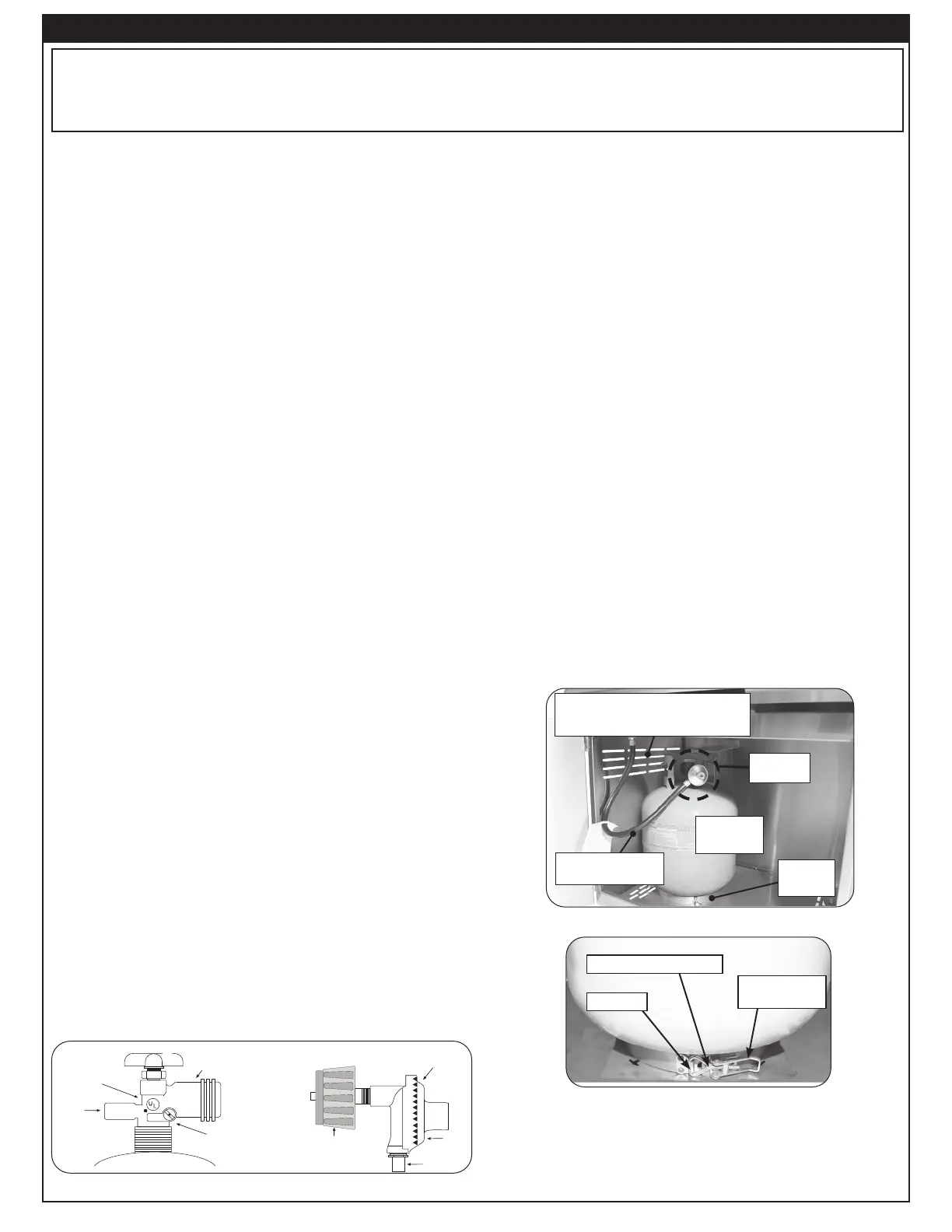
e. The pressure regulator and hose assembly (Fig. 7-1)
VXSSOLHG with this outdoor gas appliance (L.P. models
only) must be used. Original and replacement pressure
UHJXODWRUDQGKRVHDVVHPEOLHVPXVWEHWKRVHVSHFL¿HGE\
the manufacturer for connection with a cylinder connecting
GHYLFHLGHQWL¿HGDV7\SH,E\WKH$16,=&*$
(see PARTS LIST for ordering information).
f. The propane-gas cylinder valve must be equipped with
a cylinder connection device, described as Type I in the
VWDQGDUGGH¿QHGLQSDUDJUDSKe. above. This device is
commonly described as an Acme thread coupler.
g. If the cylinder comes with a dust plug, place it on the
cylinder valve outlet whenever the cylinder is not in use.
Only install the type of dust cap on the cylinder valve
outlet that is provided with the cylinder valve. Other types
of caps or plugs may result in leakage of propane.
COUPLER OPERATION
To connect the regulator/hose assembly to the propane-
JDVF\OLQGHUYDOYH¿WWLQJ Press the hand nut on the regulator
RYHUWKH$FPHWKUHDG¿WWLQJRQWKHF\OLQGHUYDOYH7XUQWKH
hand nut clockwise to engage the threads and tighten until
snug. The use of pliers or a wrench should not be necessary.
Only cylinders marked “propane” may be used.
To disconnect: Turn the hand nut counterclockwise until
detached (Fig. 7-1).
Pressure
relief
valve
QCC
Type 1
valve
Brass Acme
WKUHDG¿WWLQJ
Liquid level
indicator
(optional)
Hand nut with Acme
thread
Regulator
Vent
Hose
Hand wheel
(point toward
vent openings)
Fig. 7-1 Type I Acme thread coupler
Hook the round end of the pull-latch-screw over the bracket
(found on collar of tray).Then snap the pull-latch-handle
closed. Ensure the collar is securely holding the cylinder
in place. (If needed the pull-latch-screw can be adjusted
to tighten or loosen the collar.)
Bracket
Pull-latch-screw
Pull-latch-
handle
Fig. 7-2 Place and connect cylinder
Holder
tray
Connect
here
Fig. 7-3 Secure cylinder:
L.P.
cylinder
L.P. regulator
hose assembly
Ventilation louvers
(point pressure relief valve
toward for vapor withdrawal)
SAFE USE & MAINTENANCE OF PROPANE GAS CYLINDERS


 To Next Page