EasyManua.ls Logo

Apple Lisa - Serial Interfaces

Apple Lisa
79 pages
Print Icon
To Next Page IconTo Next Page
To Previous Page IconTo Previous Page
Loading...
Confidential
Lisa
Hardware Reference Manual
THE
SERIAL
INTERFACES
The
Lisa
has
two
built-in
RS232-C
serial
communication
ports.
Both
ports
can
support
local
asynchronous commnuications
at
speeds
up
to
19.2
Kbaud. In
addition,
port
1 conforms
to
RS232-C
type D
specifications,
permitting
full
modem
control
with
either
synchronous
or
asynchronous
protocols.
The
serial
logic
is
implemented
with
a
NEC
7201
dual
channel
communication
interface.
Refer
to
the
7201
data
sheet
for
complete
information
about
the
operation
of
the
chip.
Note
that
autovectors
are
used so you
do
not
need
to
program
the
7201
to
supply
the
interrupt
vectors.
The
7201
has
neither
an
internal
baud
rate
generator,
nor
a Ring
Indicator
input.
The
baud
rate
generator
is
provided
by
the
serial
interface.
The
Ring
Indicator
input
is
brought
into
the
channel B
DCD
(Data
Carrier
Detect)
line
where
it
must
be
decoded
by
software.
The
DCD
line
can
be
programmed
to
produce an
interrupt
whenever
there
is
a
transition
on
that
line.
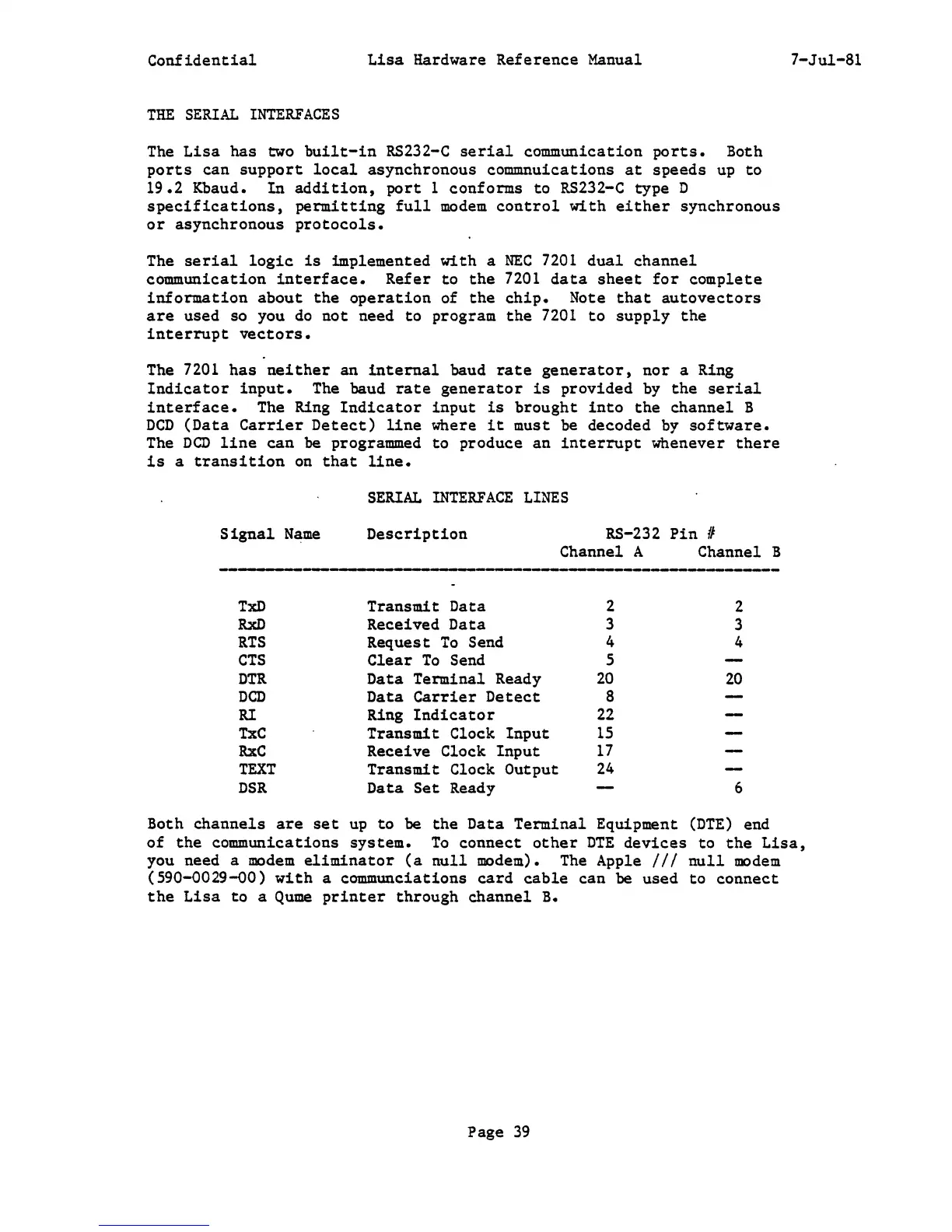
SERIAL
INTERFACE
LINES
Signal
Name
Description
RS-232
Pin
II
Channel A Channel B
,
________
___________________
n
____________________
,_
••
___________
_
TxD
RxD
RTS
CTS
DTR
DCD
RI
!xC
RxC
TEXT
DSR
Transmit Data
Received Data
Reques t
To
Send
Clear
To
Send
Data Terminal Ready
Data
Carrier
Detect
Ring
Indicator
Transmit Clock
Input
Receive Clock
Input
Transmit Clock Output
Data
Set
Ready
2
3
4
5
20
8
22
15
17
24
2
3
4
20
6
Both
channels
are
set
up
to
be
the
Data Terminal Equipment
(DTE)
end
7-Jul-81
of
the
communications system.
To
connect
other
DTE
devices
to
the
Lisa,
you need a
modem
eliminator
(a
null
modem).
The
Apple
II/
null
modem
(590-0029-00)
with
a communciations
card
cable
can
be
used
to
connect
the
Lisa
to
a
Qume
printer
through
channel
B.
Page
39

Related product manuals