Need help?
Do you have a question about the Aprilaire 700M and is the answer not in the manual?
Compares evaporative and steam humidifiers and their suitability for different applications.
A table guiding the selection based on home size and other variables.
Provides a chart to determine humidity needs based on square footage and structure tightness.
A table showing recommended indoor RH based on outdoor temperatures to prevent damage.
Explains Aprilaire's automatic control that adjusts humidity based on outdoor conditions.
Details features like displaying current RH, system status, and replacement indicators.
Lists advantages like easy maintenance, long life, simple installation, and convenience.
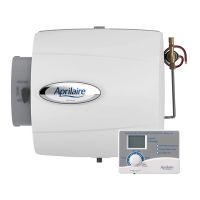
Provides a chart of Aprilaire evaporative humidifier models, sizes, capacities, and electrical data.
Highlights the ease of replacing a canister annually for maintenance.
Details the steam output (gpd) based on voltage and electrical draw.
Describes the dispersion tube used to distribute steam into the airstream effectively.
The Aprilaire Humidifier Application Reference Guide provides comprehensive information on Aprilaire whole-home humidifiers, designed to enhance indoor comfort and health. Humidification is the process of adding moisture to the air, which, when properly controlled, offers numerous benefits. It helps protect homes and furnishings from the damaging effects of dry air, guards against dry skin, hair, and scratchy throats, and reduces winter-time static electricity.
Relative humidity (RH) indicates the percentage of water vapor in the air compared to the maximum amount it can hold at the same conditions. Warmer air can hold more moisture. For instance, air heated to 70°F with only two grains of moisture per cubic foot has an RH of 25%, meaning it could hold four times as much water. Heating outdoor air significantly reduces its RH indoors, as illustrated by the outdoor-indoor RH conversion chart. For example, if outdoor RH is 70% and the outdoor temperature is +10°F, heating this air to 70°F indoors will cause the RH to drop to 6%. This substantial reduction in RH occurs in every unhumidified or under-humidified home during the heating season. To counteract this, humidifiers artificially add moisture, allowing the air to hold more water and improving overall indoor comfort and health.
The benefits of proper humidification can be grouped into four general classifications: comfort, health, preservation, and energy conservation.
Comfort: Dry air can make you feel chilly even at normal room temperatures due to evaporative cooling from your skin. Maintaining proper RH levels allows you to feel more comfortable at lower thermostat settings. Dry air also causes static electricity, which proper RH levels can reduce. Aprilaire automatic humidifiers can achieve optimum RH levels without constant manual adjustment.
Health: Low humidity can increase susceptibility to colds and flu viruses by drying out nasal membranes, making them prone to bleeding and infections. Medical professionals recommend maintaining an indoor RH of 35-40% for a healthier and more comfortable environment. The nasal mucus, which is 95% water, becomes more viscous with slight drying, interfering with the work of cilia. Experience shows that dry-nose patients appear when indoor RH falls to 25%, suggesting 40% as an ideal target.
Preservation: The moisture content of materials like wood, leather, paper, and cloth varies greatly with the surrounding RH. Rapid water loss can cause warping and cracking. For example, a cubic foot of wood holding over 3 pints of water at 60% RH will hold less than one pint at 10% RH, effectively withdrawing 2.5 pints of water. This constant change in moisture content affects furniture (glue dries out, joints separate), plaster and drywall (cracks, popping nail heads), joists and studs (shrink), wood paneling (separates, cracks), and floors (separate). Musical instruments can lose their tone, and art, books, and documents can dry out and break. Proper RH control is essential to prevent these issues.
Energy Conservation: Dry air makes you feel colder, leading to higher thermostat settings. It also shrinks wood framing around doors and windows, creating gaps that allow cold outside air to infiltrate, reducing energy efficiency. Studies suggest that approximately 74% of a home's infiltration occurs at the envelope (perimeter walls, windows, and doors). Maintaining proper indoor RH reduces shrinkage of framing, thereby reducing cracks and infiltration, and increasing energy conservation.
Aprilaire humidifiers are classified into two general types: evaporative-type units and steam-type units. When selecting a whole-home system, key criteria include capacity, control, operational efficiency, ease of maintenance, and ease of installation.
Capacity: The average home needs about eleven gallons of water per day. Aprilaire offers models producing up to eighteen gallons per day (Evaporative Units) and over twenty-three gallons per day (Steam-Type Units). The humidifier sizing chart helps determine the humidity needed (GPD per AHRI) based on structure tightness (tight, average, loose) and square footage (1000 ft² to 5000 ft²). Internal moisture sources from a typical family of four (2.0 gallons per day from cooking, showering, and breathing) can be subtracted from the total humidification load.
Control: Aprilaire humidifiers offer both manual and automatic control. The newest generation automatically adjusts up to 45 times per day based on outdoor temperatures and indoor humidity levels to provide optimum indoor RH. The Aprilaire Automatic Humidifier Control monitors outdoor temperature and adjusts the humidifier to provide the optimum RH level, delivering up to 50% more moisture than other humidifiers. This "set-it-and-forget-it" control ensures consistent humidity levels without manual adjustments.
The digital control provides accuracy and information:
Operational Efficiency: Aprilaire humidifiers are engineered for precise operation, with working parts unaffected by mineral deposits. They maintain the set humidistat level automatically, ensuring trouble-free and efficient performance.
Ease of Maintenance: Humidifiers should be checked annually. Aprilaire humidifiers are designed for simple maintenance, with components that are easy to clean or replace. For evaporative units, the water panel should be replaced annually (or twice per heating season for Model 400/400M). After replacing the water panel, turning the control knob to "test/Reset" until the "humidifier on" light blinks resets the timer. For steam units, the canister, which contains the electrodes, is replaced annually, eliminating the need for cleaning.
Ease of Installation: Professional HVAC contractors can install Aprilaire humidifiers quickly. Evaporative units mount directly on the plenum of the HVAC system. Steam units can be mounted with a blower pack if a ducting system is unavailable.
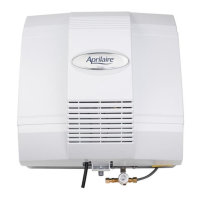
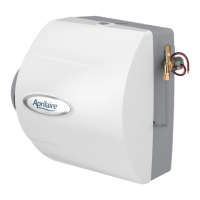
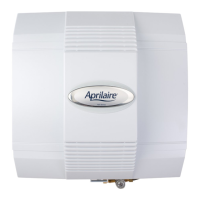
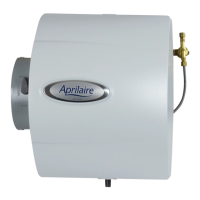
Evaporative Humidifiers: These units use hot airflow through a water panel and the HVAC system's heat draw to turn water into vapor. They are ideal for applications where the unit can be mounted on ductwork, offering easy installation, reliability, and an attractive price point. They are the primary choice in the upper Midwest and Northeast with long, harsh winters and extended furnace run times.
Sequence of Operation (Evaporative): Water flows to a distribution tray at the top, uniformly distributed across the water panel evaporator. Dry, hot air from the HVAC system moves through the moisture-laden panel, where natural evaporation occurs. The humidified air is then circulated throughout the home. An orifice determines the correct water flow, ensuring a steady stream to drain, flushing away minerals. The water panel, made of slit and expanded aluminum coated with a wicking agent, disperses water evenly, increasing the surface area for air-to-water contact and evaporation efficiency. Un-evaporated water and minerals are either trapped by the water panel, contained in the Scale Control Insert, or flushed down the drain.
Duct Location (Evaporative): Fan-powered humidifiers are installed on the warm air supply plenum of forced air up-flow furnaces or heat pumps. They can be installed on the cold air return duct if no space is available on the warm air supply plenum, but hot water must be supplied. Bypass humidifiers are installed on the warm air supply plenum or cold air return of up-flow, down-flow, or horizontal furnaces/heat pumps, then ducted to the opposite side return or supply. A minimum static pressure of 0.2" w.c. is required for proper airflow.
Water Quality (Evaporative): Evaporative humidifiers work with hard or soft, hot or cold water. 140°F water is recommended for optimum performance when the humidifier operates without a call for heat.
Steam Humidifiers: These units heat water to the boiling point, producing steam. They are ideal for applications where evaporative products cannot be installed or lack sufficient capacity, such as homes with no duct space on the plenum, attic or crawl space locations, in-floor heat, electric strip heat, boilers, hydronic heat, and systems with short run times. They are the primary choice in the southwest with mild winters and very little call for heat but very dry air. In the south-central US, either evaporative or steam can work.
Simple - to service and maintain (Steam): Aprilaire steam humidifiers use electrode technology, where electrical current flows between submerged electrodes, heating the water to boil. The electrodes are in a replaceable canister, which is replaced annually. No cleaning or scrubbing is required. This offers recurring revenue for contractors and a convenient replacement for consumers.
Simple - limited water quality concerns (Steam): Electrode technology requires impurities in the water to promote electricity transfer, so water filtration is not needed. The unit operates with water hardness between 3 and 36 grains. Reverse osmosis or deionized water should be plumbed to the unit before those devices.
Simple - unit selection (Steam): The Aprilaire steam humidifier uses electricity to boil water. The control algorithm manages the water level to ensure 11.5 amps of electricity are used, regardless of voltage (120v or 240v). Higher voltage increases steam production, allowing the same unit to be used for small and large homes.
Simple - to install (Steam): Every Aprilaire steam humidifier includes a remote mounting kit, automatic digital humidifier control, dispersion tube, drain tube, saddle valve, and mounting hardware. All necessary parts for remote or duct installation are included. Simply mount the unit, connect water feed and drain lines, and mount the dispersion tube in the duct.
Sequence of Operation (Steam): The Model 800 Aprilaire steam humidifier generates steam by energizing two electrodes in a water canister. Water is introduced through a fill valve to a fill cup, which acts as an overflow reservoir and provides an air gap (backflow prevention). The canister is filled from the bottom and seated in a drain cup assembly with a drain valve. The unit's control board determines the water level based on conductivity to maintain 11.5 amps. When draining, the unit automatically tempers the water by mixing canister water with incoming water, eliminating the need for high-temperature drain tubing and pumps.
Dispersion Technology (Steam): After steam is produced, it is dispersed into the airstream through a dispersion tube mounted in the HVAC system ductwork. Openings in the tube are fitted with "tubelets" that extend into the center, distributing steam over a wide area and directing condensed moisture back into the steam hose. This prevents application problems like rusting ducts. The preferred location for the dispersion tube is in the supply duct, where higher temperatures more readily absorb moisture. It must be in a straight section of duct, far enough upstream of obstructions or bends, to allow full absorption. Applications without forced air through a duct system can use the Aprilaire Model 850 fan pack, which mounts in the conditioned space to distribute humidity.
Absorption Distance (Steam): The distance steam absorbs into the air depends on air temperature, RH set point, and airflow velocity. If the distance from the dispersion tube to an obstruction is less than 28", the steam will have enough distance to absorb into the air. A chart provides minimum absorption distances based on input power, humidifier output, airflow velocity, and RH set points (30%, 45% at 70°F, and 45% at 65°F).
Aprilaire is committed to providing innovative products that improve indoor air quality, ensuring homes are healthy, energy-efficient, and sustainable. Their humidifiers help maintain the right amount of moisture for protection and comfort, prevent premature aging of the home's structure, provide optimum comfort, and protect respiratory systems against viruses and bacteria. Humidity control helps homes qualify for the Green-Built Certification Program.
 General
| Type | Bypass |
|---|---|
| Capacity | 18 gallons per day |
| Control Type | Manual |
| Evaporation Capacity | 0.75 gallons per hour |
| Voltage | 24V |
| Installation | Professional installation recommended |
| Coverage Area | Up to 4, 200 sq. ft. |

 To Next Page