Need help?
Do you have a question about the Areca ARC-1886-6N2I and is the answer not in the manual?
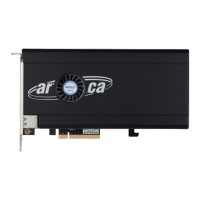
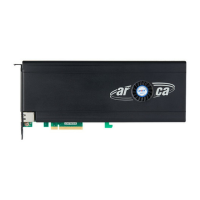
The Areca ARC-1886-4N8I is an M.2 NVMe Tri-Mode RAID adapter designed to enhance storage performance and reliability in PC and server environments. Its primary function is to provide a robust RAID solution for M.2 NVMe SSDs, leveraging a dual-core RAID-on-Chip (ROC) processor operating at 1.6GHz and a PCIe Gen 4.0 x8 lane host interface. The adapter is equipped with 8GB of on-board DDR4-2666 SDRAM with ECC, ensuring data integrity and efficient cache operations. It supports both 2280 and 22110 form factor M.2 drives, offering flexibility in drive selection.
The ARC-1886-4N8I acts as a central controller for multiple M.2 NVMe SSDs, allowing them to be configured into various RAID levels. This enables users to achieve higher data throughput, improved data redundancy, or a combination of both, depending on their specific needs. The "Tri-Mode" capability implies its versatility in handling different storage protocols, likely including SAS, SATA, and NVMe, though the manual primarily focuses on NVMe SSD integration. By offloading RAID calculations to its dedicated ROC processor, the adapter frees up the host system's CPU, leading to better overall system performance. The on-board ECC SDRAM is crucial for maintaining data integrity, especially in high-performance RAID environments where data corruption can have significant consequences.
The adapter's usage begins with a straightforward unpacking process, where users are instructed to inspect the package for damage and verify the contents, including the adapter itself, an SFF-8654 to SFF-8643 cable, and a quick installation guide.
Mounting M.2 NVMe SSDs is a key step. For 2280 M.2 NVMe SSDs, the process involves removing four screws from the front panel, gently inserting the SSD into its slot, and securing it with a board latch. This process is repeated for additional SSDs. For 22110 M.2 NVMe SSDs, the procedure is slightly different, requiring the user to turn a latch 90 degrees (clockwise or counterclockwise) to remove it, along with six screws from the board. The SSD is then gently inserted, and a screw is placed into a groove to secure it, followed by refastening the four front panel screws. This detailed guidance ensures proper physical installation of the drives.
After physical installation, the system must be powered off, and the power cable disconnected before installing the RAID adapter into a PCIe 4.0 slot. Users are instructed to remove the mounting screw and existing bracket from the rear panel, align the gold-fingered edge of the card with the selected PCIe slot, and press down gently but firmly to ensure proper seating. Finally, the bracket is screwed into the computer chassis.
Optional storage connection cables can be installed. In a direct connection scenario, SAS/SATA/NVMe drives are directly connected to the tri-mode RAID adapter's PHY port using appropriate cables. For backplane solutions, drives connect to a system backplane or through a PCIe switch/expander board. The number of drives is limited by the backplane's available slots, with some backplanes supporting daisy chain expansion. The manual highlights SFF-8612 or SFF-8654 as preferred connectors for NVMe or multiprotocol backplanes based on the SFF-TA-1001 universal bay definition (UBM), and SFF-8087/8643 for server legacy SAS/SATA backplanes.
A significant usage feature is the ability to connect a monitor via the LAN port. This allows for remote management of the RAID adapter using standard web browsers, eliminating the need for platform-specific software. This feature is particularly useful for server environments where direct physical access might be limited.
The adapter also supports an optional Cache Backup Module (CBM). This module provides several critical functions:
After physical installation, the system is powered up, and the adapter driver must be installed. The manual refers to a dedicated chapter for detailed installation procedures.
For configuration, the ARC-1886-4N8I offers multiple management interfaces:
http://[IP Address] in a web browser. The default username is "admin" and the password is "0000".Both MRAID methods offer a "Quick Create" function, which automatically configures a volume based on the number of disks in the system, creating a RAID set with one associated volume set. More advanced customization options are detailed in the user manual.
While the manual primarily focuses on installation and initial configuration, several aspects touch upon maintenance:
In summary, the Areca ARC-1886-4N8I is a high-performance RAID adapter designed for M.2 NVMe SSDs, offering robust data protection and performance enhancements through its dedicated hardware and flexible management options. Its user-friendly installation process, diverse configuration interfaces, and integrated maintenance features contribute to its overall utility and reliability in demanding storage environments.
 General
| Controller | Areca ARC-1886 |
|---|---|
| Interface | PCIe 3.0 x8 |
| Maximum Drives | 6 |
| Controller Type | RAID |
| RAID Levels | 0, 1, 3, 5, 6, 10, 50, 60 |
| Operating System Support | Windows, Linux, VMware |

 To Next Page