Need help?
Do you have a question about the Areca ARC-1220 and is the answer not in the manual?
Provides a general overview of the SATA RAID Series controller cards and their capabilities.
Details the adapter architecture, I/O processors, memory, and RAID features supported.
Explains fundamental RAID concepts like RAID Set, Volume Set, and various RAID levels.
Discusses features like Global Hot Spares, Hot-Swap support, and Auto Rebuilding for system uptime.
Covers mechanisms for ensuring data integrity and drive health, such as SMART and Consistency Checks.
Details methods for protecting data, including Battery Backup Modules and Recovery ROM.
Provides descriptions and characteristics of supported RAID levels (0, 1, 1E, 3, 5, 6).
Lists package contents and essential pre-installation steps for safety and equipment protection.
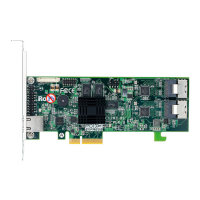
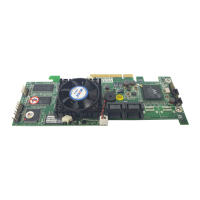
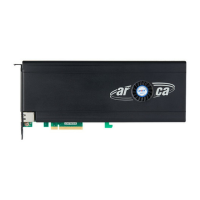
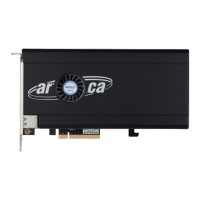
Illustrates the physical layout of different SATA RAID controller models and their connectors.
Provides detailed instructions for physically installing the RAID controller into a computer system.
Covers essential safety information regarding power handling and electrostatic discharge.
Explains how to access and start the firmware-based RAID configuration utility during system boot.
Guides users through the main menu and functions available in the BIOS configuration utility.
Details the process of creating and configuring RAID sets and Volume Sets using the utility.
Explains how to configure unused drives as hot spares for automatic rebuilds.
Describes the fast, automated method for creating RAID sets and Volume Sets.
Provides a manual method for configuring RAID and Volume sets with detailed control.
Covers operations for managing RAID sets, including creation, deletion, and expansion.
Details operations for managing Volume sets, such as creation, modification, and deletion.
Explains how to view physical drive information and manage pass-through disks.
Covers system-level settings, including beeper control, password, JBOD/RAID modes, and cache settings.
Guides on creating bootable driver diskettes from the provided CD-ROM.
Details the process of installing RAID controller drivers on Windows operating systems.
Explains installing Windows OS onto a SATA RAID volume, including driver integration.
Covers installing the controller and driver into an already running Windows system.
Provides steps for removing the SATA RAID controller driver from Windows.
Details driver installation procedures for Linux and FreeBSD operating systems.
Introduces the ArcHttp Proxy Server utility for managing RAID controllers remotely.
Step-by-step guide for installing the ArcHttp Proxy Server software on Windows.
Details the installation procedure for the ArcHttp Proxy Server on Linux systems.
Covers the installation process for the ArcHttp Proxy Server on FreeBSD.
Explains how to configure email notifications for system events via ArcHttp.
Details how to access and start the web-based McRAID Storage Manager for RAID management.
Describes the interface and functionality of the McRAID Storage Manager for controller configuration.
Provides a quick method to create RAID sets and configure basic volume parameters.
Covers creating, deleting, and expanding RAID sets through the web interface.
Details creating, deleting, and modifying volume sets via the web interface.
Explains how to create, modify, delete, and identify pass-through disks.
Covers system-level configurations like beeper settings, password, SATA modes, and cache.
Details configuring the controller's Ethernet port, including DHCP settings.
Explains how to configure SNMP for network monitoring and event reporting.
Covers Network Time Protocol settings for time synchronization.
Guides users on how to update the controller's firmware using the web interface.
Explains the process of updating the controller's firmware using various methods.
Details upgrading firmware using the McRAID Storage Manager utility.
Covers upgrading the entire flash ROM image using a DOS utility.
Describes the Battery Backup Module (BBM) and its role in protecting cache memory.
Details the physical components and environmental/mechanical specifications of the BBM.
Provides instructions for installing the Battery Backup Module onto the RAID controller.
Explains how the BBM operates and its backup capacity based on memory configuration.
Introduces SNMP, its protocol, and management concepts like MIBs and agents.
Outlines the phases involved in installing an SNMP manager and its components.
Details the installation of the SNMP Extension Agent on Windows systems.
Covers the installation of the SNMP Extension Agent on Linux systems.
Provides general tips for diagnosing and resolving common RAID controller issues.
Troubleshooting steps if the SATA RAID controller BIOS message does not display.
Guidance on resolving issues where the RAID card boot device is not recognized.
Information on PCI slot compatibility for SATA RAID controllers and motherboard considerations.
Explains the key differences in fault tolerance and performance between RAID 6 and RAID 5.
Provides information on how to contact technical support and what details to provide.
Defines essential terms like 2TB limitation, Array, ATA, Auto Reassign Sector, and Hot Spare.
Explains terms such as Hardware RAID, Hot Swap, NVRAM, Parity, PCI Express, and RAID.
Defines terms related to storage interfaces and performance like Rebuild, SATA, and XOR-Engine.
Defines terms related to cache modes and data integrity like SMART, SNMP, Volume Set, Write-back, Write-through.
 General
| Interface | SATA II |
|---|---|
| Number of Ports | 8 |
| Max Devices Supported | 8 |
| Maximum Drives Supported | 8 |
| Battery Backup Unit | Optional |
| Ports | 8 |
| RAID Levels | 0, 1, 3, 5, 10, 30, 50, JBOD |
| Cache Memory | 128MB DDR |
| Form Factor | Low-profile |


 To Next Page