Need help?
Do you have a question about the Areca ARC-1210 and is the answer not in the manual?
Provides a general overview of the SATA RAID Series controller cards and their capabilities.
Details the adapter architecture, I/O processors, memory, and key RAID features supported by the controllers.
Explains fundamental RAID concepts like RAID Sets and Volume Sets, and how they are structured.
Highlights features designed for user convenience, such as instant availability and online expansion.
Discusses features enhancing system availability, like global hot spares and automatic rebuilding processes.
Covers features ensuring high reliability, such as failure prediction and consistency checks for data integrity.
Explains data protection mechanisms like Battery Backup Modules and Recovery ROM for safeguarding data.
Details various RAID levels (0, 1, 1E, 3, 5, 6) and their performance and redundancy characteristics.
Guides on pre-installation steps, safety precautions, and package contents verification.
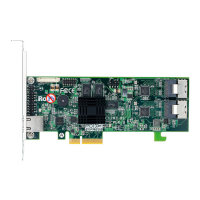
Visual representation of the controller's board layout and connector locations for proper identification.
Detailed step-by-step instructions for physically installing the RAID controller into a computer system.
Instructions on how to access and initiate the McBIOS utility for initial RAID configuration.
Overview of the utility's interface and its capabilities for managing RAID sets and volume sets.
Step-by-step guide for manually creating and configuring RAID sets and volume sets within the BIOS.
Explains how to designate spare drives for automatic rebuilds in case of drive failure, enhancing fault tolerance.
A streamlined process for setting up RAID configurations with default parameters for faster deployment.
Detailed manual setup using specific functions for RAID and Volume Sets, offering greater control.
Provides the fastest method for preparing RAID and Volume Sets with minimal user input and keystrokes.
Offers comprehensive control over RAID Set creation, deletion, expansion, and activation for flexible storage management.
Manages Volume Sets, including creation, modification, deletion, and status checks for logical storage units.
Allows viewing detailed information about individual physical disks and managing pass-through configurations for direct OS access.
Configures system-wide settings like alert beepers, passwords, SATA modes, and caching for controller operation.
Sets up the controller's Ethernet port, including DHCP, IP address, and MAC address for network connectivity.
Displays logged events and status messages from the RAID controller for monitoring and troubleshooting.
Utility to clear the controller's event log buffer, managing historical data for performance.
Provides real-time monitoring of hardware status like temperatures and fan speeds for system health.
Displays comprehensive controller information, including firmware, processor, and memory details for system inventory.
Instructions for creating bootable driver diskettes for Windows, Linux, and FreeBSD installation media.
Guides for installing the RAID controller driver on Windows operating systems, including specific procedures.
Procedures for installing the Windows OS onto a volume managed by the RAID controller during setup.
Steps to install the controller driver in a system with an already installed Windows OS as a secondary controller.
Instructions for safely removing the RAID controller driver from Windows systems via Control Panel.
Guides for installing the RAID controller driver on Red Hat and SuSE Linux distributions, including source compilation.
Instructions for installing the RAID controller driver on FreeBSD operating systems, referencing readme files.
Guidance for installing the RAID controller driver on Solaris operating systems, referencing readme files.
Guidance for installing the RAID controller driver on Mac OS X, referencing readme files.
Installation steps for the ArcHttp Proxy Server software on Windows systems, enabling web-based management.
Installation steps for the ArcHttp Proxy Server software on Linux systems, including configuration file setup.
Installation steps for the ArcHttp Proxy Server software on FreeBSD systems, similar to Linux.
Guidance for installing the proxy server on Solaris 10 X86, referencing readme files.
Guidance for installing the proxy server on Mac OS 10.X, referencing readme files.
Configuration of email notifications for system events via the proxy server, enabling alerts.
Instructions for launching the McRAID Storage Manager for browser-based RAID management.
Connecting and accessing the RAID controller via its Ethernet port for remote management.
Overview of the McRAID Storage Manager interface and its functions for configuration and monitoring.
Lists the primary functions accessible from the McRAID Storage Manager's main menu for navigation.
A quick method for default configuration, allowing modification of capacity, RAID level, and stripe size.
Manages RAID Sets, including creation, deletion, expansion, and activation for flexible storage management.
Manages Volume Sets, covering creation, modification, deletion, and status checks for logical storage units.
Allows management of physical drives, including pass-through disk creation and modification for direct OS access.
Configures system-wide settings like beeper, task priority, SATA modes, and caching for controller operation.
Configures Ethernet port settings, including DHCP, IP address, and MAC address for network connectivity.
Configures email notifications for system events, classifying them by severity for timely alerts.
Configures SNMP settings for network monitoring and management of the controller, facilitating integration.
Configures Network Time Protocol settings for accurate time synchronization across the network.
Allows viewing controller events and muting the alert beeper for operational control.
Generates test events for diagnostic or testing purposes, verifying system response.
Utility to clear the controller's event log buffer, managing historical data for performance.
Allows setting or changing the controller's access password for security and unauthorized access prevention.
Instructions for updating the controller's firmware to the latest version for improved functionality.
Provides access to RaidSet Hierarchy, System Information, and Hardware Monitor for configuration status.
Details the process of updating the controller's flash firmware using provided utilities.
Specific steps for updating firmware using the McRAID Storage Manager utility for ease of use.
Information about the Battery Backup Module, its components, specifications, installation, and operation.
Explains SNMP protocol, its operation, definitions, and installation phases for network monitoring.
Provides common troubleshooting steps for controller errors and common issues encountered during setup or operation.
Information on how to contact Areca technical support for assistance, updates, and problem resolution.
 General
| Controller | Areca ARC-1210 |
|---|---|
| Ports | SATA II |
| Number of Ports | 8 |
| Max Devices Supported | 8 |
| RAID Levels | 0, 1, 5, 6, 10, JBOD |
| Cache Memory | 128MB |
| Operating System Support | Windows, Linux, VMware |
| Interface | PCI-X 133MHz |
| Form Factor | Low Profile |


 To Next Page