Need help?
Do you have a question about the Areca ARC-1110 and is the answer not in the manual?
General overview of the SATA RAID Series controller cards, their architecture, and supported peripheral devices.
Details the adapter architecture, I/O processors, memory, bus types, and core RAID features supported by the controllers.
Explains RAID Sets, Volume Sets, and features like instant availability, array roaming, and capacity expansion.
Covers features enhancing data availability and reliability, including Global Hot Spares, Hot-Swap support, and failure prediction.
Details data protection methods like Battery Backup Modules and Recovery ROM, and explains different RAID levels (0, 1, 1E, 3, 5, 6).
Provides detailed explanations of RAID levels 0, 1, 1E, 3, 5, and 6, including their characteristics and performance implications.
Guides on checking package contents and ensuring all necessary components are available before starting the installation process.
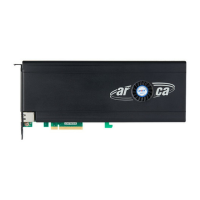
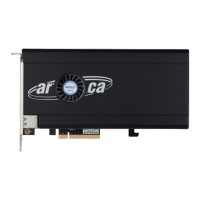
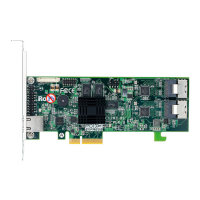
Illustrates the physical layout of the SATA RAID controllers, highlighting key connectors and components for identification.
Details the complete physical installation process of the SATA RAID adapter into a computer system, including safety precautions.
Explains how to access the McBIOS setup utility during system boot-up to configure the RAID controller parameters.
Provides an overview of the McBIOS utility, its functions, and how to navigate its main menu for RAID management.
Guides users through creating and configuring RAID Sets and Volume Sets using the McBIOS manager's various methods.
Details how to designate unused disk drives as hot spares for automatic rebuilds in case of drive failure.
Explains the simplified Quick Volume/Raid Setup method for creating default RAID configurations quickly.
Describes the manual method for configuring RAID Sets and Volume Sets, offering more detailed control.
Details functions from the Main Menu: Quick Volume/Raid Setup, Raid Set, Volume Set, Physical Drives, and System Functions.
Instructions on creating bootable driver diskettes from the included CD-ROM for Windows, Linux, and FreeBSD.
Covers installing drivers for Windows 2000, XP, Server 2003, including OS installation on RAID volumes and existing systems.
Provides instructions for installing the SATA RAID controller driver on Red Hat and SuSE Linux distributions.
Details the process of installing the SATA RAID controller driver on FreeBSD operating systems.
References the readme.txt file for driver installation instructions for Solaris operating systems.
References the readme.txt file for driver installation instructions for Mac OS X.
Step-by-step guide to installing the ArcHttp Proxy Server software on Windows systems.
Procedures for installing and configuring the ArcHttp Proxy Server on Linux operating systems.
Details the installation of the ArcHttp Proxy Server on FreeBSD systems.
References the readme.txt file for ArcHttp Proxy Server installation on Solaris.
References the readme.txt file for ArcHttp Proxy Server installation on Mac OS X.
Configures email notifications for system events, covering local and remote administration setups.
Guides on starting the McRAID Storage Manager for browser-based management, including access methods.
Explains accessing and using the McRAID Storage Manager via web browser for controller configuration.
Details menu options for managing RAID sets, volume sets, and drives via the web browser interface.
Describes Quick Function for default RAID setup, allowing volume set parameter modification.
Covers creating, deleting, expanding, and activating RAID Sets using the web browser interface.
Details managing Volume Sets: creation, deletion, modification, checking, and information display.
Explains managing physical drives: creating, modifying, deleting pass-through disks, and identifying drives.
Covers system configurations: beeper settings, task priority, SATA modes, cache modes, and network settings.
Provides access to RaidSet Hierarchy, System Information, and Hardware Monitor for status and configuration details.
Details updating RAID controller flash firmware using various methods and file types for system compatibility and upgrades.
Describes the Battery Backup Module (BBM), its components, specifications, installation, and operation for cache protection.
Explains SNMP, its agents, managers, MIBs, and definition files for network monitoring and device status.
Provides common troubleshooting steps for issues like missing BIOS messages, boot device detection, and slot compatibility.
Offers guidance on contacting technical support, including required information and available online resources.
Defines key terms used in the manual, covering concepts like 2TB, Array, ATA, BIOS, Cache, RAID, SMART, SNMP, and Volume Sets.

 To Next Page
 General