This document is a user manual for an Ariston combined fridge/freezer, model BC 312 AI UK. It provides comprehensive instructions for installation, safe use, and maintenance of the appliance.
Function Description:
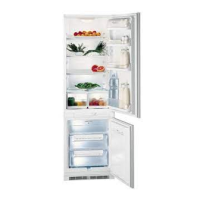
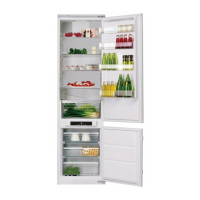
The Ariston BC 312 AI UK is a combined fridge/freezer designed for refrigerating and freezing foodstuffs. It features separate compartments for fresh food storage (refrigerator) and freezing fresh foods and storing frozen foods (freezer). The appliance is built to international safety standards (EN60) and has received European approval (IMQ) for compliance with UK electrical safety requirements, as well as EC standards for radio interference prevention and elimination.
Important Technical Specifications:
While specific detailed technical specifications like dimensions, energy consumption class, and noise level are not explicitly listed in a consolidated section, the manual does provide some key information:
- Electrical Connection: The appliance is supplied with a 13 amp fused plug and requires a 13 amp socket. It operates on 240V. The rating plate, located at the bottom left near the vegetable crisper, indicates the voltage, maximum power load (e.g., 150W), and fuse amperage (e.g., 15A).
- Refrigerant: The appliance uses cyclopentane gas in the insulation foam and possibly R600a (isobutane) in the refrigeration circuit. The rating plate also specifies the compressor type (e.g., R 134 a) and refrigerant quantity (e.g., 0.090 kg).
- Freezing Capacity: The rating plate indicates the maximum daily quantity of food that can be frozen (e.g., 4.0 kg/24h).
- Storage Volume: The rating plate shows gross and net volumes for both the refrigerator and freezer compartments (e.g., Total Gross 340, Freezer Net 75).
- Temperature Control: A thermostat knob with settings from 1 (less cold) to 5 (colder) regulates the temperature in both compartments. The "off" setting is also available.
- Defrosting: The refrigerator compartment features automatic defrosting with a drain system. The freezer compartment requires manual defrosting when the frost layer exceeds 15 mm.
Usage Features:
The appliance offers several features to enhance usability and food preservation:
- Refrigerator Compartment:
- Temperature Regulation: The thermostat knob allows users to adjust the internal temperature. A medium setting (e.g., "3") is generally recommended.
- Cooling Area: A "cooling area" is located within the back panel, which may show frost or water droplets during normal operation.
- Storage:
- Fruit and Vegetable Crispers (J): For storing fruits and legumes.
- Meat/Cheese Storage Box (K): For specific items.
- Removable/Adjustable Shelves (L): Allow for flexible arrangement and accommodate large containers.
- Removable Door Shelves (B, C, D, E): Including shelves with lids, an egg tray, a lidded butter dish, a miscellaneous shelf, and a compartment for a 2-litre bottle.
- Hinged Bottle Rack (M): Can be used for bottles or cans, and can be tipped up when not in use to create more space.
- Food Placement: Meat and cheeses should be placed above the vegetable crisper, as this is the coldest area. Liquids should be covered to prevent moisture buildup and frost formation. Food and containers should not directly touch the back cooling wall.
- Freezer Compartment (A, G, I):
- Freezing Fresh Foods (I): The top compartment is ideal for freezing fresh foods, aiming for temperatures below -18°C.
- Storage of Frozen Foods (G): Multiple drawers are available for storing frozen items.
- Ice Tray (H): A unique Merloni patent design located on the top part of the freezer drawers. It features a special hole for filling water up to the "MAX WATER LEVEL" and requires a 90° turn after filling. Ice cubes are released by knocking the tray against a hard surface.
- Space Optimization: The central drawer can be removed to place food directly onto the evaporator plate for larger storage capacity.
- Power Failure Precaution: In case of power failure, avoid opening the freezer door to slow temperature rise and preserve frozen food for 9-14 hours.
- Food Preparation for Freezing: Divide food into small portions, mark packages with content and date, and avoid refreezing thawed food. Do not place full bottles in the freezer as they may burst.
Maintenance Features:
Regular maintenance is crucial for the appliance's efficiency and safety:
- Cleaning:
- Before Cleaning: Always disconnect the appliance from the electricity supply.
- Interior and Exterior: Use a sponge with warm water and baking soda (a good disinfectant) or a neutral soap. Avoid abrasives, bleach, ammonia, solvents, and similar products.
- Removable Parts: Remove and soak shelves and drawers in hot water and dishwashing soap, then rinse and dry thoroughly.
- Drain Hole: Periodically check and clean the drain hole located behind the vegetable crispers in the refrigerator compartment to ensure proper water drainage.
- Defrosting:
- Refrigerator: Automatic defrosting. Users only need to ensure the drain hole is clear.
- Freezer: Manual defrosting is required when the frost layer exceeds 15 mm.
- Procedure: Turn the thermostat knob to "off," wrap frozen food in newspaper and place it in a cool area, leave the freezer door open, and place containers of warm water inside to speed up thawing.
- Defrost Water Collection: The unit has a system to collect defrost water in a container placed beneath the unit (illustrated in fig. 6).
- Light Bulb Replacement: The interior light bulb, located at the back of the thermostat box, can be replaced by unscrewing the old bulb and installing a new one (no more than 15 Watt).
- Seals: Keep door seals clean and ensure they adhere well to prevent cold air from escaping.
- Long-Term Storage: If the appliance will not be used for a long time (e.g., during summer), clean it thoroughly and leave the doors open to prevent mold and unpleasant odors.
Safety Recommendations:
- Do not install outdoors or in areas exposed to rain or storms.
- Use only for refrigerating and freezing foodstuffs.
- Do not touch with bare feet or wet hands.
- Avoid extension cords or multiple socket adapters.
- Ensure the power cord is not bent or pinched.
- Never pull the cord or appliance to remove the plug.
- Avoid touching cooling components with wet hands.
- Do not put freshly removed ice cubes directly into the mouth.
- Always disconnect power before cleaning or maintenance.
- Remove or disable locking devices on old refrigerators before disposal to prevent child entrapment.
- Do not attempt to repair malfunctions; consult authorized service centers.
- If the power supply cord is damaged, it must be replaced by a service center.
- Do not use electrical appliances inside food storage compartments unless recommended by the manufacturer.
- Dispose of the appliance safely at the end of its life, contacting the dealer or local waste disposal organization.

 Need help?
 General


 To Next Page