Page 40 · 6300 Series ComboSource User’s Manual
using the Callendar-van Dusen method. By default, the ComboSource uses the
Laboratory standard coefficients, which are for a 0.003926Ω/ Ω/°C curve (A =
3.9848x10
-3
, B = -0.58700x10
-6
, C = 4.0000x10
-12
, and R
0
= 100).
The ComboSource automatically determines which equation to use based on
the conditions at the time of the measurement.
2-Wire versus 4-Wire Measurements
One concern in using RTDs are their relatively low resistance (typically 100Ω at
0°C), and small Ω/°C. Because of these two factors, the resistance of the cable
used to connect to the sensor can become a significant error in the sensor
measurement. The ComboSource offers two RTD measurement modes: a
conventional two wire measurement mode, which is subject to this error, and a
four wire measurement mode that uses separate sensor and source lines to
remotely sense the actual resistance of the RTD and eliminate the cable or
connector resistances.
When using 4-wire measurement mode, you must select ‘RTD (4-wire)’ as the
sensor type, and then connect the Sensor+ and Remote Sensor+ at one side of
the RTD, and Sensor– and Remote Sensor– to the other side of the RTD. Make
these connections as close to the sensor as possible.
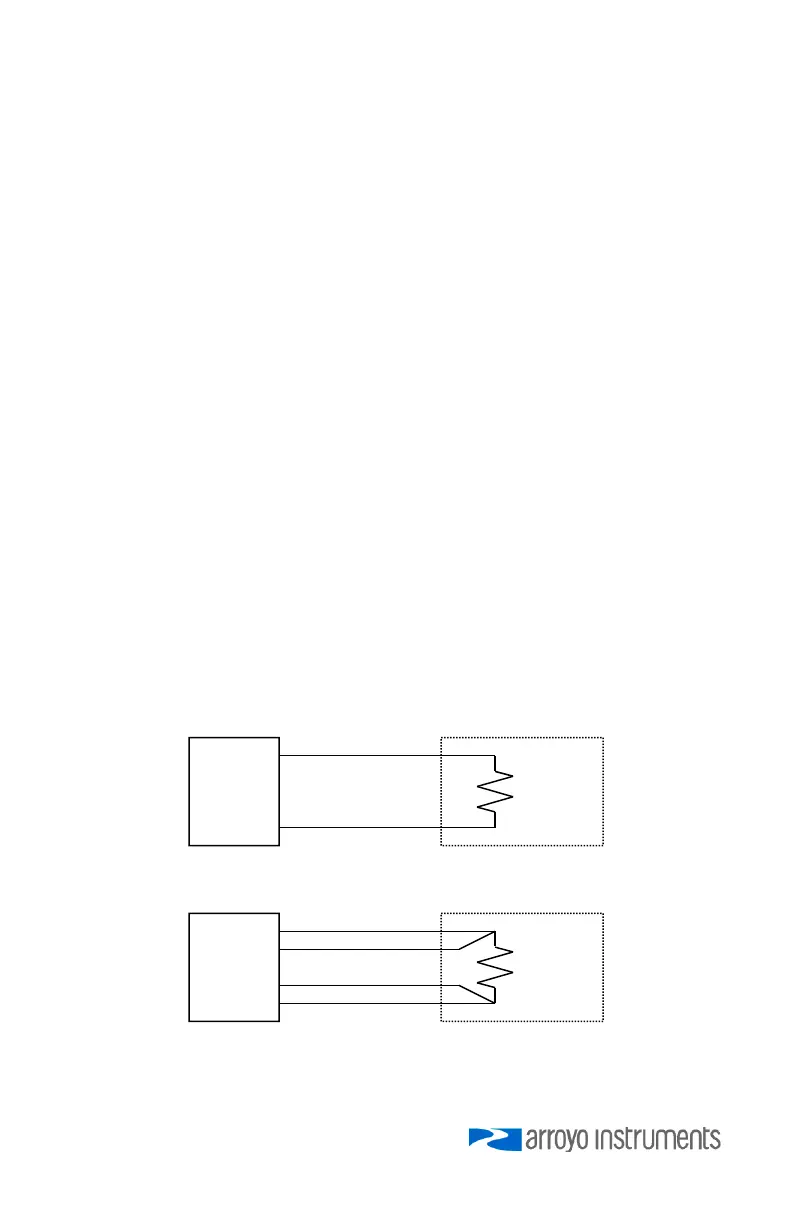
The drawings below illustrate how 2-wire and 4-wire connections work. Note that
4-wire measurements require all four wires to be brought through the cable to
the mount. The 1262 and 1263 cables carry this connection through to the
mount, but the 1260 and 1261 cables do not.
RTD 2-wire Measurement
RTD 4-wire Measurement
Mount 6300
RTD
Sensor
Sensor+
Sensor–
6300
RTD
Sensor
Sensor+
Remote Sensor+
Remote Sensor–
Sensor–
Mount



 To Next Page