
 Need help?
Do you have a question about the Ashford RIGID HEDDLE TABLE STAND and is the answer not in the manual?
Read instructions, prepare wood surfaces with wax or sealant, and use sandpaper for a smooth finish.
Lists necessary tools like a screwdriver and provides a real-scale hardware list with quantities.
Detailed instructions for attaching rubber feet, securing legs, and connecting support blocks using provided hardware.
Guides on how to adjust the stand's angle and change the loom's shed positions for weaving.
Directs users to online resources like YouTube and Facebook for how-to videos and community updates.
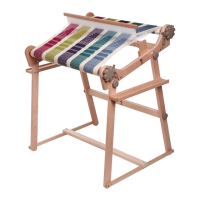
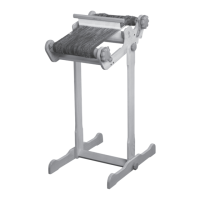
The Ashford Rigid Heddle Table Stand is an accessory designed to elevate and stabilize an Ashford Rigid Heddle Loom, providing a more ergonomic and comfortable weaving experience. This stand allows weavers to position their loom at various angles, making it suitable for different weaving techniques and personal preferences. It is constructed from kiln-dried Silver Beech timber, a native New Zealand wood known for its attractive grain and color variations, which can be enhanced with a finishing wax polish.
The primary function of the Ashford Rigid Heddle Table Stand is to hold the Rigid Heddle Loom securely at an elevated and adjustable angle. This elevation brings the weaving surface closer to the weaver, reducing strain on the back and shoulders, especially during long weaving sessions. The stand's adjustable angle feature is crucial for adapting to different weaving styles, such as tapestry weaving which often benefits from a more upright loom, or general fabric weaving which might prefer a flatter angle. By providing a stable base, the stand prevents the loom from shifting or wobbling, ensuring consistent tension and a smoother weaving process. The design also incorporates features that allow for easy adjustment of the loom's shed, which is essential for creating different weaving patterns.
The assembly process for the Rigid Heddle Table Stand is designed to be straightforward, with clear instructions provided. Before assembly, users are advised to read through the instructions completely, identify all parts, and note the assembly sequence. Sandpaper is supplied to remove any sharp edges and corners from the wooden components, ensuring a smooth and safe finish. For easier assembly, applying candle wax to the screws is recommended.
Finishing the wood surfaces is an important step, as it protects the kiln-dried timber from climatic changes and prevents it from getting dirty or stained. The manual recommends waxing or sealing the wood before assembly. Ashford Finishing Wax Polish is suggested to enhance the natural colors and character of the Silver Beech timber, resulting in a silky smooth, matte finish.
For older models of the Rigid Heddle Loom that may not have pre-drilled holes in the sides, the manual provides instructions for marking and drilling 6mm (1/4") holes as shown in the diagrams. This ensures compatibility with a wider range of Ashford Rigid Heddle Looms.
The assembly begins by attaching four rubber feet to the legs using 12mm (1/2") screws. These feet provide stability and prevent the stand from scratching the table surface. Next, the shaped legs (labeled 'A') are secured to the front holes in the loom side using 45mm (1 3/4") bolts, washers, and knobs. It's important to ensure these are tightened securely.
The next step involves pushing a 75mm (3") bolt through the reed support block and the loom side, followed by a spacer. This bolt is then secured with a leg (labeled 'B'), a washer, and a knob. This process is repeated for the other side of the loom.
Finally, a 40mm (1 1/2") bolt is pushed through a slot in leg 'A', then through a hole in leg 'B', and secured with a washer and a knob. This step is also repeated for the other side. The new reed support block is then pushed firmly against the original reed support block, and both knobs are tightened. This ensures the loom is securely mounted and ready for use.
Adjusting the angle of the loom is a key feature of the stand. This is achieved by loosening the back knobs, sliding the bolts along the slots to the desired angle, and then retightening the knobs. It's crucial to ensure that both legs are in the same position so that all four legs of the stand touch the table, maintaining stability.
The stand also facilitates changing the shed of the loom. To move from the down position to the up position, the weaver first lifts the back reed rail, slides it forward, and places it into the up position. To move from the up position to the down position, the weaver pulls the reed slightly forward, tips the front of the reed down, slides the reed back, feeds the top reed rail into the top position, and then lowers the back reed rail into the back position. The manual also references a "rest (neutral) position" which utilizes the original reed support.
While the manual primarily focuses on assembly and usage, the emphasis on finishing the wood surfaces before assembly can be considered a maintenance feature. By waxing or sealing the kiln-dried wood, users are actively protecting it from environmental factors such as humidity changes, which can cause warping or cracking. This also helps prevent dirt and stains from penetrating the wood, making it easier to clean and maintain its aesthetic appeal over time. Regular application of Ashford Finishing Wax Polish, as suggested, would further contribute to the longevity and beauty of the timber.
The use of sandpaper to remove sharp edges and corners not only improves safety but also contributes to the overall finish and durability of the product, preventing potential splinters or damage to the wood during handling.
The Ashford Guarantee provides a crucial maintenance and support feature. It states that in the unlikely event of a manufacturing fault, Ashford will replace the item. To validate this guarantee, customers are encouraged to visit their website or write to them. This commitment to quality ensures that users can rely on the product and receive support if any issues arise due to manufacturing defects.
The manual also points to additional resources for users, such as "How-to videos on YouTube" and "Facebook" pages, which can offer further guidance on using and maintaining Ashford products, including the Rigid Heddle Table Stand. These resources provide ongoing support and a community for weavers to share tips and troubleshoot issues. The "Wheel Magazine" is also mentioned as a source for articles and projects related to fibrecraft, which might indirectly offer maintenance tips or inspiration for using the loom and stand.
 General
| Type | Table Stand |
|---|---|
| Compatibility | Ashford Rigid Heddle Looms |
| Material | Wood |
| Color | Natural wood |
| Dimensions | Varies based on loom size |



 To Next Page