
 Need help?
Do you have a question about the Ashford Wild Carder and is the answer not in the manual?
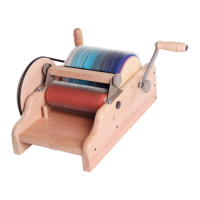
Create art yarns by blending fibres, fabrics, ribbon, feathers, noils, cocoons, paper. Prepare 40gm batts.
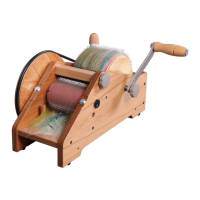
Adjustable packer brush, extra long 72 ppsi teeth, adjustable drum clearance, rubber feet.
Attach handle, place drive band, store doffer and brush, assemble clamps. Remove drive band when not in use.
Clamp carder to a bench. Lightly wash fleece, tease staples, pull apart sideways, place on feed-in tray.
Card small amounts of fibre. Use packer brush to pack fibres. Add embellishments for wild carding.
Loosen packer brush, twist off drum. Turn drum to top, part batt with doffer, pull batt over back beam.
Oil bearings. Adjust drum gap (0-1mm) for fibre type by rotating eccentric bearings.
The Ashford Wild Drum Carder is a specialized tool designed for fiber artists to create unique and textured art yarns. It facilitates the blending of various materials such as fibers, fabrics, ribbons, feathers, noils, cocoons, and paper, allowing for the creation of "fabulous fun and funky" yarns.
The primary function of the Wild Drum Carder is to prepare and blend different materials into batts, which can then be spun into yarn. It features a large drum with extra-long 72 ppsi teeth, designed to effectively process and blend a variety of fibers and embellishments. A smaller drum works in conjunction with the large drum to transfer and consolidate the material. The device is equipped with an adjustable packer brush, which helps to smooth and pack the fiber onto the large drum, ensuring an even and consistent batt. The adjustable drum clearance allows users to customize the gap between the drums to suit different fiber types, from fine to coarse and bulky.
The carder is designed for ease of use, coming pre-assembled and lacquered, ready for immediate operation. It includes essential accessories such as a doffer (awl) for removing batts, a cleaning brush for maintenance, and clamps to secure the carder to a workbench or table during use.
To begin using the Wild Drum Carder, it must first be clamped securely to a bench or table. The handle is then attached, ensuring the spring washer is placed first, followed by the handle, and secured with a dome nut. The drive band is placed onto the pulley as illustrated in the manual. When not in use, the drive band should be removed to prevent stretching. The doffer can be stored in the two screw eyes on the side of the carder, and the cleaning brush under the feed-in tray.
For preparing batts, users typically start with approximately 40gm (1.5oz) of material. If using fleece, it is recommended to lightly wash it beforehand. The fleece should then be teased by flicking the tips of the staples with a flick carder and pulling the staples apart sideways. Small amounts of fiber are placed on the feed-in tray, and the handle is turned clockwise to begin the carding process. For "wild carding," users can prepare short pieces of various embellishments like fabric, ribbon, feathers, noils, cocoons, and paper. These embellishments are added to the fiber on the feed-in tray as the carding process continues. It is crucial to ensure all fibers remain between the guide pegs on the feed-in tray to prevent them from getting caught around the shafts. The packer brush can be adjusted to pack the fibers down into the teeth of the large drum. Carding should stop once the teeth on the large drum are full of fiber or when fiber starts accumulating on the small drum.
Removing the batt is a straightforward process. First, the knob holding the packer brush is loosened, and the brush is twisted up off the large drum. The drum is then turned until the doffer strip is at the top. The doffer is used to part the batt, taking care to run it in the groove of the doffer strip. Finally, the batt is pulled down over the back beam to cleanly remove it from the drum. Prepared fiber can also be peeled into strips, stretched to lengthen, and spread out sideways before being placed on the feed-in tray for further carding. Spreading out the fiber evenly on the feed-in tray facilitates easier carding.
Regular maintenance is key to ensuring the longevity and optimal performance of the Wild Drum Carder. A drop of oil should be applied occasionally to all bearings to keep them running smoothly.
The gap between the teeth of the drums is adjustable, allowing users to fine-tune it for different fiber types. The carder comes factory-set at a recommended spacing of 0-1mm. For fine fibers without much bulk, a closer setting may be preferred, while coarser or bulkier fibers might benefit from a slightly wider setting. To adjust the gap, the drive band must first be removed. The two bolts are then loosened, and the supplied nail is used to rotate the two eccentric bearings. Once the desired gap is set, the two bolts are tightened, and the drive band is replaced. As mentioned earlier, removing the drive band when the carder is not in use helps prevent it from stretching.
For users seeking more in-depth instructions, hints, and inspiration for carding, the Ashford Book of Carding by Jo Reeve is recommended. This resource provides comprehensive information on flick, hand, and drum carding, color theory, and includes four projects.
The Ashford Wild Drum Carder is backed by a guarantee, promising replacement in the unlikely event of a manufacturing fault. Users are encouraged to visit the Ashford website or write to them to validate their guarantee. Additionally, the Ashford Club offers access to the Wheel Magazine, competitions, and more.
 General
| Type | Drum Carder |
|---|---|
| Carding Cloth | 72 point |
| Brand | Ashford |
| Material | Wood, Metal |
| Use | Preparing fibers for spinning |



 To Next Page