8
© 2021 United States Stove Company
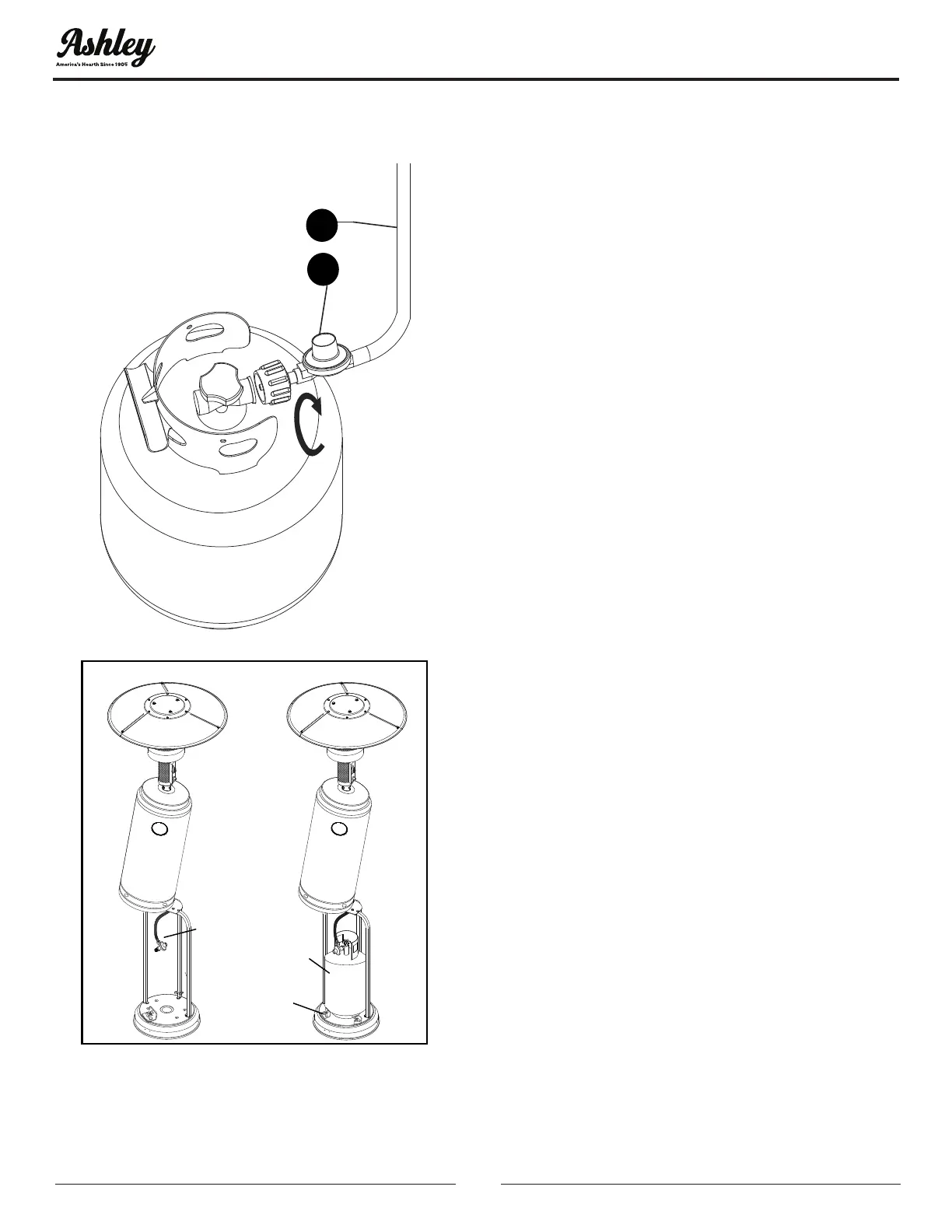
REPLACING THE GAS CYLINDER
Screw gas hose (C) and regulator (E) onto propane
cylinder (not included). Do not cross-thread.
C
J
E
Regulator
Anchoring
Gas tank
Every part of the heater should be secure against
displacement and should be constructed to
maintain a xed relationship between essential
parts under normal and reasonable conditions
of handling and usage. Parts not permanently
secured should be designed so they cannot be
incorrectly assembled and cannot be improperly
located or misaligned in removing or replacing
during cleaning or other servicing.
NOT INCLUDED
Use a standard 20 lb. (Not included.)propane
cylinder only (approximately 12.2” / 31 cm in diameter
and 17.9” / 45.5 cm high).
Use this heater only with a propane vapor
withdrawal supply system. See chapter 5 of the
standard for storage and handling of liqueed
petroleum gas, ANS/NFPA 58. Your local library or
re department should have this book. Storage
of an appliance indoors is permissible only if the
cylinder is disconnected and removed from the
appliance. A cylinder must be stored outdoors in a
well ventilated area out of the reach of children. A
disconnected cylinder must have dust caps tightly
installed and must not be stored in a building,
garage or any other enclosed area. The maximum
inlet gas supply pressure: 250 psi /1750 kPa. The
minimum inlet gas supply pressure: 5 psi /35 kPa.
Manifold pressure with regulator provided: 11” W.C/
2.74 kPa. The pressure regulator and hose assembly
supplied with the appliance must be used. The
installation must conform with local codes, or in the
absence of local codes, with National fuel gas code,
ANSI Z223.1/NFPA54, Natural gas and propane
installation code, CSA B149.1, or Propane storage
and handling code, B149.2.
A dented, rusted or damaged propane cylinder
may be hazardous and should be checked by your
cylinder supplier. Never use a propane cylinder with
a damaged valve connection.
The propane cylinder must be constructed and
marked in accordance with the specications
for LP gas cylinders of the U.S. Department of
Transportation (DOT) or the standard for cylinders,
spheres and tubes for transportation of dangerous
goods and commission, CAN/CSA-B339.
The cylinder must have a listed overlling prevention



 To Next Page