Need help?
Do you have a question about the Asus Xonar SE and is the answer not in the manual?
Brief overview for initial setup and installation of the audio card.
Essential guidelines for safe handling and operation to prevent electrical hazards.
Itemized list of all components included in the audio card package.
Specifies the hardware and software prerequisites for installing the audio card.
Detailed steps for installing the necessary software drivers for the audio card.
Describes the audio processing capabilities and audio output features of the card.
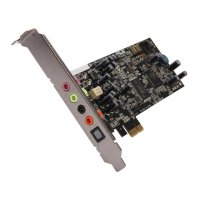
Details the physical layout and specific audio ports on the sound card.
Guide on connecting digital speaker systems, including home theater setups.
Instructions for connecting stereo headphones to the audio card.
Steps for connecting 5.1 surround sound headphones to the card.
Guidance on connecting an analog power amplifier to the audio card.
Instructions for connecting standard 2-channel speaker systems.
Steps for connecting 4-channel speaker setups to the audio card.
Guide on connecting 5.1 surround sound speaker systems.
Instructions for connecting a microphone for voice input.
Guide on connecting external audio sources via the Line-In jack.
Information regarding updated warranty policies for ASUS products.
Links to download user guides and software for the audio card.
List of trademarks and references mentioned in the manual.
Links to other relevant ASUS product manuals and guides.
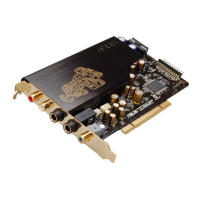
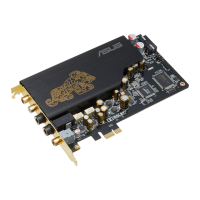
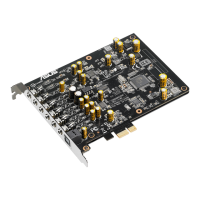
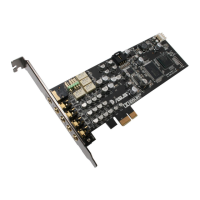
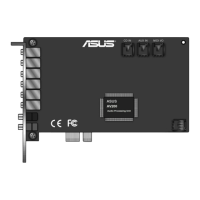
The ASUS PCIE 5.1 Headphone Amp Audio Card, Xonar SE, is designed to enhance your computer's audio capabilities, providing a high-fidelity sound experience for various applications, from gaming to home theater setups. This internal audio card connects to your motherboard via a PCIE slot, offering a significant upgrade over integrated audio solutions.
The Xonar SE functions as a dedicated audio processor, offloading audio tasks from your CPU to deliver clearer, more immersive sound. It supports 5.1 channel audio, making it suitable for multi-speaker setups and surround sound headphones, providing positional audio cues that can be crucial for gaming or an enriched movie-watching experience. The integrated headphone amplifier is a key feature, designed to drive high-impedance headphones with sufficient power, ensuring optimal sound quality and volume without distortion. This is particularly beneficial for audiophiles and gamers who use premium headphones.
The card offers a range of connectivity options to accommodate different audio peripherals. For digital speaker systems, specifically home theater setups, it provides an S/PDIF Out port, allowing for a clean digital audio signal to a compatible receiver or decoder box. For analog connections, it includes multiple 3.5mm jacks for connecting various speaker configurations, including 2-channel, 4-channel, and 5.1-channel setups, as well as analog power amplifiers.
Microphone input is also supported, enabling voice communication for online gaming, video conferencing, or recording. A dedicated Line-In port allows for connecting external audio sources like CD players or MP3 players, facilitating sound recording or playback through your computer's audio system. The front panel audio header ensures convenient access to headphone and microphone jacks from your computer's front panel.
Setting up the Xonar SE involves both hardware installation and software driver installation. After physically installing the card into an available PCIE slot on your motherboard, you'll need to install the device drivers from the provided support CD. The driver installation process is guided by on-screen instructions, ensuring compatibility with Windows operating systems. It's important to install the audio card driver before any other related drivers to prevent installation errors.
Once installed, the card's functionality is accessed through its various audio ports. For stereo headphones, simply plug them into the Front Out/Headphone Jack, which benefits from the built-in amplifier. For 5.1 channel headphones, you'll connect the front-channel, surround-channel, and center/bass-channel plugs into their respective 3.5mm jacks on the card.
Connecting digital speaker systems for a home theater experience involves plugging your decoder's TOSLINK optical cable into the S/PDIF Out connector. For analog speaker setups, the process varies depending on the number of channels. For 2-channel speakers, connect the 3.5mm plug into the Front Out/Headphone Jack. For 4-channel speakers, connect the front and surround input ports of the speakers to the Front Out and Side Surround Out ports on the card using mini-jack cables. For 5.1 channel speakers, you'll connect the front, surround, and center/subwoofer input ports of the speakers to the corresponding ports on the card.
When connecting an analog power amplifier, you'll use mini-jack to RCA cables to connect the card's Front Out, Side Surround Out, and Center/Subwoofer Out ports to the respective input ports on your amplifier. For microphone usage, plug your microphone's 3.5mm jack into the Microphone Input Jack. To connect external audio sources like CD or MP3 players, use a 3.5mm plug from the player to the Line-In jack on the audio card. The driver software typically includes a "Mixer" section for managing sound recording from these sources.
The card is designed for ease of use, with clearly labeled ports and a straightforward installation process. The driver software provides control over various audio settings, allowing users to customize their sound experience.
Maintenance for the Xonar SE primarily involves ensuring a clean operating environment and proper driver management. The safety information provided emphasizes keeping the product away from dust, humidity, and extreme temperatures to prevent damage and ensure longevity. Placing the product on a stable surface also contributes to its proper functioning and physical integrity.
Regular updates to the device drivers are crucial for optimal performance and compatibility with new operating system versions or software. While the initial installation uses a support CD, it's advisable to check the ASUS support website for the latest driver versions. Keeping the drivers updated can resolve potential bugs, improve stability, and unlock new features or optimizations.
In case of technical problems, the manual advises against attempting self-repair. Instead, users should contact a qualified service technician or their retailer. This approach prevents further damage to the device and ensures that any repairs are performed correctly. The ASUS warranty information outlines the terms for service and support, which are consistent with consumer protection laws.
The physical ports and connectors should be kept clean and free from debris to ensure good electrical contact and prevent audio issues. Periodically checking cable connections for looseness or damage can also help maintain consistent audio quality. The robust design of the card, combined with adherence to the recommended environmental conditions and proper driver management, contributes to its long-term reliability and performance.
 General
| Internal | Yes |
|---|---|
| Audio quality | 24 bit |
| Frequency range | 10 - 87000 Hz |
| Audio output channels | 5.1 channels |
| Digital-to-Analog Conversion (DAC) | 24-bit/192kHz |
| Line-in Signal-to-Noise Ratio (SNR) | 110 dB |
| Line-out Signal-to-Noise Ratio (SNR) | 116 dB |
| Line-in Total Harmonic Distortion (THD) | 0.00251 % |
| Windows operating systems supported | Windows 10, Windows 7, Windows 8, Windows 8.1 |
| Headphone outputs | 3 |
| Product color | Black |
| Full-Scale voltage | 2 V |
| Harmonized System (HS) code | 84733020 |


 To Next Page