EasyManua.ls Logo

Atmel AT89C2051 - User Manual

Atmel AT89C2051
20 pages
Print Icon
To Next Page IconTo Next Page
Loading...
Features
Compatible with MCS
®
-51Products
2K Bytes of Reprogrammable Flash Memory
Endurance: 1,000 Write/Erase Cycles
2.7V to 6V Operating Range
Fully Static Operation: 0 Hz to 24 MHz
Two-level Program Memory Lock
128 x 8-bit Internal RAM
15 Programmable I/O Lines
Two 16-bit Timer/Counters
Six Interrupt Sources
Programmable Serial UART Channel
Direct LED Drive Outputs
On-chip Analog Comparator
Low-power Idle and Power-down Modes
Green (Pb/Halide-free) Packaging Option
1. Description
The AT89C2051 is a low-voltage, high-performance CMOS 8-bit microcomputer with
2K bytes of Flash programmable and erasable read-only memory (PEROM). The
device is manufactured using Atmel’s high-density nonvolatile memory technology
and is compatible with the industry-standard MCS-51 instruction set. By combining a
versatile 8-bit CPU with Flash on a monolithic chip, the Atmel AT89C2051 is a power-
ful microcomputer which provides a highly-flexible and cost-effective solution to many
embedded control applications.
The AT89C2051 provides the following standard features: 2K bytes of Flash, 128
bytes of RAM, 15 I/O lines, two 16-bit timer/counters, a five vector two-level interrupt
architecture, a full duplex serial port, a precision analog comparator, on-chip oscillator
and clock circuitry. In addition, the AT89C2051 is designed with static logic for opera-
tion down to zero frequency and supports two software selectable power saving
modes. The Idle Mode stops the CPU while allowing the RAM, timer/counters, serial
port and interrupt system to continue functioning. The power-down mode saves the
RAM contents but freezes the oscillator disabling all other chip functions until the next
hardware reset.
8-bit
Microcontroller
with 2K Bytes
Flash
AT89C2051
0368G–MICRO–6/05
Question and Answer IconNeed help?

Do you have a question about the Atmel AT89C2051 and is the answer not in the manual?

Overview

The AT89C2051 is a low-voltage, high-performance CMOS 8-bit microcomputer, part of Atmel's family of microcontrollers. It is compatible with the MCS®-51 instruction set, offering a versatile and cost-effective solution for embedded control applications.

Function Description:

The device integrates a powerful 8-bit CPU with 2K bytes of Flash programmable and erasable read-only memory (PEROM). This Flash memory has an endurance of 1,000 write/erase cycles. It operates within a 2.7V to 6V range and supports fully static operation from 0 Hz to 24 MHz. Key features include a two-level program memory lock, 128 x 8-bit internal RAM, and 15 programmable I/O lines. For timing, it has two 16-bit timer/counters and six interrupt sources. Communication is handled by a programmable serial UART channel. The device also offers direct LED drive outputs, an on-chip analog comparator, and integrated oscillator and clock circuitry. It supports two software-selectable power-saving modes: Idle Mode and Power-down Mode. The Idle Mode stops the CPU while keeping RAM, timer/counters, serial port, and interrupt system active. The Power-down Mode saves RAM contents but freezes the oscillator, disabling other chip functions until a hardware reset. The device is available in green (Pb/Halide-free) packaging options.

Important Technical Specifications:

  • Memory: 2K bytes Flash PEROM (1,000 write/erase cycles endurance), 128 bytes internal RAM.
  • Operating Voltage: 2.7V to 6V.
  • Operating Frequency: 0 Hz to 24 MHz (fully static operation).
  • I/O Lines: 15 programmable bi-directional I/O lines (Port 1 and Port 3).
    • Port 1 pins P1.2 to P1.7 have internal pull-ups. P1.0 and P1.1 require external pull-ups and also serve as inputs for the on-chip analog comparator (AIN0 and AIN1). Port 1 output buffers can sink 20 mA.
    • Port 3 pins P3.0 to P3.5 and P3.7 are bi-directional with internal pull-ups. P3.6 is hard-wired as an input to the comparator output. Port 3 output buffers can sink 20 mA.
  • Timer/Counters: Two 16-bit timer/counters.
  • Interrupts: Six interrupt sources, five-vector two-level interrupt architecture.
  • Serial Communication: Full duplex serial port (UART).
  • Analog Features: On-chip precision analog comparator.
  • Power Consumption (Typical, 85°C):
    • Active Mode (12 MHz, Vcc=6V/3V): 15/5.5 mA.
    • Idle Mode (12 MHz, Vcc=6V/3V, P1.0 & P1.1 = 0V or Vcc): 5/1 mA.
    • Power-down Mode (Vcc=6V, P1.0 & P1.1 = 0V or Vcc): 100 µA.
    • Power-down Mode (Vcc=3V, P1.0 & P1.1 = 0V or Vcc): 20 µA.
  • Pin Capacitance: 10 pF (Test Freq. = 1 MHz, TA = 25°C).
  • Reset: RST input, all I/O pins reset to 1s when RST goes high. Requires holding RST high for two machine cycles while the oscillator runs.
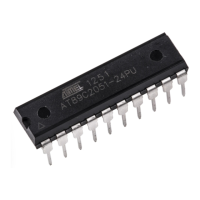
  • Packaging: Available in 20-lead PDIP (20P3) and 20-lead SOIC (20S) packages.

Usage Features:

  • Programming: The 2K bytes of Flash PEROM are programmable one byte at a time. To reprogram any non-blank byte, the entire memory array must be erased electrically.
    • Programming Algorithm: Involves a power-up sequence (apply Vcc/GND, set RST/XTAL1 to GND), setting RST and P3.2 to "H", and applying logic levels to P3.3, P3.4, P3.5, P3.7 to select programming operations. Data for code bytes is applied to P1.0-P1.7. RST is raised to 12V for programming, and P3.2 is pulsed to program a byte (typically 1.2 ms). XTAL1 is pulsed to advance the internal address counter.
    • Data Polling: Features Data Polling on P1.7 to indicate the end of a write cycle.
    • Ready/Busy: P3.1 indicates BUSY (low) during programming and READY (high) when done.
    • Chip Erase: The entire PEROM array and lock bits are erased electrically by holding P3.2 low for 10 ms.
    • Signature Bytes: Can be read to identify the manufacturer (1EH for Atmel) and device (21H for AT89C2051).
  • Oscillator: Can be configured with a quartz crystal or ceramic resonator (Figure 5-1). For external clock sources, XTAL2 should be left unconnected, and XTAL1 driven by the external clock (Figure 5-2).
  • Special Function Registers (SFRs): A map of the on-chip memory area for SFRs is provided, with reset values. Users should avoid writing 1s to unlisted locations.
  • Instruction Set Compatibility: Fully compatible with MCS-51 instruction set. However, users must ensure that jump/branch destination addresses fall within the 2K program memory space (00H to 7FFH). External data memory access (MOVX instructions) and external program memory execution are not supported.
  • Power Management:
    • Idle Mode: CPU stops, peripherals remain active. Terminated by enabled interrupt or hardware reset. P1.0 and P1.1 should be set to "0" (no external pull-ups) or "1" (external pull-ups).
    • Power-down Mode: Oscillator stops, RAM and SFRs retain values. Terminated only by hardware reset. P1.0 and P1.1 should be set to "0" (no external pull-ups) or "1" (external pull-ups).
  • Program Memory Lock Bits: Two lock bits (LB1, LB2) offer protection features:
    • No lock features (LB1=U, LB2=U).
    • Further programming of Flash disabled (LB1=P, LB2=U).
    • Programming and verification disabled (LB1=P, LB2=P). Lock bits can only be erased with a Chip Erase operation.

Maintenance Features:

  • Verification: Programmed data can be verified by reading output data at Port 1 pins after programming. Lock bits cannot be directly verified but their features can be observed.
  • Reset Functionality: A hardware reset ensures a defined state for the device, resetting I/O pins to 1s and the internal PEROM address counter to 000H.
  • Reliability: Atmel provides information on absolute maximum ratings and DC characteristics to guide proper usage and ensure device reliability. Exceeding these ratings can cause permanent damage.

Atmel AT89C2051 Specifications

General IconGeneral
BrandAtmel
ModelAT89C2051
CategoryMicrocontrollers
LanguageEnglish

Related product manuals