Proper adjustment of head restraints
Applies to vehicles: with adjustable head res tra ints
Correctly adjusted head restraints ore on im-
portant port of your vehicle's occupant re-
straint system and con help to reduce the risk
of injuries in occident situations.
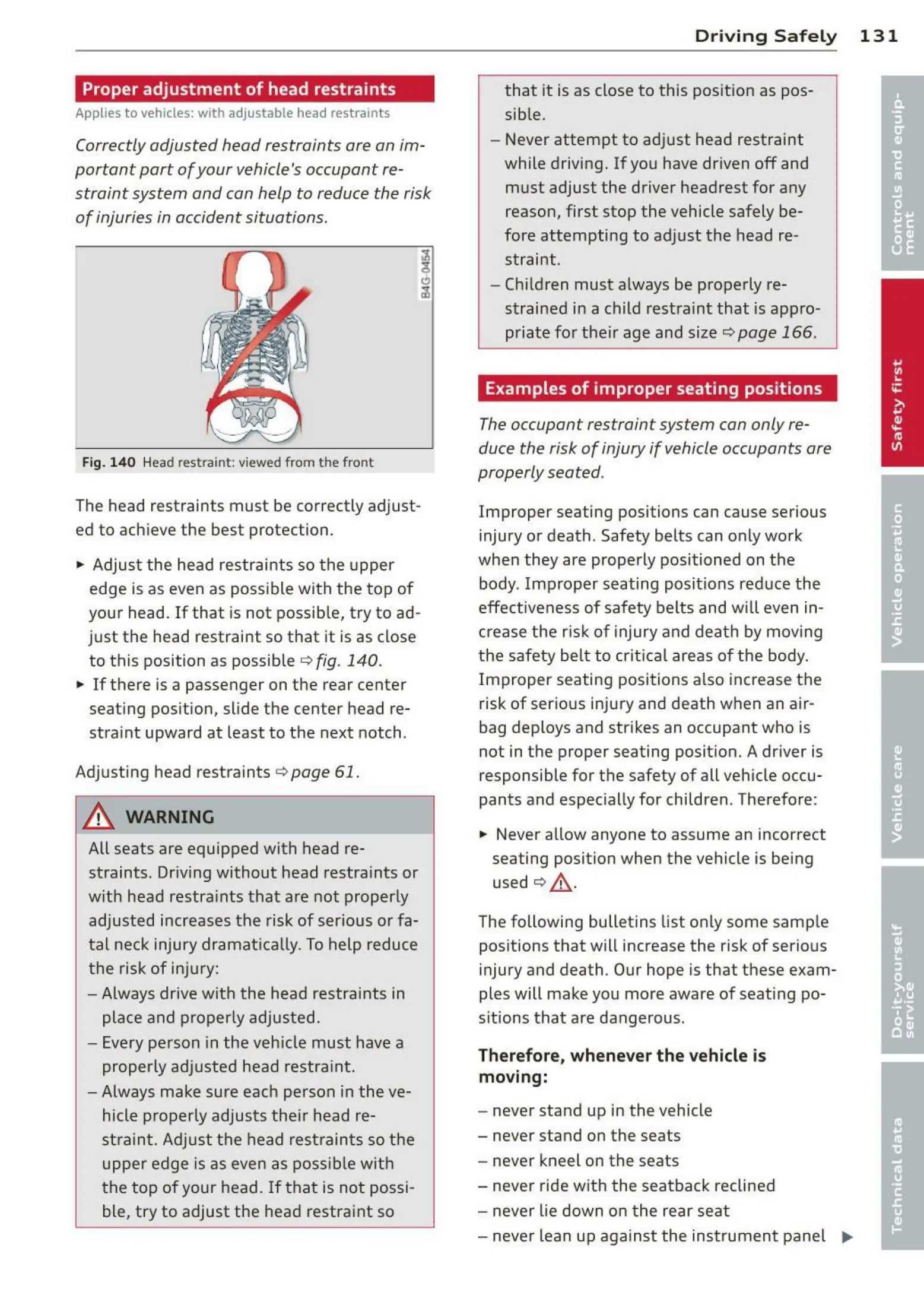
Fig. 140 Head restr aint : viewe d from the front
The head restraints must be correctly adjust -
ed to achieve the best protection .
.,. Adjust the head restraints so the upper
edge is as even as possible with the top of
your head. If that is not possible, try to ad-
just the head restraint so that it is as close
to this position as possible
r::> fig. 140.
.,. If there is a passenger on the rear center
seating position, slide the center head re-
straint upward at least to the next notch .
Adj usting head restraints
c:;, page 61.
A WARNING
All seats are equipped with head re-
straints. Driving without head restraints or
w ith head restra ints that are not properly
adjusted increases the risk of serious or fa-
tal neck injury dramat ically. To help reduce
the risk of inj ury:
- Always drive with the head restraints in
place and properly adjusted.
- Every person in the vehicle must have a
properly adjusted head restra int.
- Always make sure each person in the ve-
hicle properly adjusts their head re-
strain t. Adj ust the head restrain t s so the
upper edge is as even as possible w ith
the top of your head.
If that is not possi-
ble, try to adjust the head restraint so
Dr iv in g Sa fe ly 13 1
that it is as close to this posit ion as pos-
sible.
- Never attempt to adjust head restraint
while driving. If you have driven off and
must adjust the driver headrest for any
reason, first stop the vehicle safely be-
fore attempting to adjust the head re-
straint .
- Children must always be properly re-
strained in a child rest raint that is appro-
priate for their age and size
c:;, page 166 .
Examples of improper seating positions
The occupan t restraint system con only re-
duce the risk of injury if vehicle occupants ore
properly seated .
Improper seating positions can cause serious
injury or death . Safety belts can only work
when they are properly positioned on the
body. Imp roper seating positions reduce the
effe ct iveness of safety belts and wi ll even in-
crease the risk of injury and deat h by moving
the safety belt to crit ical areas of the body.
Improper seating positions also increase the
risk of serious injury and death when an air-
bag deploys and strikes an occupant who is
not in the proper seating posit ion. A driver is
responsible for the safety of all vehicle occu-
pants and especially for children . Therefo re:
.,. Never allow anyone to assume an incorrect
seating position when the vehicle is being
used
c:;, .&,.
The following bulletins list only some sample
positions that will increase the risk of serious
injury and death . Our hope is that these exam-
ples will make you more aware of seat ing po-
sitions that are dangerous .
Therefore , whenever the vehicle is
moving:
- never stand up in the vehicle
- never stand on the seats
- never kneel on the seats
- never ride wit h the seatback reclined
- never lie down on t he rear seat
- never lean up against the instrumen t panel ..,_


 To Next Page