
 Need help?
Do you have a question about the Audio Research LS27 and is the answer not in the manual?
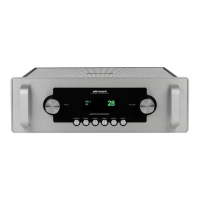
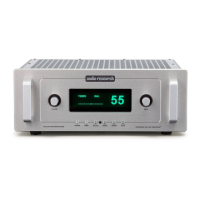
Illustration showing the placement of volume, display, and operational buttons on the front panel.
Diagram illustrating all input and output connectors on the rear panel for system integration.
Important safety notices including warnings about electrical hazards and moisture.
Explains the purpose of each button on the LS27R remote controller for system operation.
Details how the display window indicates selected functions and inputs via the remote.
Introduction to the manual and critical safety warnings for operating the LS27 preamplifier.
Guidelines for preserving packaging and safely installing vacuum tubes into the unit.
Details the dual microprocessor-driven rotary controls for volume adjustment and input source selection.
Explains the function of power, mute, and processor selection buttons, plus automatic muting.
Details volume adjustment, channel balance, and mono summing functions.
Explains monitor input routing and selecting input gain levels for optimal performance.
Covers display illumination, phase invert, and other functions accessible only via the remote.
Details the BAL/SE input connectors and main/record output connectors for system integration.
Provides essential guidelines for proper placement and airflow to ensure optimal performance and longevity.
Step-by-step instructions for safely powering the LS27 on and off, including warm-up procedures.
Instructions for using the LS27 as a control center for recording program sources to a tape deck.
Explains how to monitor tape recordings and dub between tape decks using the LS27.
Provides solutions for common operational problems, such as microprocessor glitches.
Information on routine maintenance, remote battery replacement, and cleaning the unit.
Guidelines for proper disposal of electronic waste according to WEEE directive.
Details the warranty coverage for the LS27, including duration and service procedures.
Lists detailed technical data including frequency response, distortion, gain, and impedance.
Covers dimensions, weight, power requirements, and control types.
 Frequency and Distortion
| frequency response | 0.2Hz to 160kHz |
|---|---|
| distortion | Less than .01% at 2V RMS BAL output |
| rated outputs | 2V RMS 1Hz to 100kHz into 200K ohm balanced load |
Gain and Input Specifications| gain main output | Selectable for each input: 24dB, 18dB, 12dB Balanced output |
|---|---|
| input impedance | 120K ohms Balanced, 60K ohms SE |
| maximum input | Low Gain: 48V RMS BAL, 24V RMS SE, Medium Gain: 24V RMS BAL, 12V RMS SE, High Gain: 12V RMS BAL, 6V RMS SE |
Output Specifications| output impedance | 700 ohms Balanced, 350 ohms SE Main |
|---|---|
| output polarity | Non-inverting |
| output capability | 15V RMS at less than 0.5% THD at 1kHz |
Power and Dimensions| power requirements | 105-130VAC 60Hz (210-260VAC 50/60Hz) 50 watts maximum |
|---|---|
| dimensions | 19" (48 cm) W x 5.25" (13.4 cm) H x 13.3" (33.8 cm) D |
| weight | 16.3 lbs. (7.4 kg) Net; 23 lbs. (10.5 kg) Shipping |


 To Next Page