2
OVERVIEW
Specications
Systemperformance
• Input: 4 ways electronic balanced
• Impedance: >10KOhm
• CMRR: >65dB, 50Hz-10Khz
• Output: 8 ways electronic balanced
• Output impedance: <60-ohm
• Min. loading impedance: 600-ohm
• Max. output level: +20dBm (600 ohms loading)
• Frequency response: +/- 0.5dB 20Hz - 20Khz
• Dynamic range: >110dB 20Hz - 20Khz
• Distortion: <0.02% @ 1kHz, +18dBm
• Max. delay: 650 mS (adjustable step distance is 2.6uS)
• Output gain: -40dB to +6dB,Step pitch: ±0.1dB
• Input Gain: -40dB to +15dB,Step pitch: ±0.1dB
ParameterEqualizer
• Filter: 6-bands/each output, 8-bands/each input
• Filter gain: +15dB to -30dB, the distance is 0. 1dB
• Transition frequency (low pass): 20Hz - 20kHz,
1/36 octave. (368 positions)
• Filter: Q value/band width 0.4 to 28.8 / 3 to 0.05
• Selectable low frequency / high frequency:
20Hz - 1kHz / 1kHz - 20kHz
• Gain: ±15dB, adjustable step distance is 0.1dB
• Central frequency: 20Hz - 20kHz, adjustable
step dist.: 1/36 octave (368 pos.)
HighandLowPassFilter
• Filter: Each output with one lter
• Transition frequency (high pass): 10Hz –
16kHz, adjustable step distance is 1/36 octave
• Transition frequency (low pass): 60Hz – 22kHz,
adjustable step distance is 1/36 octave
• Selectable lter: Linkwitz-Riley, Bessel, Butterworth
Limiter
• Threshold range: +20dBu to -10dBu
• Start-up time: 0.3 to 90ms
• Release time: Start-up time 4, 8, 16 or 32 times
ENGLISH VERSION
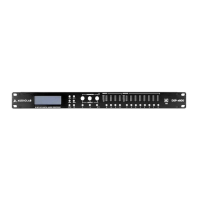
DSP-4800 is an all-in-one digital processor with 4 inputs
and 8 outputs. The unit uses a high precision 32 bit oat-
ing point and 96Khz sampling rate that greatly reduces
distortion. You can control the processor via USB or LAN
with the possibility of linking up to 250 devices. DSP-
4800 ships with XLR input and output connectors.


 To Next Page