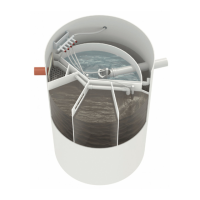
Construction:
Earthwork must be carried out strictly in
accordance with the normative acts in
force and the technical or work project of
the building.
Pits for the Units are excavated in two
steps:
In the first stage, the pit is excavated
by an excavator, leaving about a
20-30 cm thick layer to the design
altitude.
At the second stage, the layer of
20-30 cm is dug manually. This
method of earthwork will ensure
the installation of the Unit on
undisturbed soil.
IMPORTANT! Pit depth depends on
the depth of the wastewater pipe at the
installation location. The pit must have
a funnel shape: the diameter of the pit
must be at least 150 cm wider than the
diameter of the device at the top and 50
cm wider than the diameter of the device
at the bottom.
IMPORTANT! Installations must be
mounted on a reinforced concrete base
in order to ensure horizontal and vertical
levelling of the Units. A concrete base
(about 15-20 cm thick, with reinforcement
mesh) is concreted on the compacted soil,
or prefabricated reinforced concrete soles
can be used.
Units can be fully or partially buried
(depending on the groundwater level).
IMPORTANT! Units are mounted above
groundwater level (see Principal diagram
2).
IMPORTANT! If there is high
groundwater on the construction site, the
Units are partially buried, i.e. to a certain
depth, and the remaining part is covered
with a gravel-sand mixture (0.4 mm
fraction) by forming a dyke. In this case,
the pumping stations for sewage lifting
should be installed upstream of the Units.
It is necessary to raise about 30 cm of
undisturbed soil to the groundwater level.
3.1
3.2
3.2.1
3.2.2
3.3
3.4
3.5
3.6
3.



 To Next Page