Need help?
Do you have a question about the AusClimate WDH-716DE and is the answer not in the manual?
Identifies and labels the external parts of the dehumidifier unit.
Explains the LCD display, control panel functions, and indicators.
Steps for initial setup and powering on the dehumidifier.
Procedure when the water tank is full and the indicator is on.
Explanation of the automatic defrost mode and its indicators.
Guidelines for correctly installing the drain hose for continuous drainage.
Instructions for cleaning the exterior shell of the dehumidifier.
Procedure for cleaning the air filter to maintain performance.
What to do if a problem occurs, including contact information.
Ensuring the work area is safe, ventilated, and personnel are informed.
Measures for detecting refrigerant, fire safety, and ignition sources.
Verifying refrigerant and electrical components meet safety standards.
Specific guidance for repairing sealed and intrinsically safe components.
Acceptable methods and precautions for detecting refrigerant leaks.
Steps for removal, evacuation, charging, and decommissioning refrigerant circuits.
Requirements for labeling equipment and recovering refrigerant safely.
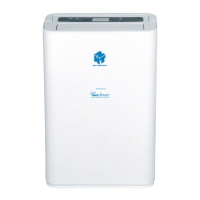
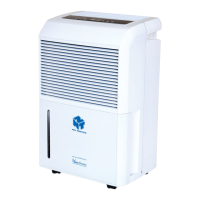
This document serves as the user's manual for the WDH-716DE Dehumidifier, a product designed by Ausclimate to provide healthy indoor climate solutions. It outlines the device's functions, operational procedures, and maintenance requirements, emphasizing safety precautions, especially concerning the R290 refrigerant gas used.
The WDH-716DE Dehumidifier is designed to remove excess moisture from the air, contributing to a healthier indoor environment. Its primary function is dehumidification, which involves drawing in moist air, extracting water vapor, and expelling dry air. The device features a control panel for user interaction, an air filter to clean incoming air, and a drain bucket to collect condensed water. For continuous operation without manual emptying, it offers a continuous drainage option. The dehumidifier also incorporates an automatic defrost function to maintain efficiency in low-temperature conditions, preventing ice accumulation on its coils.
To operate the WDH-716DE, users must first place it upright on a flat, stable, heat-resistant surface, ensuring at least 100 cm (39 inches) of clear space around it to avoid fire hazards or damage to heat-sensitive items. The power plug should be inserted firmly into a suitable wall socket, matching the voltage specified on the rating label. Before initial use, it's crucial to ensure the water tank is correctly positioned; if the "Bucket Full" lamp illuminates upon startup, the tank should be pulled out, the float lever checked for free movement, and then reinserted.
The control panel allows users to manage various settings. The "Power" control turns the unit on or off. The "Humidity Setting" allows adjustment of the desired humidity level within a range of 30% to 80%. The "Fan Speed" button toggles between high and low fan speeds. The "Timers" function enables users to set an auto switch-on or switch-off time for 1 to 12 hours. The LCD display provides real-time information, including room humidity, room temperature, and the timer setting.
A key operational feature is the "Bucket Full Lamp." When the water tank reaches its capacity, this lamp illuminates, and the machine automatically stops running to prevent overflow. Users must then carefully remove the tank by sliding it outwards from the front, empty the collected water, and replace the tank properly for the machine to resume operation.
For extended, unattended operation, the dehumidifier supports "Continuous Drainage." This feature bypasses the internal water tank, allowing water to flow directly out of the unit through a drain hose. To set this up, users need a hose with an inner diameter of 13mm. The process involves unscrewing the drain cap from the drainage outlet, removing the soft rubber cover, and connecting the drain hose. It is critical to ensure the drain hose is placed horizontally below the level of the drainage hole, avoiding uneven ground or kinking, to facilitate proper water flow.
The dehumidifier also includes an automatic "Defrost" function. In cooler environments, ice can build up on the dehumidifier's coils, reducing its efficiency. When this occurs, the unit enters defrost mode: the defrost icon illuminates, the compressor pauses, and the fan continues to run until the ice melts. Once defrosted, the compressor restarts, and normal dehumidification resumes. The duration of the defrost cycle varies based on room temperature and humidity.
Regular maintenance is essential to ensure the dehumidifier's optimal performance and longevity. Before performing any cleaning or maintenance, the appliance must be disconnected from the power supply to prevent electrical hazards.
The "Outer case" of the dehumidifier should be wiped with a soft, slightly damp cloth. Harsh abrasives or solvents should be avoided, and the unit should never be immersed in liquid. After cleaning, the outer case should be dried with a dry cloth.
The "Air filter" plays a crucial role in cleaning the air and preventing dust and impurities from hindering the dehumidifying function. Therefore, the air filter should be cleaned regularly, at a minimum of once every two weeks. The filter is located behind the rear grill and can be removed by pulling it outwards from the top. It can be cleaned using a vacuum cleaner or by washing it with clean water, followed by thorough drying with a dry cloth before being replaced.
In case of any problem or emergency, users are instructed to immediately switch off and unplug the unit. For troubleshooting or repairs, Ausclimate should be contacted, and users are explicitly warned not to disassemble the dehumidifier themselves for safety reasons.
Special instructions are provided for repairs involving R290 refrigerant gas, which must only be performed by "Authorised Persons." These instructions detail stringent safety protocols, including checks of the work area for flammable atmospheres, ensuring the presence of fire extinguishing equipment, eliminating ignition sources, ensuring adequate ventilation, and verifying the integrity of electrical components and cabling. Procedures for refrigerant removal, evacuation, charging, and decommissioning are also outlined, emphasizing the use of inert gas, proper recovery cylinders, and adherence to all safety and environmental regulations. These specialized maintenance tasks underscore the importance of professional service for complex repairs involving the refrigerant circuit.
 General
| Model | WDH-716DE |
|---|---|
| Type | Dehumidifier |
| Dehumidification Capacity | 16 liters per day |
| Power Consumption | 220W |
| Operating Temperature | 5°C to 35°C |
| Refrigerant | R134a |
| Air Flow | 120m3/h |

 To Next Page