EasyManua.ls Logo

AUTO ARC 120 - WELD BEAD CHARACTERISTICS AND TROUBLESHOOTING

Default Icon
36 pages
Print Icon
To Next Page IconTo Next Page
To Previous Page IconTo Previous Page
Loading...
7-2.
Welding
Troubleshooting
Table
7-1.
Porosity
Porosity
small
cavities
or
holes
resulting
from
gas
pockets
in
weld
metal.
S-0635
Possible
Causes
Corrective
Actions
Inadequate
shielding
gas
coverage.
.
Check
for
proper
gas
flow
rate.
Remove
spatter
from
gun
nozzle.
Check
gas
hoses
for
leaks.
Eliminate
drafts
near
welding
arc.
Place
nozzle
1/4
to
1/2
in
(6-13
mm)
from
workpiece.
Hold
gun
near
bead
at
end
of
weld
until
molten
metal
solidifies.
Wrong
gas.
Use
welding
grade
shielding
gas;
change
to
different
gas.
Dirty
welding
wire.
Use
clean,
dry
welding
wire.
Eliminate
pick
up
of
oil
or
lubricant
on
welding
wire
from
feeder
or
liner.
Workpiece
dirty.
Remove
all
grease,
oil,
moisture,
rust,
paint,
coatings,
and
dirt
from
work
surface
before
welding.
Use
a
more
highly
deoxidizing
welding
wire
(contact
supplier).
Welding
wire
extends
too
far
out
of
nozzle.
Be
sure
welding
wire
extends
not
more
than
1/2
in
(13
mm)
beyond
nozzle.
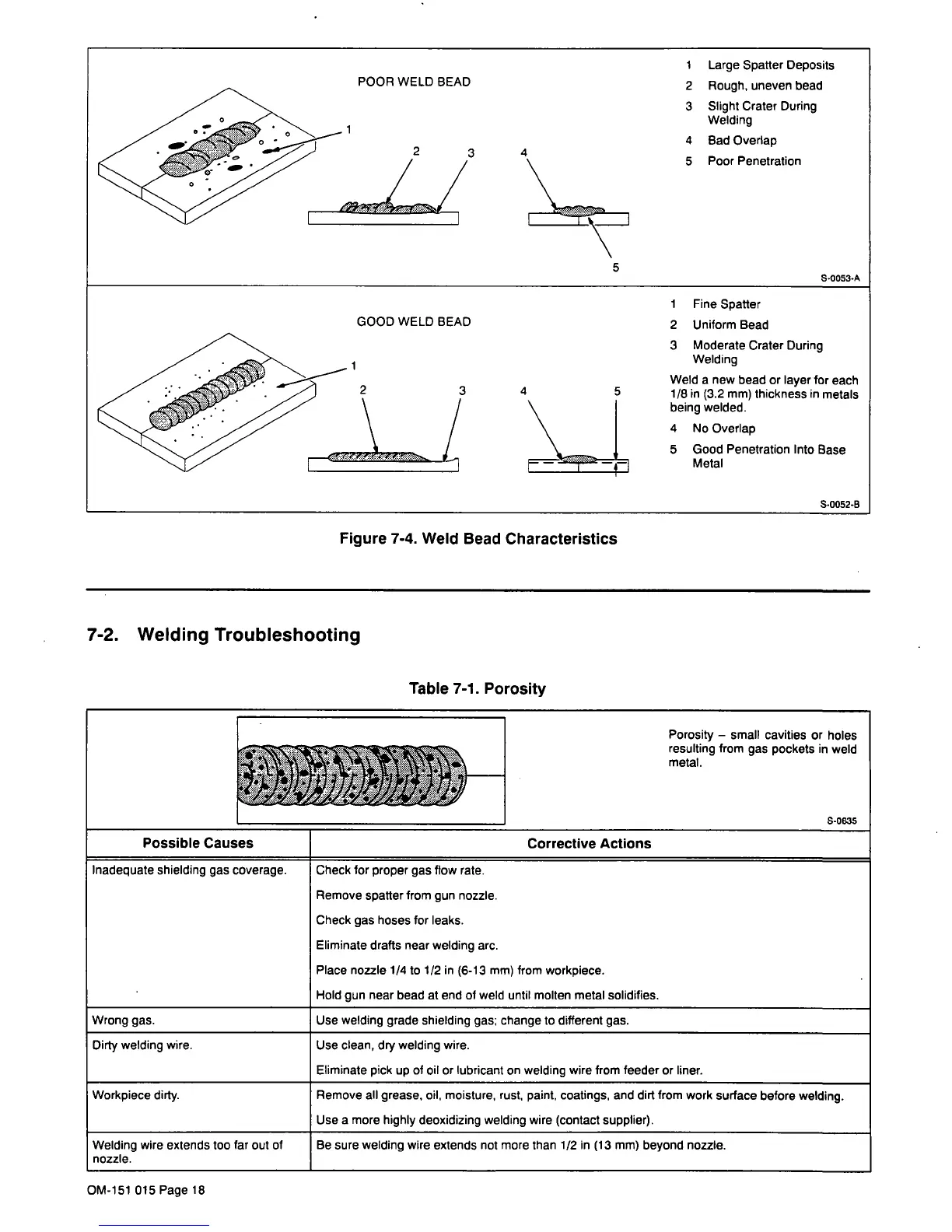
POOR
WELD
BEAD
I
Large
Spatter
Deposits
2
Rough,
uneven
bead
3
Slight
Crater
During
Welding
4
Bad
Overlap
5
Poor
Penetration
:.~
5
GOOD
WELD
BEAD
S.0053-A
1
Fine
Spatter
2
Uniform
Bead
3
Moderate
Crater
During
Welding
Weld
a
new
bead
or
layer
for
each
1/8
in
(3.2
mm)
thickness
in
metals
being
welded.
4
No
Overlap
5
Good
Penetration
Into
Base
Metal
Figure
7-4.
Weld
Bead
Characteristics
S-0052-B
OM-151
015
Page
18

Related product manuals